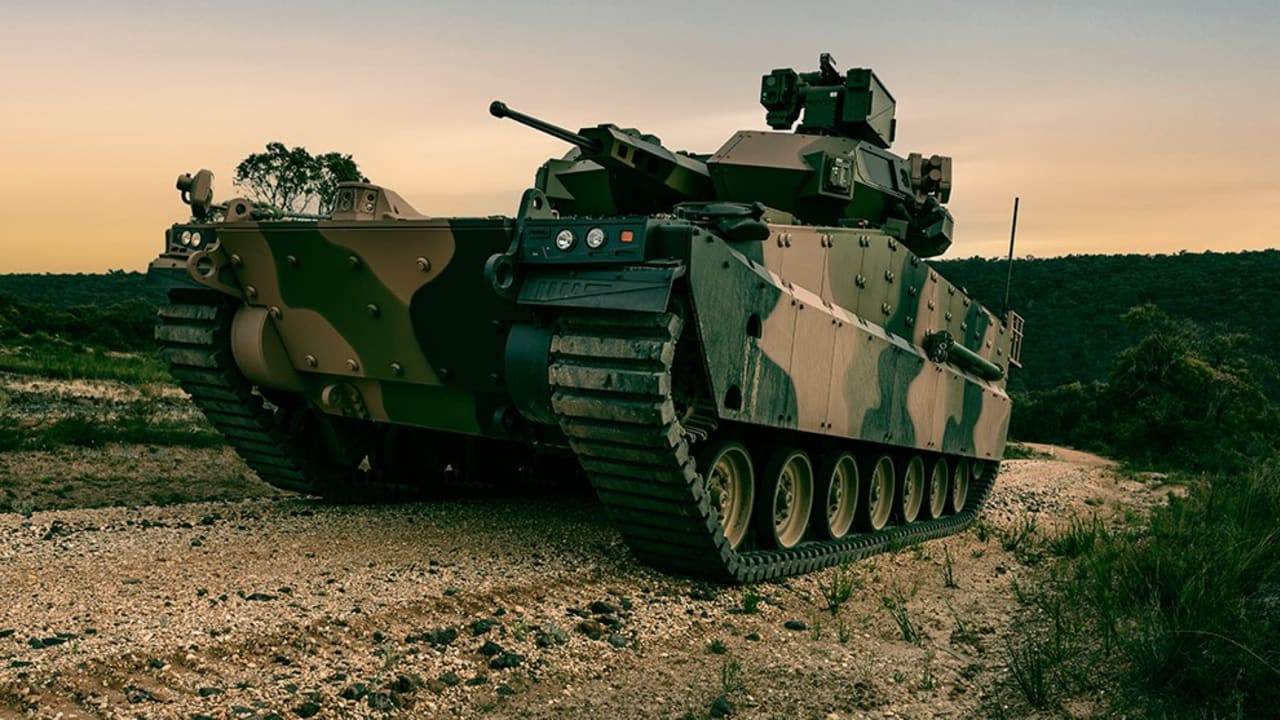
A pro-Hamas hacker group has reportedly leaked classified plans for Australia’s Redback next-generation infantry fighting vehicles as well as dozens of photos of employees of Israeli defense companies.
Cyber Toufan, a hacking group believed to be linked to Iran, posted classified 3D renderings and technical details of the $7 billion project following a spate of attacks on Israeli defense companies from 17 different companies after gaining access to supply chain firm MAYA technologies.
According to a report by The Australian, the group said that it had “infiltrated the heart of Israel’s defense engineering operations” and on October 22 began publishing details of 36 military projects between the two countries.
Cyber Toufan
“Through the systems, we have breached Elbit and Rafael’s through then [sic]. Their phones, printers, routers, and cameras as well,” the group said. “We have recorded your meetings with sound and video for over a year. This is just the beginning with Maya!”
The group claimed to “have obtained tens of terabytes of personal data, administrative and technical documents, audio calls, and video recordings of these criminals… Some designed the rocket, the UAVs, and the tank, while others participated in making their parts and programming their systems, even transporting them to the battlefield.”

Cyber Toufan emerged shortly after the October 7 massacre by Hamas.
Israeli cybersecurity firm OP Innovate released a report on the group in May, stating that the group has a “clear focus on entities tied to Israel’s economy and security” and targets government contractors, tech firms, infrastructure providers, and international companies doing business in Israel.
The group also focuses on “organizations whose VPN or firewall infrastructure is managed by third-party service providers (e.g., Bezeq, Partner). In these cases, attackers appear to exploit default or previously leaked credentials associated with the service provider’s configurations – gaining access not by breaking in, but by walking through an unlocked door.”
Australia and South Korea’s Hanwha Defense signed an agreement for 127 Redbacks for AUD$7 billion. The Redback was developed for enhanced performance, firepower, and protection that soldiers need on the modern battlefield.
Among the systems integrated onto the platform are Israel’s Elbit Systems turrets that are based on the latest generation of the company’s 30 mm.-manned turret and COAPS gunner sight, a sensor suite, and Iron Fist active protection system, Iron-Vision advanced situational awareness helmet-mounted display system, and a laser-warning system.
What was leaked?
Hundreds of photos of employees were leaked as well as dozens of projects, including the helmet-mounted display system, Rafael's Iron Beam laser defense system, Ice Breaker missile, Spike NLOS (non-line-of-sight)anti-tank missiles, Elbit's Hermes 900 storage container, ROEM self-propelled howitzer, and Crossbow turreted mortar system.
The Australian report said that the plans for the helmet-mounted display system had been leaked. The group also leaked the fact that the Australian Defense Force is considering purchasing Rafael’s Spike NLOS (non-line-of-sight) anti-tank missiles.
Israeli defense industry sources told Defense and Tech by The Jerusalem Post that no classified information had been obtained or leaked by the group.
In a statement provided to Defense & Tech by The Jerusalem Post, Rafael said that “no Rafael classified networks, customer data, or operational systems were affected.”
“Rafael’s cybersecurity framework is among the most advanced in the industry, with continuous monitoring and protection applied across all digital environments. All projects, programs, and customer engagements remain fully secure and uninterrupted.”
Tough talk
Australia has been heavily critical of Israel’s war in Gaza.
But while Prime Minister Anthony Albanese has insisted that the country does “not sell arms to Israel,” Defense Industry Minister Pat Conroy defended the country’s use of Israeli military systems at the Indo-Pacific Maritime Exposition last week.
“We make no apology for getting the best possible equipment for the Australian Defence Force,” he said.
Nevertheless, according to local press The Nightly, the country has quietly begun placing new restrictions on material sent from Australia to Israel.
Quoting various industry sources, the report claimed that the Defence Export Controls (DEC) – which assess permit applications to export military or dual-use items overseas – had placed a new condition under “Customs (Prohibited Exports) Regulations 1956”, where licence holders are no longer allowed to send “approved goods” to Israel.
The report said that the Department of Defence “is declining to comment on the move, citing national security and commercial in-confidence reasons.”