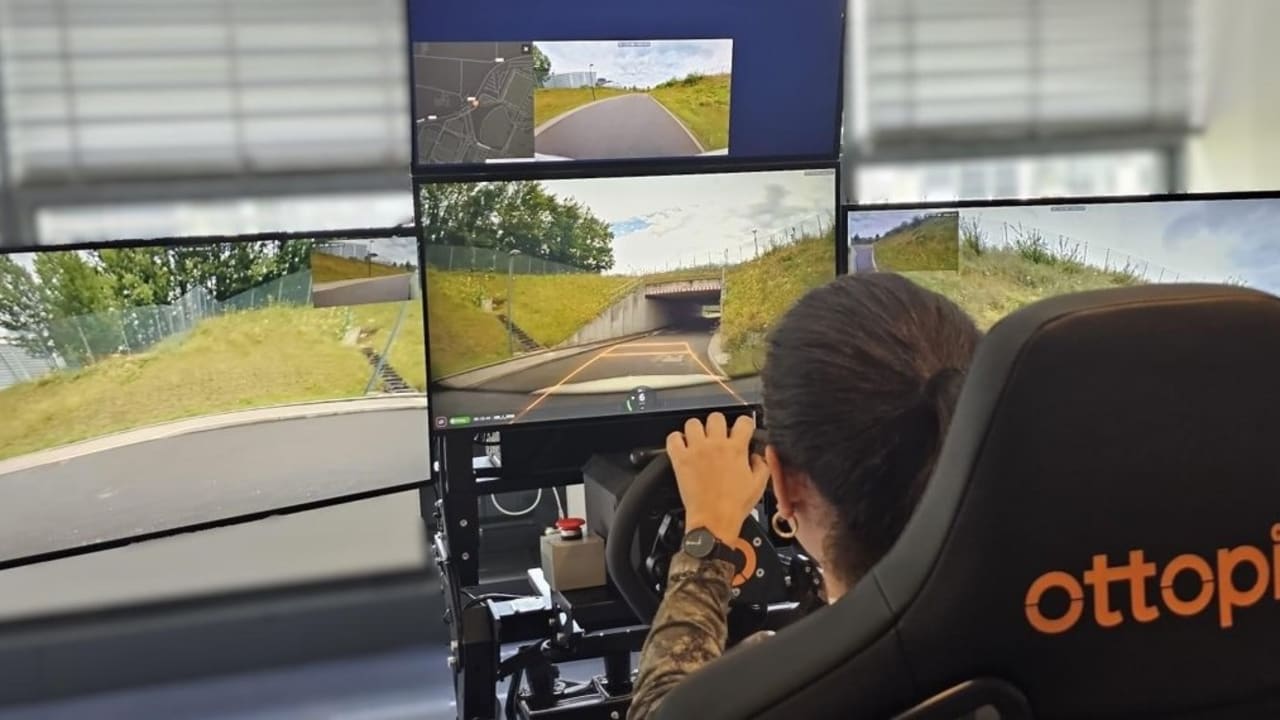
In an impressive office nestled in Tel Aviv, Ottopia is reshaping how ground autonomy is understood on civilian roads far from Israel and deep behind enemy lines.
Founded in 2018 by Amit Rosenzweig, a graduate of the Talpiot military academy and a former officer in the IDF’s elite 8200 Unit, this Israeli start-up has become a pivotal force in teleoperation (remote control systems), offering cutting-edge software that allows human operators to assist or control vehicles across vast distances remotely.
What was once considered a stopgap for autonomous driving has proven to be a vital technology with sweeping implications far beyond civilian applications.
The 8200 Unit is known for the leaders that emerge from it, and Rosenzweig is no different. In 2015, he received the Israel Defense Prize, one of the highest awards in the country, for a project that he commanded while in uniform.
During his military career, he also spent time at ELTA, a subsidiary of the Israel Aerospace Industries company, working on the complex algorithms integrated into the radars of the Iron Dome and Arrow missile defense systems.
“I went from missiles to offensive cyber capabilities before going into the world of start-ups,” Rosenzweig told Defense & Tech.
“At age 21, as an officer, I already knew that I would be working on algorithms that could save my life and the lives of my children. Unfortunately, I was right,” he said.
After leaving ELTA, Rosenzweig wanted to work on something that would not be in the field of cyber and founded Ottopia several years later.

“I asked myself: how can I save lives, personally? And I decided to focus on car crashes, which is a big issue around the world,” Rosenzweig said.
What does Ottopia do?
Ottopia’s platform delivers ultralow latency communication between human operators and machines, transmitting control signals and live video feeds seamlessly, even in areas with compromised connectivity.
It powers various types of vehicle fleets, from delivery robots on busy urban streets to mining operations in isolated terrains. Ottopia is now a crucial component in the defense sector as well.
“Before October 7, our focus with Hyundai robotaxis (driverless vehicles) was commercial,” Rosenzweig continued. “After Hamas’s attack, we received a call from MAFAT (the Defense Ministry’s Directorate of Defense, Research, and Development). It wanted our help to automate as much as possible.”
“The center told us that the IDF needed as many robots as possible. That’s how Ottopia became a supplier to the Israel Defense Forces, and it is a great honor.”
Military forces have used Ottopia’s system to operate crewless ground vehicles to enable route clearance, explosive ordnance disposal, and logistics delivery, all while keeping soldiers out of direct danger.
With the modern battlefield continuing to evolve rapidly, Western militaries are starting to prepare for a wide range of future threats. They are adapting to face evolving enemy capabilities.
According to Rosenzweig, while the focus in this regard is now on uncrewed aerial vehicles (UAVs), “in the coming 10 years, a ton of capital will be going into automated ground vehicles (UGV), even more than UAVs.”
Ottopia offers its teleoperation platform in two deployment models: turnkey systems on new vehicles and a novel UGV, or by retrofitting legacy vehicles and transforming them into ultra-modern, automated robotic modes of transport.
The technology’s robustness in high-stakes environments, resisting interference and maintaining control under cellular, satellite, or RF conditions, has made it indispensable to modern warfare.
By doing so, Ottopia is redefining how humans interact with machines in volatile scenarios. It transforms uncrewed ground vehicles into extensions of human intent, enabling operators to guide, assist, and manage remote assets safely and intuitively.
With strategic partnerships spanning automotive leaders like BMW, Hyundai, and military clients, Ottopia’s footprint continues to expand.
In February, Col. Christopher Charles Miller, a former US defense secretary, joined Ottopia’s advisory board.
“The United States’ Armed Forces are woefully behind in automating ground combat vehicles. Ottopia has mastered how to operationalize the theory and research and is leading the way in this transformation of warfare,” he said in a release at the time.
“Ottopia’s team has proven their vision and technology in the most extensive and hazardous ground combat in modern memory. The United States’ military can’t wait any longer for the legacy defense contractors to catch up and provide our war fighters with the essential tools they need to fight, win, and survive on the modern battlefield.”
Rosenzweig said that Ottopia isn’t just about teleoperation but about enabling autonomy in real-world conditions, including Ottopia’s own state-of-the-art Hybrid AI software.
The remote operator can assist with the autonomy when unexpected challenges arise. This approach is both technical and transformational.
Notably, in combat zones, dense urban streets, or unpredictable terrain, autonomy alone can fall short. Human judgment remains essential – Ottopia’s system creates a dependable bridge between human and machine.
“We enable automated military power thanks to our hybrid AI tech that combines the best of AI technology and humans. You can do so many things with robots. Just send the robots before the troops to serve as front line guards. Use them for logistics and even homeland security tasks. That way, you get the job done and achieve ground superiority. We are saving soldiers’ lives worldwide,” Rosenzweig said.
In Israel’s storied tradition of innovation born from necessity, Ottopia stands out, not for the loudness of its promises, but for the quiet clarity of its solutions.
Whether steering a robot through combat rubble or nudging a robo-taxi through the gridlock of Las Vegas, its mission remains the same: empower autonomy, but keep humanity in the loop – even if it is at a distance.