In the automotive world there are quite a few iconic cars that both reinvented entire vehicle categories in their design and became sales queens. The Citroën Traction Avant (front-wheel drive), the Mini Minor (a small, economical car with front-wheel drive), and the Volkswagen Golf (the compact family car), for example.
And then there is Smart. A rare attempt in the automotive industry to innovate and solve a real transportation problem - the shortage of parking spaces - a concept that passed through several manufacturers before ending up with Mercedes...", which was looking for a project that would give it an additional foothold in the market.
A separate factory was established in France 30 years ago. An interesting design concept was born: Refreshing the car’s appearance throughout its life by replacing colorful external plastic panels. And of course, the concept of a car for two people only – short enough to park sideways, and still a car that would be small enough, but also sufficiently “car-like” in terms of safety, handling, and performance.
The public and media attention the car received stood in contrast to its size as well as its commercial success. Mercedes introduced two generations and even began expanding the brand into a compact model (with Mitsubishi’s help) and a tiny roadster, but profits never materialized. So it tried again with a third generation developed together with Renault, in a short version called ForTwo and a longer version (ForFour, a conventional 5-door), which also failed to deliver the expected results.
In an attempt to squeeze something out of the lemon, 50% of the brand rights were sold to China’s Geely, and the partnership began launching electric crossovers at a rapid pace, with design cues recalling the original small Smart. First came the Smart #1, then the longer coupe version Smart #3, and last year also the #5 and even a sedan, the #6. But in order to complete the brand, reconnect it to its roots, and differentiate it from countless other Chinese brands, Geely and Mercedes did not give up on another attempt to produce a true urban small car.

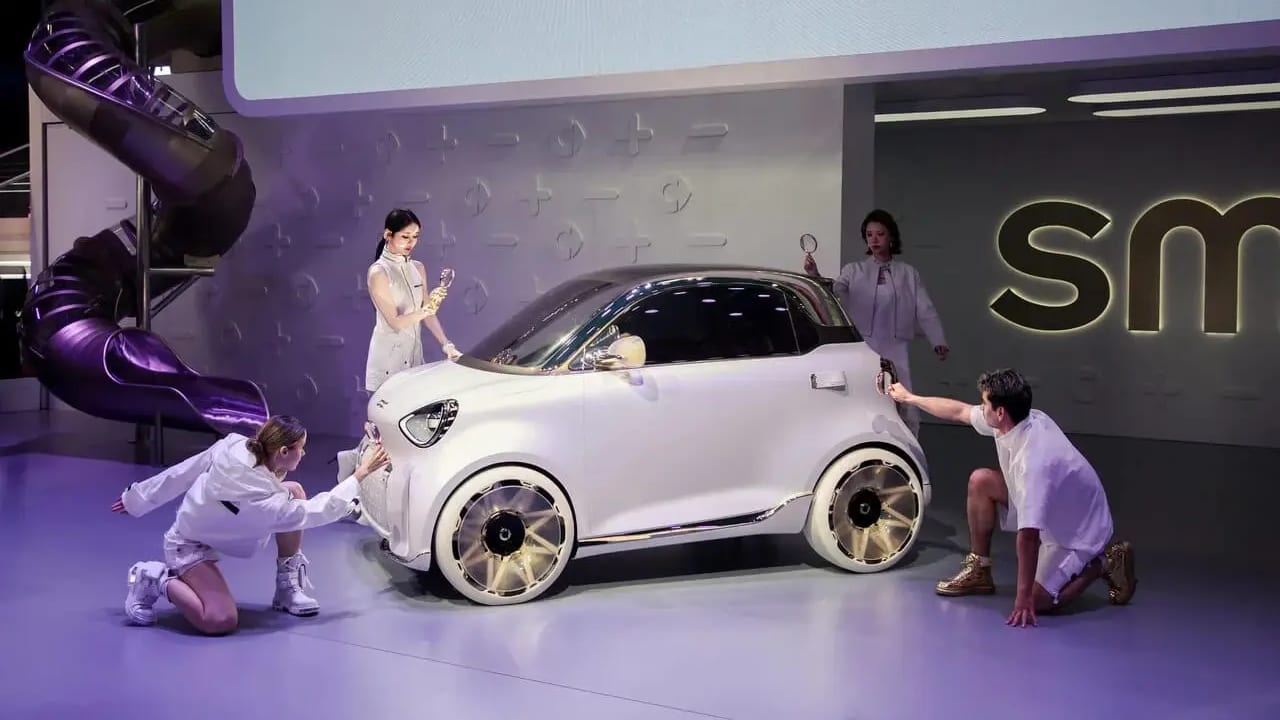
Recently the Smart #2 concept was unveiled in Beijing. There are still no technical specifications, which will be revealed with the production model at the Paris Motor Show in September. The design is a good blend between the original small Smart and the updated styling of the crossovers. The dimensions are expected to be similar to the last model, with a length of about 2.7 meters despite stricter safety requirements. The drivetrain will be electric, but with a longer range than the previous generation electric Smart, which achieved only about 200 real-world kilometers. The hint is for around 300 kilometers, similar to entry-level versions of Europe’s new generation of small electric cars.
The partnership has made extensive use this time of existing Geely components in order to save money and time, and to try to price it similarly to other new electric cars – less than the Renault 5, and close to the Volkswagen ID.1 and the electric Fiat 500.

According to Colmobil, Mercedes’ importer, the Smart #2 is planned to arrive in Israel in 2027. There is still no official price announcement, but it is likely that any figure between NIS 120,000 and NIS 150,000 would be reasonable. Smart models have always been relatively expensive in Israel, although electric car prices are now trending downward.
In any case, the fundamental question remains: Did Geely and Mercedes succeed this time in refining the formula and building a truly urban small car people will actually buy? Parking problems have only worsened, but so have traffic jams – which the Smart #2 does not solve. And after it has already become clear that in 2026 an electric scooter is a far more relevant and effective urban tool than many mini cars, this challenge has only become even greater.