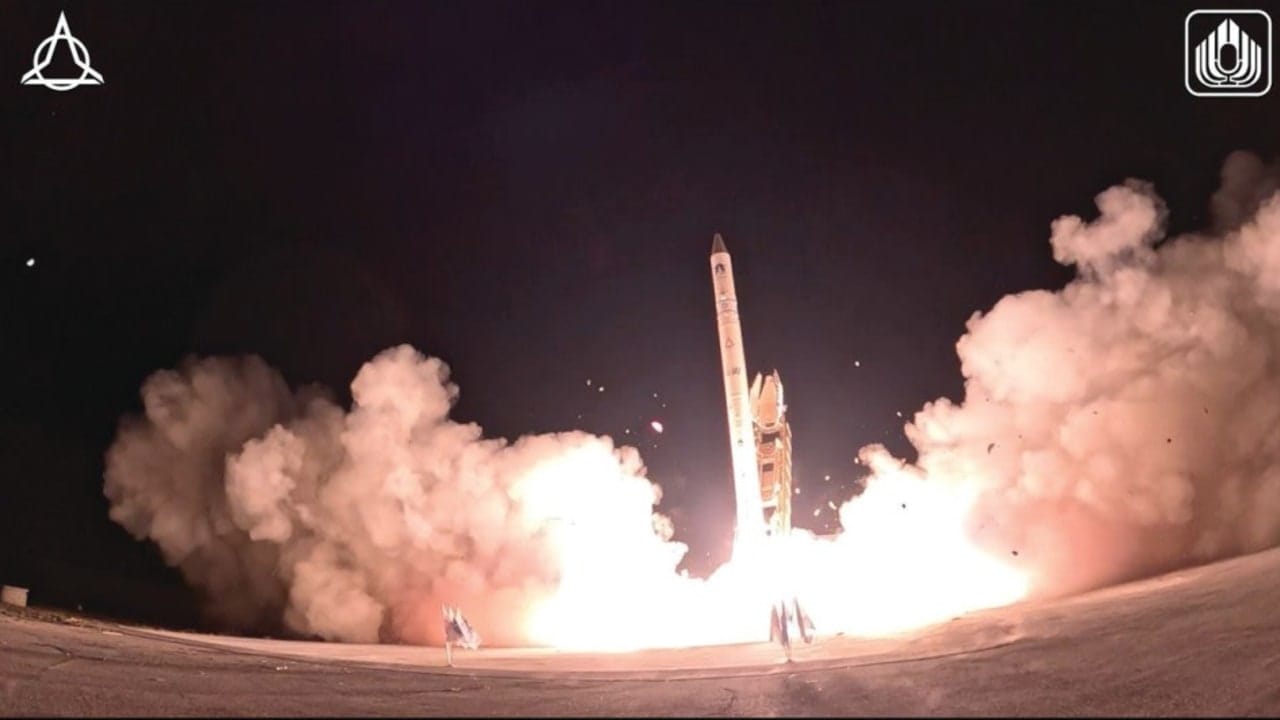
Eye in Space: The new Israeli reconnaissance satellite Ofek 19 was successfully launched into space from the Palmachim base using the Shavit satellite launcher. Minutes after the launch, a white streak was observed in the skies over central Israel, causing confusion among residents who thought it was an interceptor.
The satellite, built by Israel Aerospace Industries in cooperation with Unit 9900 and the Air Force, is expected to enter operational service after a series of tests. It is an advanced electro-optical observation satellite equipped with optical cameras. The combination of capabilities gives Israel an exceptionally sharp intelligence eye against enemy states, including Iran and Yemen.

Prof. Dan Blumberg, Vice President of Ben-Gurion University and outgoing Chairman of the Israel Space Agency, explains: "The State of Israel needs the ability to observe and understand what is happening beyond its borders. Access to space allows us to receive real-time situational awareness of nearby and distant countries and use this information for security and defense purposes."
So, how do satellites work, what is the difference between them, how do they avoid colliding with each other, where does Israel stand compared to other countries with satellite capabilities, and how long does one of these satellites last? Here are all the answers to these questions.
What is a satellite?
An artificial object built by humans and launched into orbit around Earth or other planets. Its purposes are diverse: Intelligence gathering, communication, weather forecasting, navigation, and scientific research. An observation satellite like Ofek 19 provides visual and radar information, while communication satellites are used to transmit phone calls, television broadcasts, and internet.
How much does a satellite weigh?
The weight varies depending on its purpose. Small satellites may weigh only a few dozen kilograms, while large observation and communication satellites can reach hundreds or even thousands of kilograms. Ofek satellites are relatively light to allow launch using the Shavit launcher.
How does a satellite reach space?
Launch is carried out using a rocket. In Israel, the Shavit launcher, which takes off from the Palmachim base, is used. The rocket accelerates the satellite to an enormous speed, allowing it to enter a stable orbit around Earth. Prof. Blumberg emphasizes: "The ability to launch a satellite means controlling a sophisticated missile with advanced navigation and control systems. This achievement places Israel among the leading countries in the world."
Why are Israeli satellites launched in the opposite direction from most of the world?
Most countries launch satellites eastward to take advantage of Earth's rotational speed, moving from west to east at about 1,600 km/h. This saves fuel and allows heavier payloads to be launched with an additional speed of about 460 meters per second using the Earth rotation boost. Israel, however, chooses a different and challenging path: Launching westward over the Mediterranean. This choice is dictated by geography and security considerations.
If it were launched eastward, rocket debris or payload parts could fall on the territories of hostile neighboring countries. To prevent such risks, Israel sacrifices the eastward launch advantage, meaning the satellite moves against the direction of Earth's rotation. This requires more fuel or limits the payload capacity. Despite this drawback, westward movement has advantages: Israeli satellites pass over Mediterranean areas at different angles than other satellites and at higher frequency over the region, providing very high observation and operational advantages.
At what altitude do satellites orbit?
Altitude varies depending on purpose. Ofek 19 orbits Earth in a low orbit at about 500 kilometers, completing one orbit every ninety minutes. In contrast, communication satellites are positioned at 36,000 kilometers above the equator, allowing them to remain relatively fixed relative to the ground.

How are collisions in space avoided?
Space is increasingly filled with satellites and debris, known as "space junk." There are American and international monitoring systems that track objects and warn of collision risks. In such cases, a satellite's orbit can be slightly adjusted. "We have had to adjust a satellite in the past to prevent a collision," notes Prof. Blumberg.
What types of satellites exist?
There are observation satellites that photograph using cameras or radar, communication satellites that transmit data, weather satellites that monitor clouds and storms, and navigation satellites like GPS. Israel focuses mainly on observation and communication satellites, which serve both security and civilian needs.
What is the difference between an observation satellite and a communication satellite?
An observation satellite acts as a camera in space, collecting visual and radar information. A communication satellite functions like a mirror in space, transmitting data between ground stations. The first is essential for intelligence and security, while the second enables international phone calls, internet, and television broadcasts.
Are satellites affected by weather in space?
Satellites are not affected by Earth's weather but are exposed to cosmic radiation and solar storms. This radiation can damage electronic circuits, so satellites are equipped with specialized shielding. Observation satellites like Ofek 19 can photograph day and night in all weather conditions.
How long does a satellite last in space?
A satellite's lifespan varies. Small satellites usually operate for only a few years, while large communication satellites can be active for up to fifteen years. Ofek 19 is expected to serve for several years until replaced by a newer model.
Can a satellite identify people inside buildings?
The answer is no. Satellites can detect relatively small objects like vehicles or facilities, but they do not penetrate buildings or identify faces. "A single tree in the desert will stand out, but in a forest, it blends in," explains Prof. Blumberg.
How do satellites communicate with Earth?
Communication is done via radio waves and microwaves. Ground stations send commands, and the satellite returns information and images. In Israel, there are dedicated receiving stations, and international stations are also used.
How much does a satellite cost?
The cost of a satellite ranges from tens to hundreds of millions of dollars, depending on its size and purpose. "The investment is not small," emphasizes Prof. Blumberg, "but it provides enormous advantages in both security and the economy."
How does Israel compare to other countries in the space club?
"Currently, only thirteen countries in the world have independent satellite launch capability, including the United States, Russia, China, India, France, Japan, and Iran. Israel joined the club in 1988 with the launch of 'Ofek 1' and was the eighth country in the world to achieve this capability."
"Since then, it has launched dozens of military and civilian satellites. The ability to develop and launch satellites is evidence of impressive technological power," says Prof. Blumberg. "It is not only an intelligence tool but also a message to the world about Israel's scientific and engineering capabilities."

Why does Israel launch satellites?
"The main reason is security. Observation satellites provide vital information about enemy countries, protect soldiers, and prevent surprises. At the same time, communication satellites provide independence for television and internet broadcasts. The latest launch demonstrates impressive technological capabilities built through great effort," concludes Prof. Blumberg.
"These capabilities provide us with security but also open the door to civilian uses that contribute to Israel's economic prosperity. The view from the sky has long ceased to be a distant dream; it is an integral part of Israel's security and technological reality," he concludes.