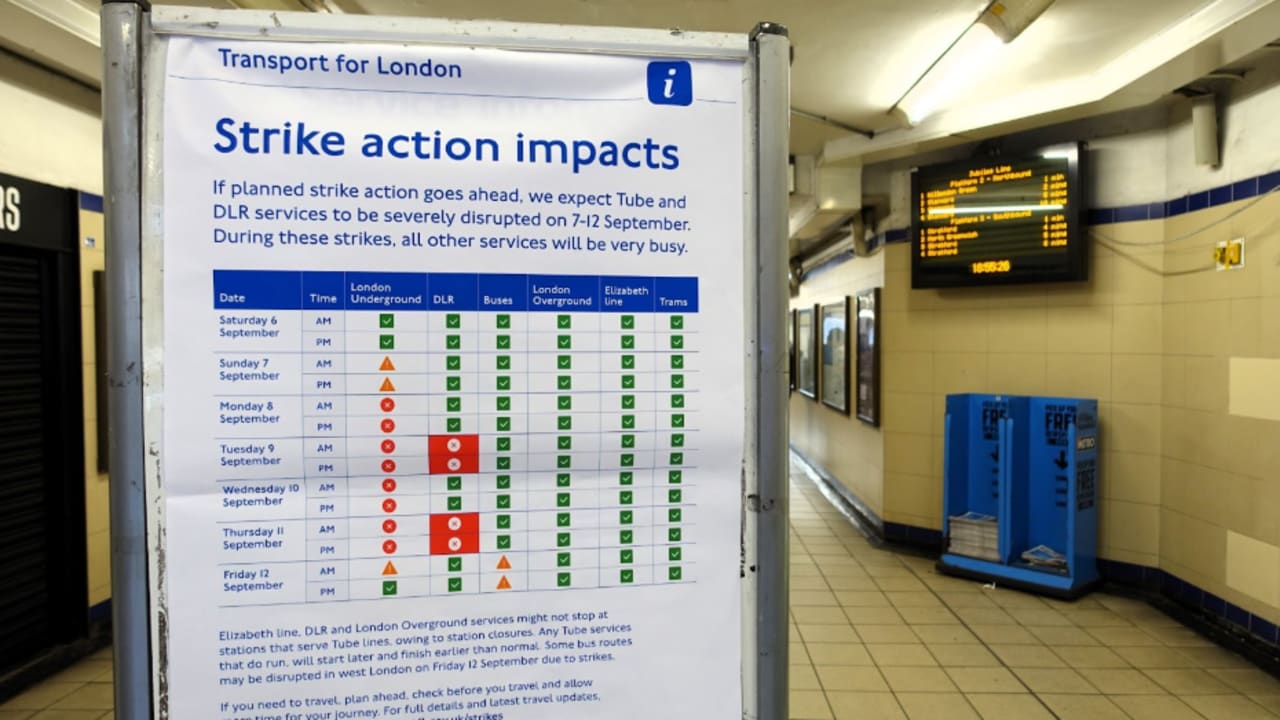
London’s Underground is largely shut as a five-day strike brings the network to a standstill, with little or no service expected until Thursday and severe knock-on disruptions for buses, trams and surface rail. “Disruptions expected across the network, little or no service, no service before 8 a.m., complete your journey before 6 p.m.,” said Transport for London in a forecast.
The Docklands Light Railway is stopping completely on Tuesday and Thursday, disrupting access to and from London City Airport. The Elizabeth line and London Overground are running but are busier than normal, and bus queues are long. Lena, a tourist visiting from Amsterdam, said she missed her Eurostar train back home due to bus delays and Uber surge pricing. “Our train was rescheduled for free to the following morning, but we had to find a hotel for the night”, she shared.
It is the first Tube-wide strike in three years and part of five days of industrial action with the greatest impact between September 8 and 12. About 10,000 members of the Rail, Maritime and Transport union began the action at midnight on Sunday, the first major action since March 2023, with different categories of workers striking on a rolling basis and all Underground lines affected. Train drivers, signalers, maintenance staff, security service inspectors, controllers and station attendants staged staggered walkouts that made services operate differently, and roads and other transport were extremely busy and subject to delay.
The dispute centers on pay, fatigue management and working conditions, including extreme shift patterns, and on the union’s demand to cut the working week from 35 hours to 32 hours. “They are not after a king’s ransom, but fatigue and extreme shift rotations are serious issues impacting on our members’ health and wellbeing,” said Eddie Dempsey, the general secretary of the RMT. TfL offered a 3.4% pay increase to all Underground employees and called it fair, but the union rejected the proposal and said London Underground was doing well financially, arguing a shorter week was fair and affordable and citing TfL’s surplus and budget.
TfL said it could not afford to cut the working week and that the union would accept only an agreement that led to such a reduction. “We welcome conversations about managing fatigue but a reduction in the contractual 35-hour working week is neither practical nor affordable,” said Claire Mann, chief operating officer at TfL, according to the New York Times. “Union demands for a cut in the 35-hour week are simply unaffordable and would cost hundreds of millions of pounds,” said Nick Dent, London Underground’s director of customer operations, according to the Independent.
TfL warned of little to no service across all Underground lines until the strike ends at midnight on Thursday, with almost no Tube trains expected to run between Monday and Thursday. It would take several hours after the strike ended for trains to begin running again, there would be no service before 8 a.m. on Friday, and services are expected to return to normal on all lines by late Friday morning. During the strike, stations open only from 8 a.m. to 6 p.m. local time until September 11.
Buses, trams and surface rail operate but face severe congestion and long queues. Passengers are urged to check schedules before traveling, consider walking or cycling where possible, set off early with the journey planner out of service, and expect some stations to be closed. Elizabeth line or Overground trains might not stop at certain stations if they are closed due to industrial action.
Major events were hit. Post Malone postponed two concerts at Tottenham Hotspur Stadium to September 20 and 21 due to the strike, and organizers canceled or rescheduled other shows because the Tube network is needed to move large crowds safely. “Without the Tube service, it is impossible for people to get to the concert and return home safely,” said Live Nation UK, according to BFMTV. Coldplay concerts were also rescheduled. The Center for Economics and Business Research estimated a direct economic cost of around £230 million from the strikes, with an even greater indirect effect from reduced consumer spending.
Both TfL and the RMT said they remained open for negotiations. The union called on the mayor of London to intervene to secure a settlement and said management failed to honor previous agreements made with staff. Passengers were advised to complete journeys as early as possible, plan around limited opening hours and expect services across the city to be extremely busy and subject to delay. The London Underground, with 272 stations and 11 lines handling more than four million trips on a typical weekday, remains largely shut.
Produced with the assistance of a news-analysis system.