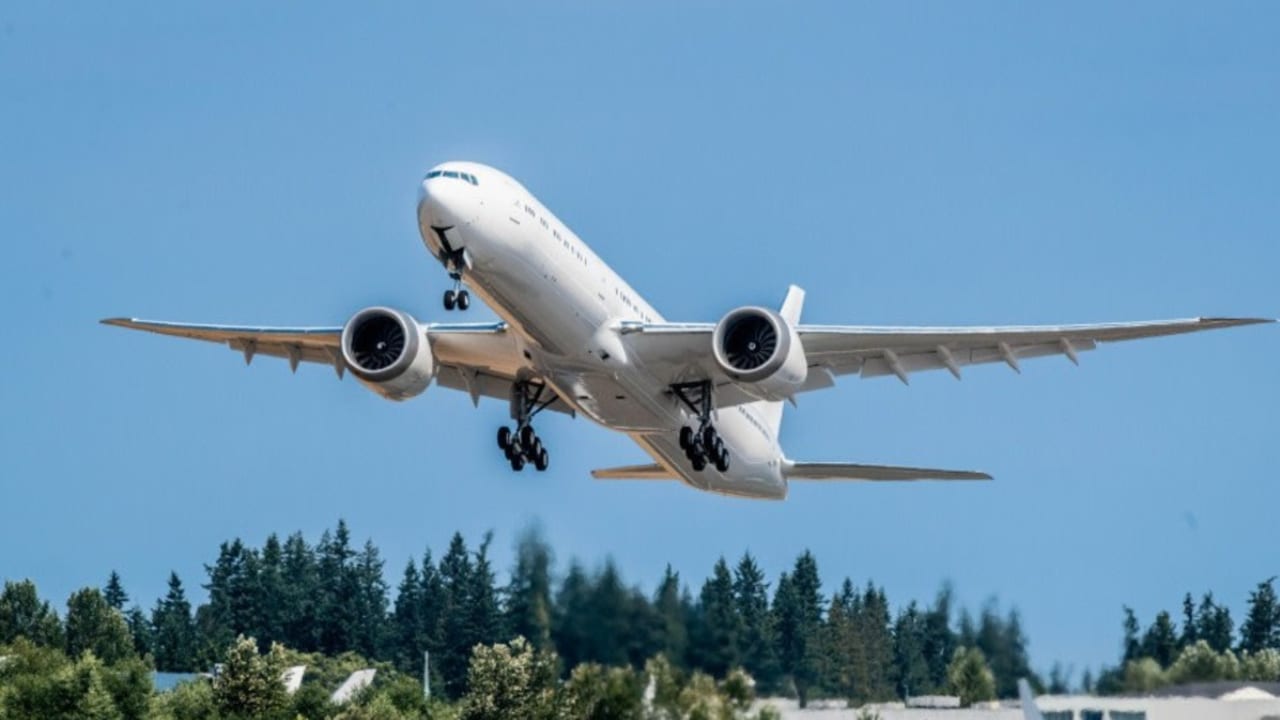
The maiden flight of Boeing’s newest and most advanced plane, the 777-9, took place last week and sparked excitement in the global aviation industry. This was the first flight in almost five years during which Boeing crews completed the build, preparation, and test run of a new model in the 777 family, intended to eventually replace the widest jetliners in regular service.
The plane took off from Paine Field in Everett, Washington, at 11:03 a.m. local time. Captain Ted Grady, the chief pilot on the 777 project, together with co-pilot Mark Brown, led the flight which lasted two hours and 27 minutes. During the flight, the plane’s behavior was tested at typical altitudes and speeds, including flying at 39,000 feet and at a speed of Mach 0.84, about 950 km/h.
Alongside the two pilots were four system and flight experts who documented and analyzed the plane’s performance in real time. At 1:30 p.m., the plane landed safely back at the base and was greeted with applause on the ground. The pilot noted after landing that the plane "flew wonderfully, exactly as we expected," adding that Boeing will now continue the certification process with authorities, ahead of integrating the new model into commercial airline fleets.

The Boeing 777-9 is the fifth model built within the new aircraft family but the first to be fully developed since the outbreak of COVID-19. It belongs to the 777 family, which also includes the 777-8 freighter model and the shortened model designed for complex field landings. It is a wide-body aircraft with folding wings, some of the most advanced flight technologies in the world, and the ability to carry up to 426 passengers over a range of more than 13,000 kilometers depending on the configuration chosen by airlines.
The teams worked intensively in the past month preparing the plane for its maiden flight after it was fully assembled in July. The preparation process included refueling, engine start-up, ground tests, and preparation of all monitoring and flight systems. Michael Kleiner, a senior engineer on the project responsible for cross-disciplinary coordination, said: "We treat these planes like our children. It is a tremendous pride to see how our work takes to the air."
The flight was only the beginning of a series of expected tests, which will include simulations of emergency situations, resistance tests against electromagnetic radiation and lightning, and extreme scenarios of stress, weather, and unusual speeds. All of this to meet the strict requirements of aviation authorities in the United States and Europe.

To date, the test fleet of the 777-9 model has already accumulated more than 4,000 flight hours as part of ongoing tests the company is conducting ahead of receiving the awaited certification. If there are no further delays, Boeing expects to deliver the first 777-9 model to a commercial customer during 2026. Potential customers include Emirates, Qatar Airways, Lufthansa, All Nippon Airways, and possibly United Airlines.
Compared to previous models, Boeing’s main advantage is the combination of very high passenger capacity, long flight range, and significant fuel savings. The plane features carbon-fiber folding wings, allowing it to be efficient in the air while still fitting existing passenger gates at airports. Thanks to the new GE9X engines, which are the largest and most powerful engines ever built for a passenger aircraft, it consumes less fuel and produces fewer pollutant emissions compared to similar models. This makes it particularly attractive in an era where airlines are required to meet stringent sustainability targets.
The maximum range of over 13,000 kilometers translates into the ability to fly direct, non-stop flights between especially distant destinations. For example, the plane will be able to fly nonstop from Ben Gurion Airport to San Francisco or from Dubai to Sydney, flights which previously usually required a stop for refreshment or refueling. For comparison, older Boeing 777 models such as the 300ER can fly shorter distances by about 1,000 to 1,500 kilometers. This range means airlines will be able to operate new direct routes between continents, saving passenger time and reducing logistical costs.
The maiden flight is considered a significant success for Boeing, after years of delays, regulatory issues, and turmoil following the company’s previous crises. Against the backdrop of close competition with Airbus, Boeing hopes that the 777-9 will become the new flagship in the long-haul aircraft market and restore the company’s leading position.