
The next leg of the metals supercycle
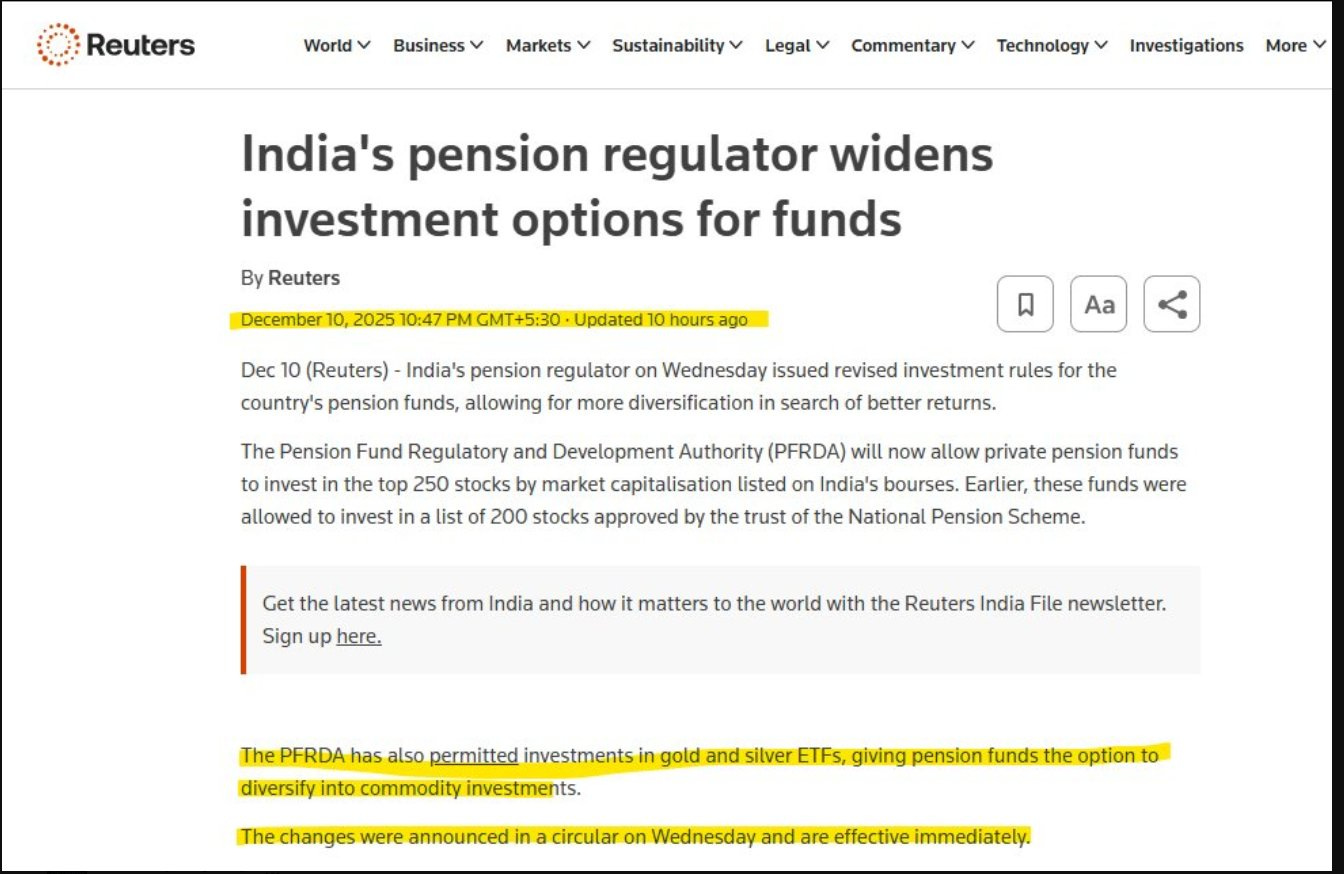
Indian pension funds have just been unleashed into gold and silver ETFs, effective immediately - a structural change to how trillions of future savings will be parked and protected. The PFRDA has revised its rulebook so that National Pension System and other regulated schemes can finally allocate into commodity ETFs tracking gold and silver, alongside a broadened equity universe of the top 250 listed stocks.
This is not a cosmetic tweak to asset menus; it is a rewiring of capital flows at the deepest, slowest, most powerful layer of India's financial system. Pension money does not day-trade - it accumulates, rebalances slowly, and then sits there for decades, silently grinding demand into whatever asset classes it is allowed to touch.
From "alternative" to structural bid
Until this week, gold and silver sat mostly in the "personal stash" and "jewelry tradition" bucket for hundreds of millions of Indians, plus thin institutional wrappers like Sovereign Gold Bonds. Now, for the first time ever, retirement capital can systematically accumulate monetary metals through regulated ETFs - with formal mandates, model portfolios, and mechanical monthly contributions doing the buying.
Layer this on top of PFRDA's move to expand equity eligibility from 200 to 250 stocks, and you see the broader strategy: India is diversifying away from a narrow, paper-only savings system toward a multi-asset, commodity-aware pension architecture. But make no mistake - the real story is the metals sleeve, not the extra 50 midcaps.
Don't miss out on the opportunity to invest in Gold & Silver. Check out our featured companies today: (Ad)

Augusta Precious Metals — Named “Best Overall” by Money Magazine and trusted by high-net-worth investors. Augusta specializes in premium IRA and 401(k) rollovers, offering direct access to educational 1:1 web conferences and U.S. Mint-approved gold and silver.
- Minimum Investment: $50,000
- Fees: $0 storage up to 10 years
- Rating: ★★★★★ (A+ BBB, AAA BCA)

Goldco — With over $2 billion in precious metals placed for customers, Goldco is a leading name in Gold & Silver IRAs and direct bullion purchases. Known for its strong buyback program and industry awards, Goldco offers both IRA and non-IRA investments.
- Minimum Investment: $25,000
- Buyback Guarantee: Yes
- Rating: ★★★★☆ (A+ BBB, AAA BCA)

American Hartford Gold — Ranked #1 Gold Company on Inc. 5000, endorsed by Bill O’Reilly and Rick Harrison. AHG offers flexible IRA rollovers and direct gold & silver purchases, serving over $2B in precious metals to clients nationwide.
- Minimum Investment: $10,000
- Endorsements: Bill O’Reilly, Rick Harrison
- Rating: ★★★★☆ (A+ BBB)
RBI just turned silver into working collateral
This pension bombshell lands directly on top of the Reserve Bank of India's April 2026 rule change: silver officially becomes acceptable collateral for loans under new standardized lending directions. Households and small businesses will be able to walk into a bank, pledge silver ornaments and coins within defined limits, and unlock credit without dumping their metal into the market.
That is remonetization in practice: silver that used to sit dead in cupboards and temple vaults is now recognized by the banking system as live collateral - a parallel balance sheet that can be tapped without liquidating the underlying wealth. At the same time, pension funds are being given a green light to buy more of the same metal through ETFs, creating a one‑two punch of collateral demand and institutional investment demand.
When long-horizon money meets finite metal
India's private pension complex already oversees on the order of 15-16 trillion rupees in assets, with total pension wealth across NPS and related schemes measured in the hundreds of billions of dollars and growing at high single to low double-digit rates. Even if initial gold and silver ETF caps look small on paper, the direction of travel is unmistakable: a dedicated, recurring, policy‑blessed allocation stream into scarce, non-printable assets.
If anyone still thinks the current gold and silver rally is "just speculation," they are ignoring the quiet monster that is pension reallocation. This is how secular bull markets are built: not by a few traders chasing spikes, but by entire nations deciding that hard money deserves a permanent seat in the retirement stack. India just made that decision - and lit the next fuse.
India sidebar: silver, credit, and 1.4 billion people
India is a nation of roughly 1.4 billion people, with a rapidly expanding formal financial system and tens of millions flowing into pension and credit products every year. An estimated hundreds of millions routinely rely on bank loans and other formal credit channels to smooth cash flow for households and small enterprises, making collateral rules a frontline economic issue.
From April 2026, silver will stand alongside gold as recognized collateral in India's standardized lending framework, allowing borrowers to pledge silver jewelry, ornaments, and coins up to specified weight and value limits. The key breakthrough is simple but profound: people no longer have to sell their silver to monetize it - they can unlock liquidity while retaining ownership of the metal itself.
This transforms silver from a passive savings object into an active financial asset, especially in rural and semi-urban regions where silver is a traditional store of value. Combined with the new pension access to gold and silver ETFs, India is quietly building a two-tier system where silver is both collateral on the ground and a long-term reserve in national retirement portfolios - the ultimate leverage on a finite, monetary metal.
Content quality approved by JPost. JPost oversees the native, paid, and sponsored content on this website and guarantees quality, relevance, and value for the audience. However, articles attributed to this byline are provided by paying advertisers and the opinions expressed in the content do not necessarily express the opinions of JPost.The sponsor retains the responsibility of this content and has the copyright of the material. For all health concerns, it is best to seek the advice of your doctor or a legal practitioner.