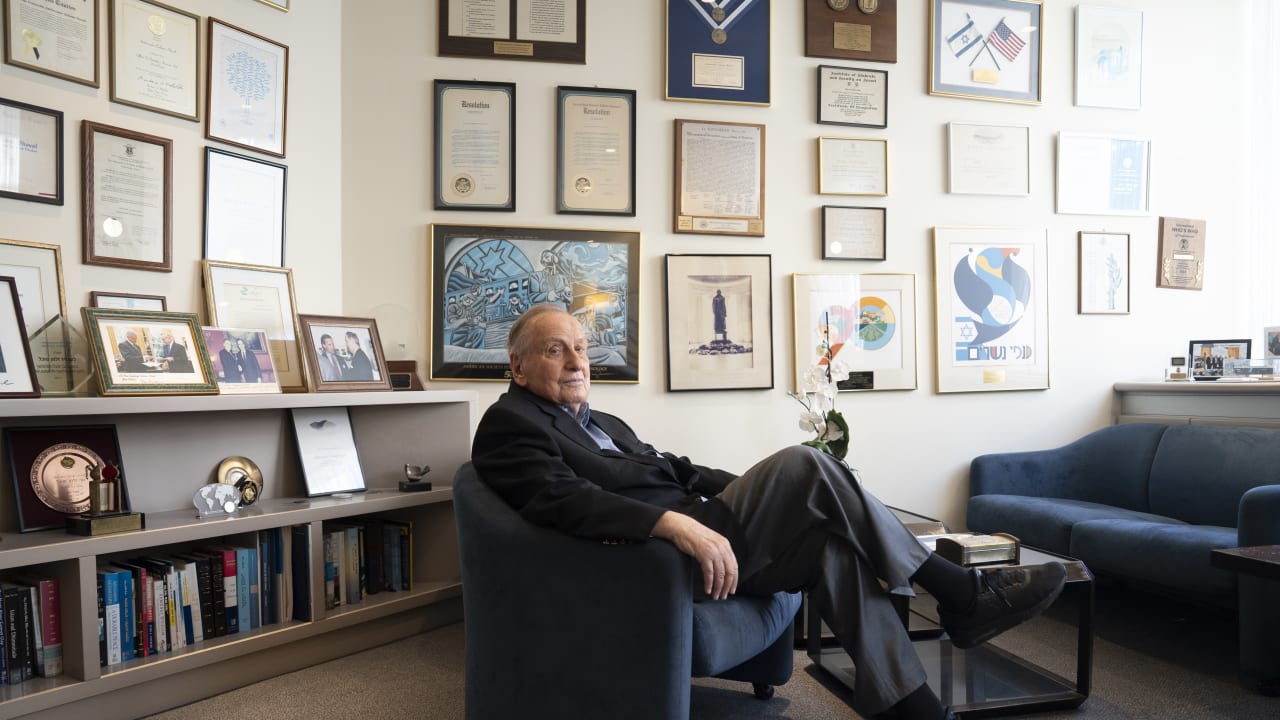
"It all began almost by accident,” Zalman Shoval says, leaning back with the half-smile of a man who has told and lived this story many times before. “Like many things in life.” At age 95, Shoval, a distinguished former IDF lieutenant-colonel, diplomat, seasoned politician, and initiator of the Bank of Jerusalem, has a unique perspective.
Over the course of four terms in the Knesset, he served on both the Foreign Affairs and Defense and Finance committees, became Moshe Dayan’s de facto deputy at the Foreign Ministry, and later, in Menachem Begin’s first government, was tasked with leading Israel’s public diplomacy.

His life story, much like the city after which his bank is named, is deeply intertwined with Israel’s history. In the early 1960s, as a young Israel was finding its economic footing, Shoval and his family laid the foundation for what would become the Bank of Jerusalem. It originated from a conversation with David Horowitz, the governor of the Bank of Israel. The bank’s establishment combined pragmatism with vision. “I told him, ‘Sir, we need a branch in Jerusalem,’” Shoval recalls.
Horowitz agreed, but with one condition: the new bank would prioritize the city’s growth and mortgages for its residents. This challenge resonated with Shoval, who saw it as both a business opportunity and a mission. What started as a single desk grew into a financial institution closely tied to Jerusalem’s destiny, reflecting its struggles and successes.
The bank’s initial partners included the State of Israel and prominent Jewish businessmen from England, Isaac Wolfson and Charles Clore. Their first project financed a housing development that eventually became Modi’in Illit, a vibrant ultra-Orthodox city today. “We funded it entirely,” Shoval states proudly. “From that, the city grew.”
Shoval also ventured into politics. He joined David Ben-Gurion’s breakaway Rafi Party and later helped establish Likud. His life became a rhythm of alternating between politics, diplomacy, and banking. “I applied for two licenses upon returning from my first ambassadorship in Washington – one for full banking operations, and one for foreign currency. I received both, and, as they say in English, we never looked back.”
The Six Day War, he reflects, gave the Bank of Jerusalem “a kind of bonus.” Founded when the city was in decline, the bank suddenly found itself in a united Jerusalem, a city swelling with new investment, neighborhoods, and optimism.
Shoval recalls one incident vividly: “Moshe Dayan toured around Jerusalem, looking for sites for new neighborhoods. He came to a place he thought ideal – what later became Gilo – and said, ‘Here, we’ll build.’ Someone in his entourage objected: ‘But Minister, this is beyond the Green Line.’ Dayan looked down and said, ‘I don’t see any green line.’ Classic Dayan.” Shoval laughs at the memory, the kind of story that reveals as much about the man telling it as about the general himself.
Shoval’s career would take him far from Jerusalem’s hills, across the ocean to Washington, where he twice served as Israel’s ambassador to the United States. He represented Israel under leaders as different as Yitzhak Shamir, Yitzhak Rabin, Ehud Barak, and Benjamin Netanyahu, while navigating American administrations from George H. W. Bush to Bill Clinton. “Diplomacy is not something you learn,” he says. “You’re either born with the instinct or not. I suppose the same qualities that served me in politics and diplomacy also guided me in business.”
One of the battles of his diplomatic career became a defining chapter for Israel’s economic survival and also fulfilled its Zionist aims. In the early 1990s, as waves of immigrants from the collapsing Soviet Union poured into Israel, Shoval fought to secure US loan guarantees worth $10 billion. “It was a fight from start to finish,” he recalls.
“From that moment, the financial world began courting Israel, instead of the other way around.” When it seemed the guarantees might not materialize, Shoval gathered a group of wealthy American Jews to create a contingency framework.
That same network, once the crisis passed, eventually helped launch Birthright. “I won’t take credit for the idea – Yossi Beilin was among those who brought it forward; but in a way, I was there at the foundations.” Back in Israel, the Bank of Jerusalem continued to expand, now with 19 branches across the country.
Its presence is unusual: rooted in ultra-Orthodox communities like Bnei Brak and Modi’in Illit, and, of course, Jerusalem, but also operating in Arab towns such as Nazareth, Sakhnin, and Umm el-Fahm. “I still see it as a kind of mission,” Shoval says. “We could have invested in more profitable ventures – hi-tech, for example. But we chose this path, true to that first conversation with Horowitz.”
What sets the bank apart, in his view, is its dual identity. “On one hand, we are regulated like any public company. On the other hand, we’ve always tried to maintain the spirit of a private bank, a boutique bank. Especially in private banking for foreign residents or new immigrants – the relationship, the personal touch – like a Swiss bank, but in Jerusalem and Tel Aviv.”
He believes this blend explains the bank’s resilience in a turbulent financial sector. “We are the only bank founded after Israel’s establishment that still exists independently, under the same family ownership. That continuity builds trust.”
At 95, Shoval insists he is no longer “active” in the day-to-day management of the bank. “By law, even controlling shareholders cannot involve themselves in daily operations. And that’s good. But as board members, my son Gidi and I help set the strategy and direction. There’s a fine line between not interfering in management and still ensuring that the bank moves in the right direction. And yes, sometimes that requires diplomacy, too.”
Looking back, Shoval says, “Above all, I’m proud of the very establishment of the bank. If I hadn’t responded positively to Horowitz’s proposal, it may never have existed.” Pride is both institutional and personal. The Mayers, his wife, Kena’s, family, who immigrated to Palestine in the 1920s, were among Israel’s pioneering economic figures, supporting the young nation with barter trades: exporting textiles to Denmark in exchange for butter, which was then traded for Argentinian beef to feed a hungry Israel.
“That spirit influenced me, too,” Shoval says, connecting those postwar barter deals to the modern financial institution he built. His views on Israel’s economy mix realism with optimism. “Despite challenges, Israel has become the most successful post-colonial story of the 20th century. With its human capital and ingenuity, I believe Israel will overcome political hurdles and continue to thrive. I’m optimistic. I see the obstacles, but I also see possibilities beyond them.”
As he speaks, his tone reflects someone who has watched his country grow from a fledgling state to a global economic power. Its having endured wars, diplomatic struggles, financial crises, and political upheavals, he remains hopeful. “I think there is a great future for the Bank of Jerusalem,” he says. “And for Israel, too. Perhaps even more than people imagine.”
For Zalman Shoval, the mission that started at a single desk in Jerusalem 60 years ago is far from over.
For a man who quoted Moshe Dayan saying he could not see a green line, boundaries – whether political, financial, or generational – seem designed to be crossed.