
Initiated and Led by the Israel Advanced Technology Industries Association (IATI), the Annual Conference of Managing Partners from Israel’s Leading Venture Capital Funds and Investment Firms Was Held. The conference was held as part of JOURNEY 2026, the annual high-tech conference of EY, the consulting and accounting firm.
At the center of the conference were two special sessions under the title:
“The Future of Israeli High-Tech as an Engine of Economic Growth – 2026 Elections”
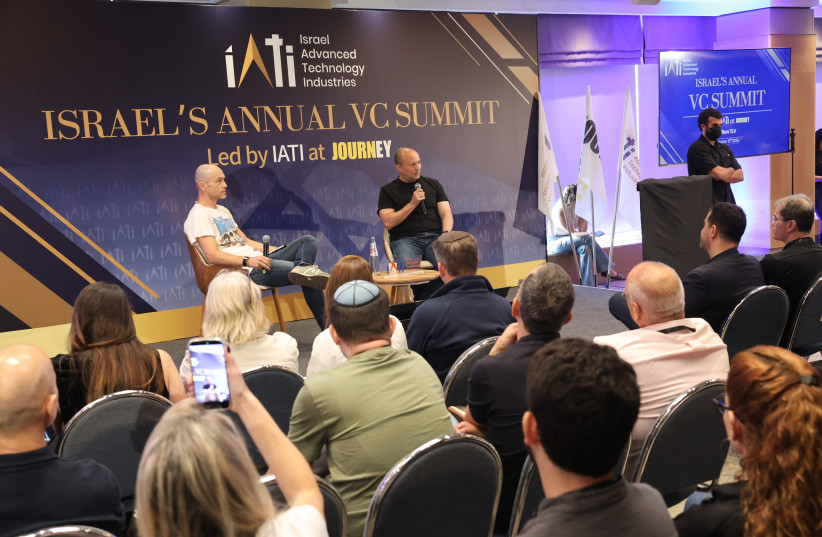
In the first session, Gigi Levy-Weiss, Founding Partner at NFX, led a discussion with former Prime Minister and leader of the B’Yachad Party, Naftali Bennett
In the second session, Sarel Eldor, Co-Founder and Managing Partner at Key1 Capital, led a discussion with MK Avigdor Liberman, Chairman of the Yisrael Beitenu Party.
Former Prime Minister Naftali Bennett at IATI’s Annual Venture Capital Conference: “High-Tech Sustains the Country and the Economy”; Presented Measures to Bring Talent Back to Israel, Remove Barriers, and Expand Opportunities for Young People in the Periphery.
Bennett added: The question is not how to help high-tech, but how to make Israel the best place to establish a company and stop companies from leaving the country. Former Prime Minister Naftali Bennett said at the annual venture capital conference of the Israel Advanced Technology Industries Association (IATI) that the key to keeping entrepreneurs in Israel and fostering the growth of the high-tech industry is creating a better-functioning, more stable, and better country. “High-tech sustains the country,” he said. According to Bennett, the question is not how the state can help high-tech, but rather what actions would lead an entrepreneur to decide that Israel is the best place to establish a company.
Bennett outlined his intention to advance a comprehensive program to bring Israeli talent back to Israel and attract Jewish talent from around the world, noting that the wave of antisemitism also creates an opportunity to encourage people to come to Israel. He called for the advancement of a constitution, which he presented as a means of retaining Israel’s liberal population, and emphasized the need to improve the overall atmosphere and remove obstacles to the industry’s operations.
Regarding expanding the high-tech workforce, Bennett called for greater access to advanced five-unit mathematics, English, and physics studies in Israel’s periphery, the integration of hands-on artificial intelligence experience into the education system, and the development of fast transportation links between the periphery and the center of the country. According to Bennett, young people must be provided with the conditions and opportunities that will enable them to integrate and thrive in Israel.
On regulatory certainty and taxation, Bennett said he was adopting the plan presented by Karin Mayer Rubinstein, CEO and President of the Israel Advanced Technology Industries Association (IATI), and called for listening to the needs of the high-tech industry and rolling out the red carpet for it.
At the same time, he expressed reservations about deliberately directing pension funds toward high-tech investments, emphasizing that the guiding consideration should be returns for savers.
To remove regulatory and bureaucratic barriers, Bennett proposed establishing a dedicated contact center led by a senior professional official, which would identify broader systemic problems through individual cases and promote solutions that address their root causes. According to Bennett, this approach would make it possible to reach businesses’ pain points directly and reduce the distortion of information as it makes its way to decision-makers.
Bennett also warned of the damage to Israel’s image and to investment and trade relations with the country, placing particular emphasis on concerns about harm to relationships with customers. He called for restoring normal functioning in Israel and developing assets and capabilities that would make other countries dependent on it.
Alongside his criticism of the government’s performance, Bennett expressed optimism about the younger generation, which he described as strong, committed, and guided by values of giving and teamwork. According to Bennett, October 7 revealed that even when the state is not functioning, Israel has “a nation of lions,” and its people must be given the opportunity to realize their capabilities.
MK Avigdor Liberman Warned at IATI’s Annual Conference: Within Two Years, the United States Could Recognize a Palestinian State and Impose Sanctions on Israel; Israeli High-Tech Will Not Be Able to Withstand the Consequences When asked who should lead the bloc for change, he replied: “Whoever is the smartest.”
MK Avigdor Liberman said at the annual venture capital conference of the Israel Advanced Technology Industries Association (IATI) that he believes that if the current situation continues, within two years the United States will recognize a Palestinian state and begin imposing sanctions on Israel. According to Liberman, the British are already discussing sanctions against Israeli banks, and the Israeli high-tech industry will not be able to withstand the consequences of such measures.
“An industry like high-tech requires mobility, the ability to fly, communicate, and be accepted by the international community,” Liberman said. He warned that the deterioration of Israel’s international standing threatens the high-tech industry, venture capital funds, and investors, emphasizing that the first necessary step is to normalize Israel’s standing in the world.
At the same time, Liberman pointed to Israel’s human and economic potential, saying that with proper management, the country could surpass Switzerland and Norway within four to five years. He called for the creation of a framework that would enable institutional investors to invest in Israeli startups, including through investment funds, while providing indemnification and backing.
In addition, he called for reducing bureaucracy and consolidating regulatory bodies, raising the question of whether the Israel Securities Authority and the Capital Market Authority need to operate as separate entities.
Regarding Israel’s international standing, Liberman called for establishing a joint emergency task force involving the State of Israel and the Jewish diaspora to address global public opinion. According to Liberman, modern warfare is conducted simultaneously on three fronts: Military, diplomatic, and public perception. Losing public support around the world, he said, also leads to a loss of political support.
On domestic issues, Liberman called for an investigation into responsibility for the failures of October 7 and sharply criticized the Prime Minister’s performance. He presented his demand for a universal conscription law, with two tracks, military and civilian, administered by the Defense Ministry, as well as mandatory core curriculum studies as a condition for receiving state funding. According to Liberman, these are two essential measures for integration into the labor market and for safeguarding Israel’s economic future.
He also called for the establishment of a constitution through a team of experts that would draft a proposed text within six months, followed by its approval in a national referendum. In addition, he proposed moving to a single Chief Rabbi, both at the national level and in local authorities.
Adv. Karin Mayer Rubinstein, CEO and President of the Israel Advanced Technology Industries Association (IATI), said: “This year’s conference is taking place close to the elections, at a significant time for the high-tech industry. High-tech is the main growth engine of the Israeli economy, but in order for it to continue fulfilling this role in the years ahead, the industry needs, first and foremost, certainty, a competitive business environment, and conditions that will enable entrepreneurs, companies, and investors to continue choosing Israel.
The next government that is formed will need to place high-tech high on the national agenda, with the understanding that Israel’s ability to retain capital, technology, intellectual property, and human capital here will directly affect the country’s growth, productivity, and economic resilience. In a world where countries compete for the leading industries of the future, Israel must continue strengthening its advantages and ensure that the center of gravity of the high-tech industry remains here.
This is also the work we are leading at IATI with government ministries and regulators, to create certainty and long-term competitive conditions for the industry. We are working together with the government and various ministries and authorities, including the Finance Ministry and its Budget Division, the Israel Tax Authority, the Israel Innovation Authority, and the Chief Economist, to advance solutions.
One example is our work to reduce the impact on the competitiveness of high-tech companies operating from Israel and to promote a model that would provide high-tech entrepreneurs and investors with a significant incentive to establish and develop their companies in Israel, including examining a full capital gains tax exemption under a model similar to the American QSBS. Another example, against the backdrop of the strengthening shekel and the erosion of dollar-denominated revenues, is our work to advance solutions that will reduce the impact on Israeli companies and preserve their competitiveness. At the same time, we are working to advance the regulation of Pillar 2 rules in a way that will provide companies with regulatory certainty and clarity.
These are precisely the tools that can make continuing to build their future here in Israel the right business decision for entrepreneurs and companies.”
Noam Canetti, Co-CEO of EY Israel, said: “As part of the JOURNEY 2026 conference, we held IATI’s annual gathering of managing partners from venture capital funds today. This year’s conference theme, Into the Wild, aptly reflects the complex reality in which the Israeli high-tech industry operates, amid security and policy challenges, the effects of exchange rate fluctuations, and above all, the artificial intelligence revolution that is changing the rules of the game.
Especially in a period of rapid change and uncertainty, bringing together leaders of the investment industry is of great importance, enabling open dialogue on the challenges and opportunities and helping shape thinking about the future of the industry.
I would like to thank former Prime Minister Naftali Bennett and MK Avigdor Liberman for participating in the conference, presenting their perspectives on the future of the Israeli economy, and emphasizing the importance of the high-tech industry as a key growth engine of the economy.”
The conference was attended by managing partners from approximately 200 of the leading venture capital funds and investment firms operating in Israel, including:
Michael Eisenberg, Co-Founder and Partner at Aleph; Dror Nahumi, General Partner at Norwest; Yifat Oron, CEO of Blackstone Israel; Varda Shalev, Managing Partner at Team8; Yair Schindel, Co-Founder and Managing Partner at aMoon; Eyal Niv, Managing Partner at Pitango; Sarel Eldor, Co-Founder and Managing Partner at Key1 Capital; Edward Zuckerman, Founder and Managing Partner at Catalyst; Uri Geiger, Founder and Managing Partner at Accelmed; Ari Shamiss, Founder and Managing General Partner at ALIVE; Mati Gill, CEO of AION Labs; Tal Barnoach, Founder and Partner at Disruptive; Omer Shachar, Managing Partner at Next Gear Ventures; Idan Tendler, Partner at Wing; Avi Zeevi, General Partner and Co-Founder of Viola Ventures; Ari Shamiss, Founder and Partner at ALIVE; Natalie Refuah, Partner at Viola; Gigi Levy-Weiss, Founder and Partner at NFX; Yoav Tzruya, Partner at JVP; Hila Goldman-Aslan, Managing Partner at RUNI Ventures; Yuval Cohen, Founder and Managing Partner at StageOne; Harel Beit-On, Founder and Partner at Viola.
The conference opened with remarks by Adv. Karin Mayer Rubinstein, CEO and President of IATI, and welcoming remarks by Noam Canetti, Co-CEO of EY Israel. The conference was held as part of JOURNEY 2026, the annual high-tech conference of the consulting and accounting firm EY.
The conference continued with a discussion on “The National Artificial Intelligence Strategy and Investment Opportunities in Israel,” featuring Erez Eskel, Head of the National AI Directorate at the Prime Minister’s Office.
In addition, Izhar Shay, Co-Founder and Partner of Next October and Partner at Disruptive AI, shared the personal story of his son, Staff Sergeant Yaron Oree Shay, of blessed memory, a soldier in the Nahal Reconnaissance Unit who fell in battle on October 7, and spoke about remembrance, hope, and the path forward.
The conference also included a ceremony presenting an appreciation and farewell award to Dror Bin, outgoing CEO of the Israel Innovation Authority.