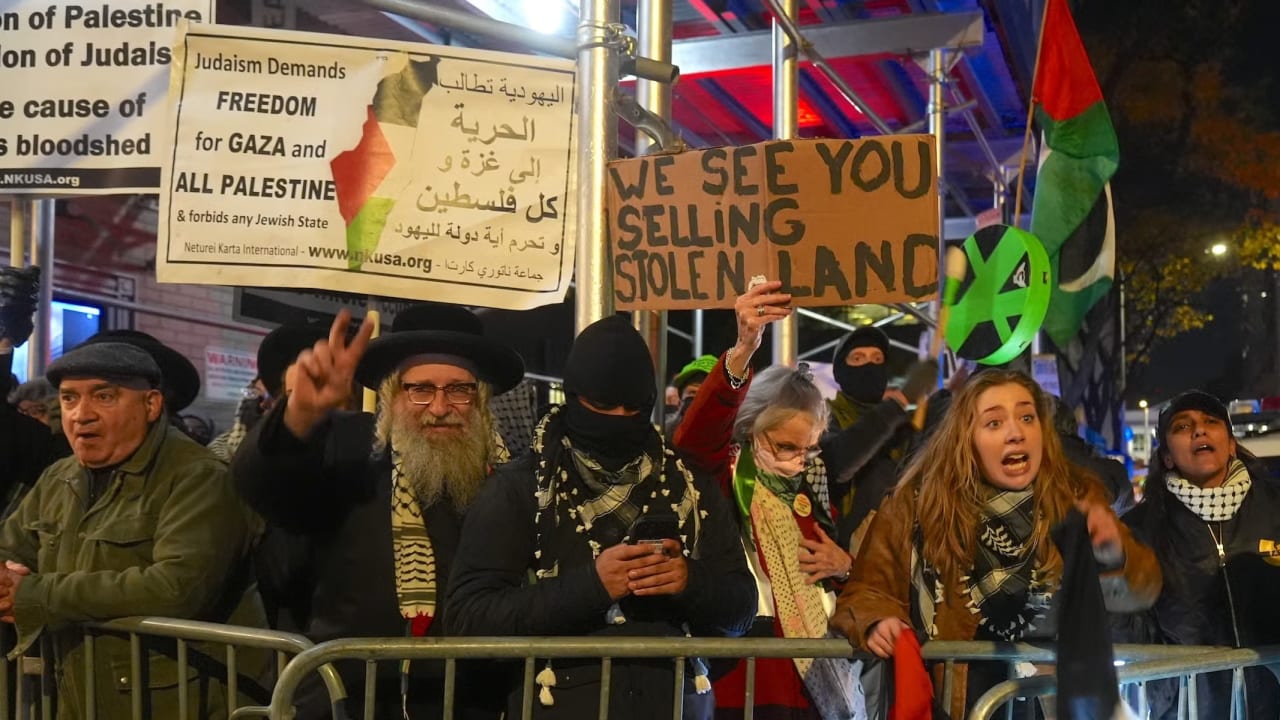
Aliyah, Jewish immigration to Israel, has been placed in the crosshairs of anti-Israel activists, with two synagogues being protested over the week for hosting aliyah events. The targeting of aliyah clarifies once again, after two years of incessant Israel-Hamas War protests, that the activists’ ultimate objective was not a ceasefire. They are instead animated by the same goal that drew them to the streets immediately after the October 7 massacre: The end of Israel.
The Palestinian Assembly for Liberation – Al Awda New York and New Jersey (PAL-Awda NY/NJ) demonstrated outside the New York City Park East Synagogue on Wednesday against a Nefesh B’Nefesh event. The anti-Israel group characterized the event as a “settler recruiting fair,” furthering the “colonization of Palestinian people and land.”
“Settler, settler, go back home, Palestine is ours alone,” keffiyeh-clad activists chanted, according to PAL-Awda’s Instagram. “Death to the IDF.”
On Sunday night, groups led by Jewish Anti-Zionist Action (JAZA) and Palestine Pulse rallied outside the St John’s Wood United Synagogue against a World Zionist Organization Aliyah Day, asserting that the event was facilitating the genocide of Palestinians and colonization of their land. JAZA said in a statement that it didn’t wish to protest outside a synagogue, but while it was “heartbreaking” to do so, it was “unacceptable that two years into the ongoing genocide of Palestinians in Gaza” that the synagogue was “hosting an event supported by and supportive of the Israeli regime.”
The organization rejected the concept of aliyah, casting it as “colonial and racist” and stating that “Palestine always has, and always will, belong to the Palestinians.”

Protests at synagogues and Jewish community centers became an unfortunate but common feature of the post-October 7 activist landscape. Many of these events targeted Israeli real estate events. A My Home event at a Flatbush synagogue was canceled in March after threats. PAL-Awda led a protest last July against an event that had to be moved from a Queens synagogue after the demonstration was announced. Montreal 4 Palestine protested outside a March 2024 exposition at the Spanish & Portuguese Synagogue of Montreal.
On Wednesday and Sunday, organizations accused both the synagogues of hosting the sale of real estate in the Levant, with JAZA projecting “stolen lands sold here” onto the United Synagogue wall, and PAL-Awda activists asserting that they were there in part to stop the sale of “stolen land.”
New York City mayor-elect Zohran Mamdani condemned the method but sanctioned the spirit of the protest, with a spokesperson, according to JTA, asserting that while “every New Yorker should be free to enter a house of worship without intimidation,” and that synagogues “should not be used to promote activities in violation of international law.”
The spokesperson didn’t specify what activity violated international law.
Pro-Palestinians against Israel's existance
Neither the WZO nor Nefesh b’Nefesh events were about the sale of real estate, but rather guidance and advice for making aliyah. Real estate wasn’t really the issue; the point about “stolen land” was ancillary to the arguments presented by PAL-Awda and JAZA, which focused more on the “settlers” themselves than the “settlements.” The slogans about “stolen land” served more as a rhetorical bridge between past and current protests, trying to stretch the sliver of plausible deniability that came with protesting activity in the West Bank.
For years, anti-Israel activists have constantly retreated to the motte of West Bank settlement criticism, that they weren’t against Israel, seeking its destruction, or the scouring of its people; they simply demanded a return to 1949 armistice lines. It is even reasonable to accept this maneuver in good faith; after all, many Zionist Jews are critical of West Bank settlements to varying degrees.
The Sunday and Wednesday protests shook the global Jewish community so much more than previous synagogue protests, not because of violent rhetoric – that was nothing new – but because the occupation of the bailey was so blatant.
“We don’t want no two states, Palestine ‘48,” JAZA activists chanted, referring to a rejection of any Israel and an establishment of a Palestinian state on the territory that had been the British Mandate.
“Palestine is Arab,” PAL-Awda wrote in an Instagram story.
JAZA and PAL-Awda rejected, on principle, any immigration of Jews to Israel, regardless of whichever side they reside of an arbitrary boundary. Aliyah is a central component of Zionism. The ingathering of the Jewish people back to Israel is written into Jewish scripture and the modern state’s Declaration of Independence.
“The State of Israel will be open for Jewish immigration and for the Ingathering of the Exiles,” reads the Declaration.
The principle of Jewish immigration is not just etched into our culture through the history and mythos of the First Aliyahs, but also into a raison d’être for the state’s existence: A safe haven for Jews, where they could live according to the traditions of their forefathers and act to secure their interests without abandoning themselves to the fickle mercies of other authorities.
There is no retreat from the principle of aliyah. There is no strong rhetorical point to fall back on. A surrender of the importance of aliyah is a surrender of Masada.
When PAL-Awda declared, “No settlers on stolen land,” it meant that all of Israel was stolen land, and every single Israeli was a settler.
The fundamental destructive and revanchist nature of the mainstream pro-Palestinian movement can’t be denied by hoping that they’re only referring to those other Jews engaging in “activities in violation of international law.”
Nor can there be any confusion regarding whether the protesters are simply incensed by Israel’s military operation in Gaza. While there are minor skirmishes, as of writing, the ceasefire still holds.
The protests against aliyah are of the same clarifying nature as the orgy of celebration and encouragement that erupted immediately in response to the October 7 massacre. It was never about settlements, nor a particular war; it was always about Israel as a whole. The objective is, and remains, death to Israel.