
A new annual immigration and absorption index from the Million Lobby reveals a significant increase in new immigrants from former Soviet countries who want to stay in Israel, but it also highlights major systemic failures in the country's absorption process. The survey, conducted by the Sphinx polling institute in July 2025, shows that 85% of new immigrants from the former Soviet Union want to stay in Israel, a substantial rise from 66% last year.
The former Soviet Union (FSU) refers to the 15 independent states formed following the dissolution of the Soviet Union in 1991. These countries include Russia, Ukraine, Belarus, Moldova, Kazakhstan, Kyrgyzstan, Tajikistan, Turkmenistan, Uzbekistan, Armenia, Azerbaijan, Georgia, Estonia, Latvia, and Lithuania.
Immigrants from FSU nations make up around 15% of the country’s population, at around 1.3 million people.
Despite this high retention rate, the study points to serious difficulties in integration. Only 44% of immigrants feel welcome in Israel, a 10% decrease from last year. The main reasons cited for considering leaving are systemic issues: 42% cite language difficulties, 37% complain about employment difficulties, and 28% about social integration problems. In contrast, 42% also point to the security situation as a reason for considering departure. The data shows that the primary issue is not the war alone, but rather "systemic absorption difficulties that existed even before."
The survey data challenges the stigma that these immigrants view Israel as a "transit station." The majority are highly educated; 57% have a master's degree or higher, and 47% have graduated from an ulpan. However, their professional potential is largely underutilized. Only 18% of immigrants are engaged in their profession, with 33% working in temporary jobs to survive financially. Only 7% express satisfaction with their current job, and 17% are forced to work remotely for jobs in their country of origin. This underemployment represents a "national waste" of "high-quality human capital" according to Alex Reif, CEO of the Million Lobby, an NGO in Israel that advocates for the rights and needs of Israelis from former Soviet Union countries. The organization conducts an annual immigration and absorption index to track the experiences of this population. Reif argued that the state is creating obstacles instead of helping immigrants, stating, "It is a national waste that Israel is losing immigrants who wish to integrate due to basic failures in absorption."
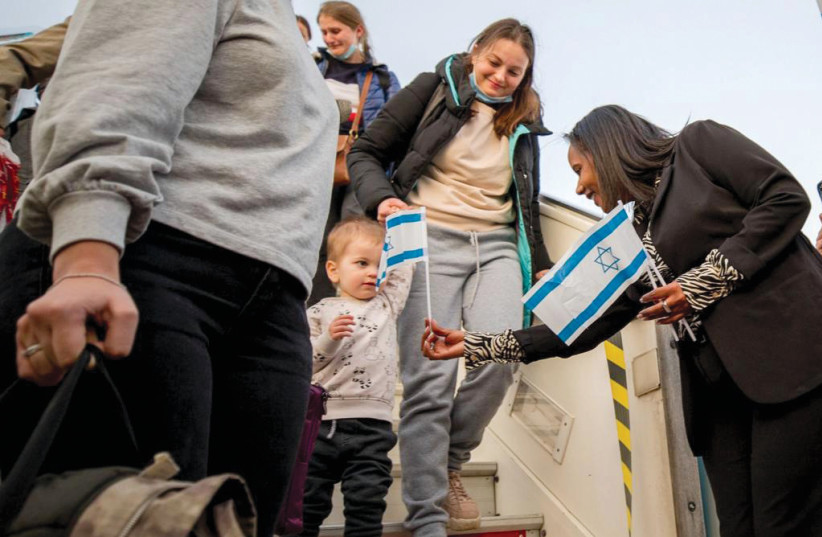
A rise in immigrants not feeling welcome in Israel
The sense of belonging is on an "alarming decline," with 56% of immigrants feeling little to not at all welcome in Israel, a significant increase from 45% in 2024. While 65% of parents feel their children have been absorbed well, an increase from 55% in 2024, 35% still do not, with this rate higher among more recent immigrants. In the political arena, new immigrants show strong support for opposition parties, with 75% supporting the opposition compared to 25% who support the Likud-Right-ultra-Orthodox bloc. Yisrael Beytenu is the clear frontrunner among this demographic, with 39% support, while a notable 33% of new immigrants are undecided about who they will vote for.
For Katya Rozenoer, 43, the move from St. Petersburg, Russia to Israel was not intentionally permanent — just how the cards played out. Rozenoer came to Israel 13 years ago with her husband, Max, and her almost two-year-old son, while pregnant with her daughter. “We thought that we might be coming for a limited period of time, mainly to allow my husband to connect with his roots and to get an experience of living in Israel, which both of us liked a lot,” Rozenoer told The Jerusalem Post. “We ended up staying, and so far, we have no plans to leave.”
Rozenoer explained the the Post that because her husband and children have US passports, going to live in the United States might seem like an attractive option; both she and her husband work in hi-tech and opportunities were bountiful. Rozenoer is the co-founder of DelivApp, as well as the author of a Telegram channel Nontechitech.
However, so much more came into play. “We came here by choice, and we will stay here by choice. For both of us, Israel - geographically and mentally - is in between Russia and the US. The relationships between people are not so business-like as in the US: in Israel everyone seems to be genuinely happy (or unhappy) with you and yet it’s not as personal as it sometimes gets in Russia,” she told the Post, adding comfort that comes with it. “The government is not as insane as in Russia — not without problems — but here you’re not helpless, and it feels as if people can make an impact,” she said.
“One of the most important things that those who grew up in Israel often take for granted is how kids are being treated here. Strangers in the streets are friendly, smile at children, they talk to them, teachers love kids, yes they may not teach at such a high level as in Russia or US, but they treat kids with love and respect,” Rozenoer said. “I feel our kids have been growing up in an atmosphere of love and safety that’s not just inside our home but also outside. I realize that it may sound absurd since the country is at war, the society is divided, we see a lot of aggression out there. I get it. Still, I feel there’s love, there’s unity, there’s hope, there are moments of happiness.”
She reaffirmed that staying in Israel wasn’t questionable — “I wouldn’t want to be in any other place and I am very committed to this country.”
Though immigrants to Israel from FSU countries have come in large quantities, each ultimately determines their future in Israel based on personal decisions, with each taking into account a variety of factors.