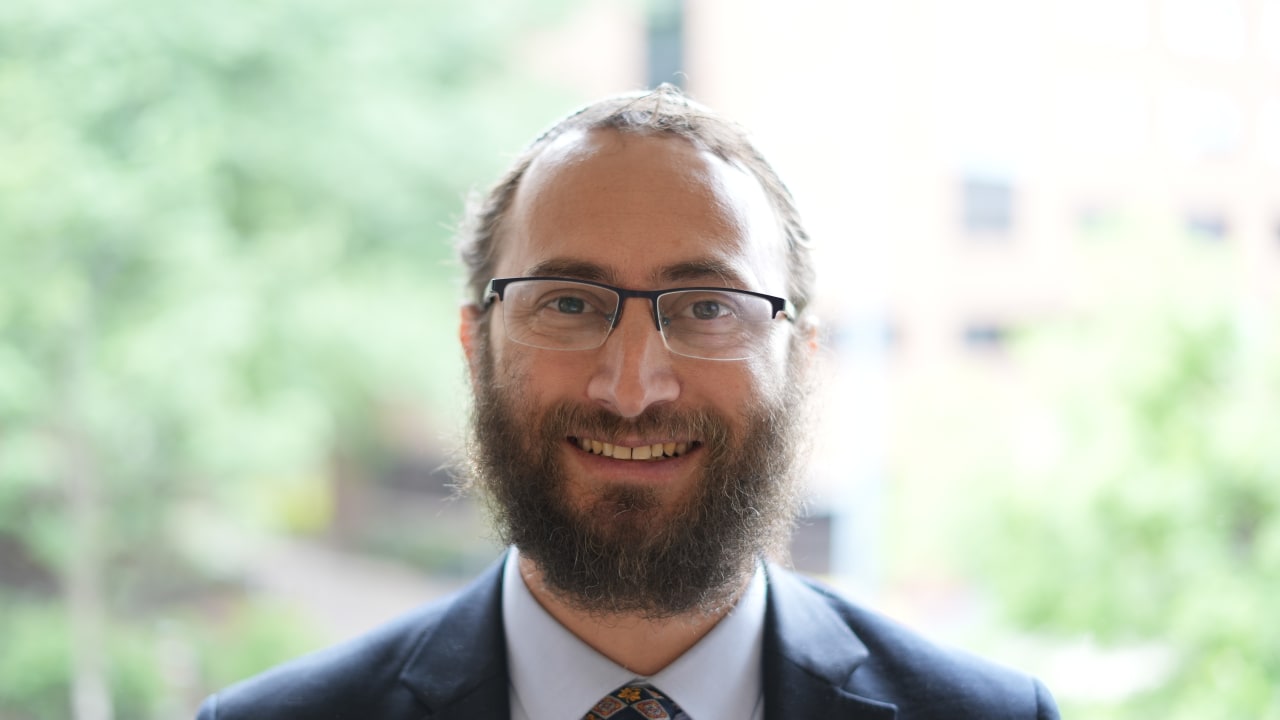
Fifteen years ago, Rabbi Yonatan Neril founded the Interfaith Center for Sustainable Development, “based on an awareness that concern and care for God’s creation is not unique to Judaism and that religious teachings can be a vehicle for promoting living in balance on the land.”
Neril, a Stanford-educated environmentalist and author, traces his interest in ecology to the organic garden, orchard, and creek behind his childhood home in northern California.
The connection between religion and ecology
“I grew up with a good amount of environmental awareness. I was first exposed to the connection between Judaism and ecology at Camp Tawonga, a Jewish summer camp near Yosemite [National Park],” he said.
Neril took environmental studies courses in college, “and then when I came to study in Israel in 2003, I saw environmental linkages in Jewish texts. And I took notes. Those notes ended up becoming the basis of four books that I’ve co-authored on Judaism and ecology, such as Eco Bible with Rabbi Leo Dee, which provides 400 ecological commentaries on verses in the Torah,” he explained.
One of his favorite examples is Genesis 2:15, “Now the Lord God took Adam and placed him in the Garden of Eden l’ovdah u-l’shomrah,” – usually translated as “to work it and to guard it.” Neril said he prefers Rabbi Jonathan Sacks’s translation, “to serve it and conserve it,” because these verbs more strongly stress the aspect of caring for the land.
His aliyah roots go a generation deeper.

“My bubbie grew up in Chicago in the 1910s in a Religious Zionist family. Her parents made the commitment to speak Hebrew at home, and that was her first language. Her father visited Israel several times in the 1920s. So I grew up with a healthy dose of love of Israel,” said Neril, whose parents and all but one sibling also made aliyah over the years.
“I came here for the first time when I was 15, on a six-week teen trip. When I was 19, I studied for a summer at Pardes [Institute of Jewish Studies in Jerusalem]. I came on a shorter trip during college and then, after finishing my master’s degree, I came back and learned in several yeshivot,” he recounted.
He earned rabbinic ordination at Yeshivat Hamivtar.
“My commitment to living in Israel, which I’ve stood by for the past 22 years, was reinforced and shaped by marrying my wife, who shares that commitment. We made aliyah together in 2006, a few months after we got married here, in Israel.”
His wife, former New Jerseyite Shana Steinman Neril, is a naturopath, somatic therapist, and wellness coach. The couple’s two children are 10 and 15 years old.
On the Sunday we spoke in May, Israel had just experienced an extraordinarily hot Shabbat, with temperatures reaching 37° C [98.6° F]. This is one of the issues that worries Neril.
“The Middle East has been heating up at twice the global average. A recent study indicated that last July was 2.8° C [5°F] hotter than the average temperature 70 years ago,” he said.
“The fact is that everyone on this planet is experiencing climate change in one way or another is something we have in common. It doesn’t matter what religion you are or what country you live in – some have a bigger [carbon] footprint than others, but we all have a role to play in the problem, and we all have a role to play in the solution.”
Interfaith environmental NGO takes initiative
His organization, the only interfaith environmental NGO in Israel, arranges conferences and workshops in Jerusalem, where Jewish, Christian, and Muslim clergy and seminary students are empowered to teach their congregations religious views on ecology.
“I’m proud of the fact that we’ve reached over 1,000 people who are probably active clergy now. And for many of them, it was their first encounter in a positive experience with ‘the other.’ I like to say ‘the other’ is a brother of a different mother or a sister of a different mister. It’s not about us vs them. It’s about us and them,” he asserted.
Several people have told Neril, “You must have been born outside of Israel to have come up with such an idea.”
“I’m not sure I totally agree, but there is something to be said for olim contributing to Israeli society,” he told the Magazine.
“The Nefesh B’Nefesh motto is ‘Live the dream,’ but perhaps a more accurate motto would be ‘Try to manifest the type of Israel that you dream about.’
“Israel needs people who are committed to bringing goodness and making a contribution. Even though it may not be rosy all the time, this is a good land with good people. It’s a holy land,” he said.
Regarding his own contribution to Israeli society, Neril reflected, “There’s so much work to be done, and such a tiny community of religious environmentalists in Israel. Our movement needs to scale up because religious communities have a big impact ecologically and even politically.”
OVER THE past six months, the Interfaith Center for Sustainable Development has produced 50 videos on religion and ecology in collaboration with Israeli-Palestinian-Kittian vlogger Nas Daily. The series has reached seven million views.
Videos filmed in Jerusalem include one on the problem of disposable plastic, and another about how Shabbat relates to ecology and the practice of slowing down.
Neril doesn’t confine his activities to Israel; for example, he recently taught a workshop to Christian clergy in Mumbai.
“There’s still a lot of work to do in bringing religion on board in addressing the ecological crisis and in activating clergy and religious institutions to be stewards of God’s creation,” he said.
“The importance of prioritizing caring for God’s creation should be a common-sense religious value and should be part of religious education.”
He noted a recent positive development: a new elective course about Judaism and ecology for high school students in Israel’s National Religious schools.
On the negative side, however, the COVID-19 pandemic and the current war have severely affected Eco Israel Tours, an ecotourism project of the coalition. “We experience a precipitous drop in clients with every missile aimed at the airport,” Neril acknowledged.
“The war has also brought out a low point in Jewish-Muslim relations in this country, as well as internationally.
“And because our work does involve engaging with Muslims, it has made some interactions more challenging. But we continue to work with some Muslims in doing this work. Ecological issues transcend borders and religions. They are among the few issues that we can find common cause on and collaborate around.”
Neril encourages members of any house of worship to ask their spiritual leader to speak about ecological issues, and to form a “green team” with the goal of making the synagogue, church, or mosque a model for sustainability.
Though Neril has chosen to live in Jerusalem, which he quoted Simon Montefiore in calling “a holy city, the fulcrum of world history,” it is not surprising that he enjoys hiking and being out in nature.
He also has a less predictable passion: juggling.
“I try to juggle several times a week. It helps me to juggle other things in my life,” he said, “and it opens up my energy.” ■
YONATAN NERIL, 44 FROM CALIFORNIA TO JERUSALEM, 2003