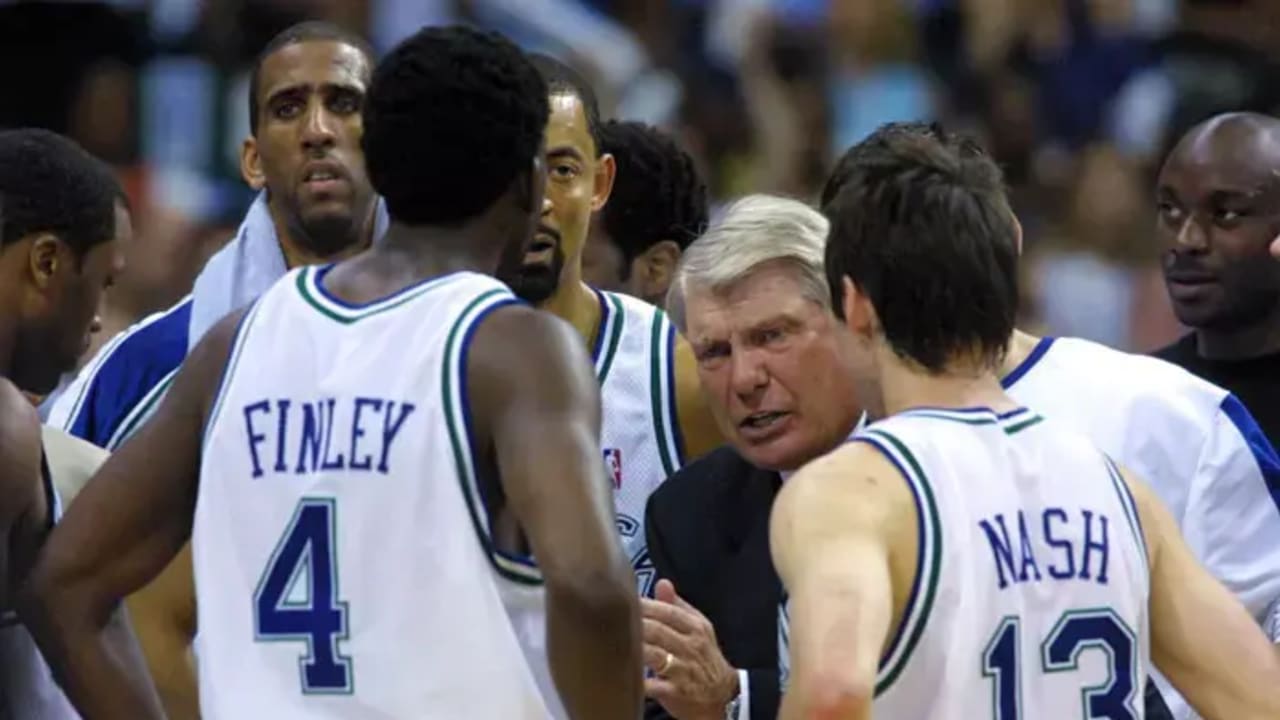
Exactly 30 years before the New York Knicks won their first championship since 1973, Don Nelson was fired from the team, mainly because he wanted them to play basketball the way it is played today. The coach arrived in the Big Apple as the replacement for the tough-minded Pat Riley. Nelson, a man with a fondness for alcohol who was not particularly strict about discipline or defense, to tell the truth, and who used to write down plays by hand that no one but him could decipher, was something entirely different.
"Nelli," who won five championships as a player with the great Boston Celtics of the 1960s and was crowned Coach of the Year three times before coming to the Knicks, presented his players with a vision that seemed completely absurd to them. He wanted practices to be lighter than under his predecessor. He aimed for a point-forward like Anthony Mason to run the game, and demanded that they stop forcing balls into the low post for Patrick Ewing, arguing that the offense needed more variety and spacing.
Ahead of his time in New York: A vision too bold for the big apple
Additionally, he tried to execute a trade that would send the 33-year-old Ewing in exchange for a young Shaquille O'Neal (23), and demanded that the players shoot much more from beyond the arc. His failure in New York stemmed from his inability to sell the vision of flowing, offensive, and futuristic basketball to a group of conservative soldiers who still remained loyal to Riley and his 1980s methods.
Nelson, a rather unusual figure at the time, spoke about "load management," predicted the emergence of players like LeBron James, and understood that big men would have to function entirely differently once basketball stopped being a trench war in the paint. He essentially coached 2026-style basketball back in the 1970s, 1980s, 1990s, and early 2000s.
On the surface, his firing in 1996 was considered the low point of his coaching career. But the beauty of Nelli was that, as far as he was concerned, everything was for the best. Because after all, this was basketball, the most wonderful thing in the world to him. "There are a lot of ups and downs in this profession," he once said. "At this point, I can't even remember any bad period. I mean, they were all good. There were a lot of tears when we lost, and many difficult moments, but I just don't remember them. Everything looks positive now. Even the hard times were good."

The birth of "Nellie-ball": Revolutionizing golden state
The "Nellie-ball" system was born out of pure love for the game, and overall worked very well, even with weaker teams. He stood on the sidelines for the Golden State Warriors and the Dallas Mavericks long before they became champions in the league, and in many ways laid the cultural foundations for their success years before the titles arrived.
In the Bay Area, he introduced super-offensive basketball based on the shooting of Chris Mullin, Tim Hardaway, and Mitch Richmond (the famous Run TMC trio). Since then, the crowd in Oakland became addicted to the style with which the Warriors eventually built their dynasty around Steph Curry and Klay Thompson. Incidentally, the aging Nelson was also the one who pushed management to select Curry in the 2009 draft. "When you come to bad teams, you have to be creative to win games you're not supposed to win," he previously explained regarding the innovations he introduced to the sport. And he truly was creative, especially in what he did in Texas.
The Dallas experiment: Redefining positions and embracing Europe
Heading into the 1998 draft, the coach, who also served as general manager of Dallas, and his son Donnie (who later became a GM himself), closely tracked a 19-year-old German talent. They tried to keep the abilities he showed in practice a secret, and on draft night executed a deal with the Milwaukee Bucks: The sixth pick (Robert Traylor) went to the Bucks in exchange for the ninth pick, Dirk Nowitzki, and Pat Garrity. He quickly packaged the latter in another trade that landed Steve Nash on the team.
In his head, something was brewing that no one else had. He wanted to take Nowitzki, a 2.13-meter giant, and turn him into a mobile three-point shooter who also knew how to drive to the basket. Just to understand the context: In those days, Charles Oakley, a sort of boxer and linebacker posing as a basketball player, was still a legitimate power forward in the league and considered one of the best.
Thus, an entirely new role was invented for the German: The "stretch 4." In this move, the coach not only laid the foundation for the Mavericks' historic 2011 championship, but for the biggest change basketball has ever experienced: The spacing revolution.
Of course, he also influenced his son to select Luka Dončić in the 2018 draft, and to build a team around him based on the brilliant mind of the Slovenian kid. Incidentally, he was also ahead of the curve regarding the use of European players. He was among the first in the NBA who knew how to utilize overseas talent, finding qualities in them that other Americans missed. He drafted Lithuania's Šarūnas Marčiulionis at 127th overall in the 1987 draft (yes, there used to be that many picks), and turned him into a legitimate starter. In doing so, he opened many minds regarding the integration of foreign players in the United States.

A giant legacy: Mentoring Popovich and changing the game forever
And let us conclude with the fact that he left behind a legacy even greater than Nowitzki, Doncic, "Euro-ball," and "Nellie-ball." In 1992, Gregg Popovich, who had served as an assistant to Larry Brown with the San Antonio Spurs since 1988, was fired along with the entire staff. For "Pop," it was likely the end of his road in the league, but Nelson liked the hard-working assistant coach, who had no professional playing background but displayed extensive knowledge about the Soviet Union.
Nelli appointed him as his top assistant with the Warriors, a role he filled between 1992 and 1994. Popovich frequently noted those two seasons as a major turning point in his coaching philosophy, during which he was exposed to his mentor's unconventional offensive concepts. "He gave me a job when I didn't have one," he later recalled. "He brought me in and saved my family. He was awesome."
The assistant left Golden State in 1994 to return to the Spurs as general manager. In December 1996, after a weak start to the season, he fired then-head coach Bob Hill. Popovich turned to Nelson to come coach in Texas, but the latter remained loyal to his contract with the Warriors. Following this, Pop appointed himself as head coach. And the rest is history.
Later, Nelson called Popovich "the greatest coach to ever coach the game," and expressed genuine pride when the latter passed his all-time NBA wins record. The Hall of Famer was himself one of the most decorated coaches on the league's win chart, and although he never won a championship on the sidelines, when he passed away at age 86, he left behind one of the grandest and most respected legacies in world basketball in general, and American basketball in particular.