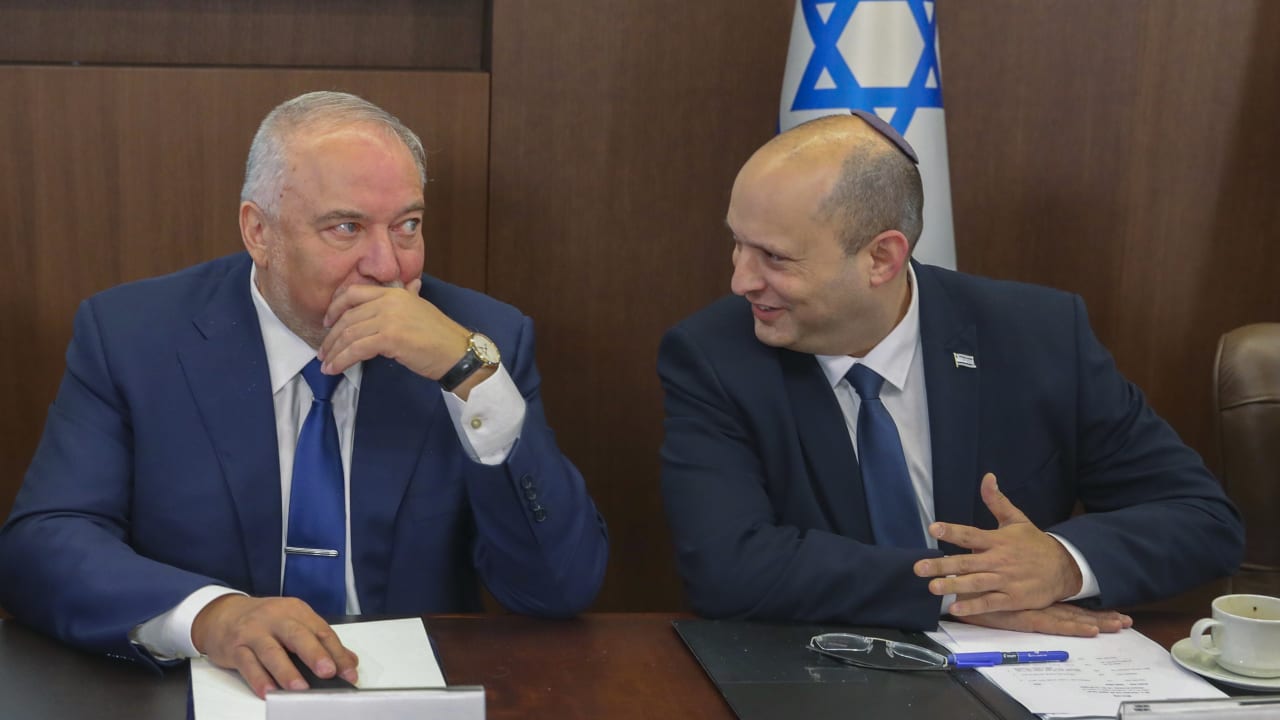
Naftali Bennett and Gadi Eisenkot spent part of this week doing what party leaders do before an election: filling a few more spots on their lists.
After adding several relatively unknown women – in what appears to be an effort to broaden his appeal among female voters – Bennett has now begun adding men, also mostly unknown and with little political experience.
Eisenkot has gone in the opposite direction. He has already brought in the inexperienced newcomers; this week, he has turned to former Knesset members.
It is an interesting process to watch. Exactly how they choose their candidates, and according to what criteria, remains somewhat unclear. What is obvious, though, is that both men are looking for people who will function as “political soldiers” once they enter the Knesset.
Bennett learned the importance of loyalty the hard way in 2021, when two members of his Yamina Party, Amichai Chikli and Idit Silman, broke ranks and helped bring down his government.

Eisenkot appears to have internalized the same lesson. Political experience might be useful, but loyalty comes first.
There is some irony here when remembering Yair Lapid. For years, Lapid was mocked by leaders of other parties for assembling a party that sometimes looked like a bus stopping at random stations and picking up passengers along the way. Yesh Atid, his critics argued, lacked an ideological backbone. What united its members, beyond Lapid himself?
Now Lapid has effectively been swallowed up by Bennett, who is assembling a party that, at least for now, does not look all that different from the one Lapid was once ridiculed for building.
But the composition of the lists is not the opposition’s biggest problem. Another is taking shape, and it could become far more consequential.
Who leads the opposition?
Despite having an overriding objective that should unite them – replacing Prime Minister Benjamin Netanyahu – the leaders of the opposition remain divided over the most basic questions they will face the day after the election. Most importantly of these is: Who actually leads their camp?
Eisenkot has been remarkably consistent on this question. From the beginning, he has said that whichever of the opposition parties – his Yashar, Bennett’s party, Avigdor Liberman’s Yisrael Beytenu, or Yair Golan’s Democrats – wins the most seats will receive his recommendation to the president to form the next government.
He said this when Yashar was polling at six seats. He continues saying it now, when his party is polling at around 24. Bennett and Liberman, however, refuse to make the same commitment.
Bennett was asked about this in a comprehensive Channel 12 interview this past week. His answer was long and winding, but the bottom line was clear: he is not prepared to recognize Eisenkot’s current lead in the polls or commit to recommending the leader of the largest opposition party.
Liberman is playing a similar, if quieter, game. From their perspective, this makes political sense. There are still two months until the election, an eternity in Israeli politics.
Polls will change, campaigns will flip, and voters will move between parties and even blocs. Neither Bennett nor Liberman sees a reason to crown Eisenkot prime minister before a single vote has been cast.
But their refusal to make that commitment tells us two things, and both should concern the opposition amid its effort to translate current polling into a coalition government.
The first is that Bennett and Liberman appear to understand that their ability to bring significant numbers of new right-wing voters into the anti-Netanyahu camp has probably reached its limit.
IF THEY now concede that Eisenkot leads the bloc, they risk becoming little more than feeder parties for Yashar. Bennett has already watched hundreds of thousands of voters migrate from him to Eisenkot.
Declaring that he will recommend Eisenkot for prime minister this early will accelerate that process. Why vote for Bennett if Bennett himself is telling you that Eisenkot should lead the country?
The same applies to Liberman.
So they keep fighting for first place, hoping that doing so will pull some voters back from Eisenkot.
The problem is that this means the opposition’s focus is on the camp’s existing members, rather than expanding the camp itself. And that is precisely the opening Netanyahu needs.
The prime minister does not necessarily need to win over Bennett or Eisenkot voters. His more realistic target is the roughly 10 percent of voters who remain undecided, many of them former right-wing voters who have not yet decided whether to support an opposition party, return to the Netanyahu bloc, or simply stay home.
While Bennett, Eisenkot, and Liberman fight over who gets to lead their camp, Netanyahu gets to focus on bringing those voters home.
There is, however, a second and potentially more troubling explanation for Bennett’s and Liberman’s silence: The possibility that they will not recommend that Eisenkot form the coalition after the election, even if Yashar is the largest party.
There is precedent for this – Bennett created it. In 2021, he became prime minister with just six Knesset seats even though Lapid had won 17. Lapid agreed to let Bennett take the first rotation as prime minister because that was the price required to form a government.
At the time, there was political logic to the arrangement. Bennett was a right-wing politician agreeing to cross an enormous ideological divide and sit in a government with Meretz and Ra’am. So, once that precedent has been set, what is to stop it from happening again?
Liberman, for example, could make the same argument Bennett made in 2021: I am the leader of a right-wing party. If you want me to sit in a government dependent on an Arab party, then I need to be prime minister.
That scenario becomes particularly relevant if the opposition cannot reach 61 seats without Arab support, something that, according to current polls, is the case.
But even if the opposition does reach 61, another scenario cannot be dismissed. Bennett and Liberman could decide to form a technical bloc and recommend one of themselves instead of Eisenkot.
Together, they could claim that their combined strength gives them a mandate comparable to Yashar’s and that the premiership therefore cannot automatically go to Eisenkot.
If they insist and Eisenkot refuses to budge, the opposition recommendations will be split, and Netanyahu could end up receiving more cumulative recommendations. President Isaac Herzog would then be compelled to give Netanyahu the first opportunity to form a coalition.
Think about the absurdity of that possibility: The opposition parties could win a majority of the Knesset and still enable Netanyahu to receive the mandate because they cannot agree among themselves who should replace him.
Seeing this happen would require an extraordinary amount of chutzpah from Bennett and Liberman, especially after the failure of the 2021 government.
What happened then could at least be explained by the exceptional political circumstances that Israel found itself in after four elections – Bennett was making a political 180 and breaking a promise he had made to his voters.
That is not the situation today.
Bennett and Liberman are firmly and openly part of the opposition camp. If Eisenkot wins significantly more seats, on what basis would they claim that one of them should nevertheless become prime minister? Even contemplating this idea is simply wrong and needs to be stopped.
Another important detail is easy to overlook. Bennett’s current polling is somewhat misleading. His joint party with Yesh Atid is expected to separate again after the election.
That means that if the combined list wins, say, 13 seats, Bennett may ultimately arrive at coalition negotiations as the leader of a faction with only seven or eight MKs – potentially smaller even than Liberman’s.
Would a leader of seven or eight seats really demand the premiership from the leader of a party with more than 20?
Avigdor Liberman's argument for prime minister
Liberman will have his own argument.
Unlike Bennett or Eisenkot, he will point to decades of political and ministerial experience – as a foreign, finance, defense, and strategic affairs minister with a long list of other senior positions as well.
Members of his party are already beginning to argue that Liberman has more government experience than any other opposition leader and that it is finally his turn.
The problem with this thinking is that prime ministers are not chosen according to seniority.
What the opposition seems to fail to understand is something that Netanyahu has implemented throughout his political career: Blocs matter, but leadership matters too.
Netanyahu’s camp has disagreements, rivalries, and competing ambitions – just look at the tension right now between him and National Security Minister Itamar Ben-Gvir – but nobody questions who the Right’s candidate is for prime minister.
There is still plenty of time before Election Day, and Bennett and Liberman are entitled to campaign as aggressively as they want. Neither needs to concede the race just yet. Eisenkot’s lead in the polls could disappear just as quickly as it emerged.
But at some point, the opposition needs to get its act together and answer a simple question: If the anti-Netanyahu camp wins a majority, will the leader of its largest party be given the first opportunity to form a government?
Leaving that unanswered right now might help Bennett and Liberman hold on to a few seats. But if it carries on past Election Day, it will produce one of the strangest outcomes in Israeli political history: An opposition with the votes needed to replace the incumbent, but that refuses to agree on who should do it.
The writer is a co-founder of the MEAD Forum, a senior fellow at the Jewish People Policy Institute, and the former editor-in-chief of The Jerusalem Post. His latest book (with Amir Bohbot), While Israel Slept, is a bestseller in the United States.