
Recently, Kalman Liebskind, one of the founding journalists of Makor Rishon, wrote a piece positing that people who no longer live in Israel who are returning to vote have a lot of nerve.
In that piece, which appears in Hebrew, he wrote: “The people coming back to vote are doing something profoundly immoral. They don’t live here, they didn’t fight in the war, they’ve chosen not to be part of this society – so they have no right to decide who will govern us.” While I have full respect for Liebeskind’s right to feel the way he does, I strongly disagree, on a number of counts, with both his premise and his conclusions.
First of all, if those who choose to live abroad have not renounced their Israeli citizenship, then according to Israeli law they are fully entitled to vote if they present themselves at a polling station on election day. There is nothing immoral about their doing so.
The law gives them the right to vote and, quite frankly, I have always been impressed with Israeli citizens living abroad who still feel so strongly about what is happening here that they are willing to bear the cost of traveling to the country for one day simply to exercise their legal right to vote.
By contrast, as someone living here who holds dual Israel-US citizenship, I cannot see myself ever being willing to spend the time and money to travel to the US simply to vote. If America would eliminate mail-in balloting, I would simply not vote. The fact that Israelis living abroad feel otherwise is, quite frankly, impressive.
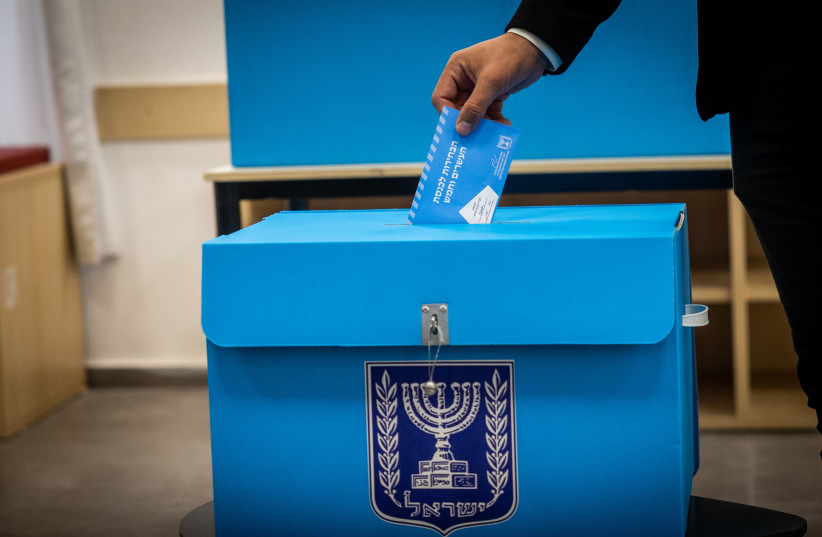
Of course, if there is a groundswell of opinion that the law should be changed, then those who feel strongly about this should work on changing the law. However, someone exercising his or her right under the law cannot be classified as immoral simply for doing so.
Secondly, Liebskind makes assumptions about these people which could simply be untrue. For example, when he wrote, “they didn’t fight in the war,” while it may be true that they did not fight in the current war, it is certainly possible and even probable that they or their children may have fought in previous wars; after all, we certainly have had our share of them. It may well have been a factor that led them to leave Israel, having already experienced the fear of the “knock on the door” once in their lives (or perhaps even the actual “knock”) and not wanting to have that experience ever again.
'Chosen not to be part of this society'
Similarly, when he wrote, “they’ve chosen not to be part of this society,” what does that really mean? I would venture to say that the overwhelming majority of these people still have family living here. No doubt most travel here with some frequency, perhaps send their children here every summer to spend time with grandparents and cousins, as well as share some of their financial success with philanthropic institutions that operate in Israel. Does that not qualify them yet as part of this society? I would submit that it does.
In addition, of course, one needs to be very careful when stratifying who can vote by whether or not they have chosen to be part of this society. There are those here in Israel who would argue that certain elements within Israel have made choices not to be part of this society as well.
Does Liebskind want to also apply that same standard to citizens living here? It seems to me that such a “litmus test” starts us on a slippery slope toward autocracy that would be better avoided if we want to preserve democracy.
Lastly, it would appear that Liebskind has lost sight of worldwide Jewish demographics. If we were to sit across a table from each other, I would ask him whether it is possible for a people whose global population is just 15.8 million people to be completely detached from the country where 50% of us live?
Have we not internalized the concept that “when one Jew is injured, all Jews feel the pain?” This is an ancient tenet of Jewish peoplehood and mutual responsibility, often traced back to teachings from the classical sages, such as Rabbi Shimon bar Yochai in the Mechilta, expressing that the Jewish community functions as an interconnected collective. This shared vulnerability reflects a profound, interconnected sense of peoplehood where violence against one member is felt as an injury to the whole. And the corollary is also true: we have a responsibility to care for each other wherever we are in the world.
We, who compose the 15.8 million Jews in the world, are one small community, older than any other yet considerably fewer in numbers than normal generational growth would have predicted.
Therefore, it is simply not honest to take the position that Israeli citizens living abroad who come here only to vote are immoral. On the contrary, their doing so is very much in the spirit of Jewish unity and serves as an incredible lesson of responsibility being taught to their children and grandchildren, that we all, no matter where we live, have a stake in each other’s lives and a moral obligation to demonstrate that commitment whenever the opportunity presents itself.
To those who will travel here to vote on election day, I would say thank you for continuing to care about us and for remembering, “Kol Yisrael arevim zeh bazeh,” the Hebrew phrase that signifies a profound, mutual responsibility where every Jewish person acts as a guarantor for one another. We are grateful for your support and encouragement wherever you may reside.
The writer, a 42-year resident of Jerusalem, is a former national president of the Association of Americans and Canadians in Israel, a past chairperson of the board of the Pardes Institute of Jewish Studies, and a Board Member of the Israel-America Chamber of Commerce (AMCHAM).