
“What will you take home with you from your visit to Israel?”
I put that question to a group of American college students who had come to Israel for a week of volunteering and Jewish learning with Birthright Israel and Manhattan’s MJE. We were standing on the rooftop of the Aish HaTorah building, overlooking the Western Wall, after a beautiful Kabbalat Shabbat service.
Here is what they said. I think Israelis need to hear their answers too.
The first student said she had not felt well all week. “But when I went to a pharmacy, I could tell that people really cared. They tried to help me and make me feel better. Our Israeli guides kept checking in on me too. That doesn’t happen in New York. I truly felt at home.”
The second student described her experience in two words: “beauty” and “healing.” She had grown up in Oregon with little connection to Judaism, and being in Israel had simply been good for her.
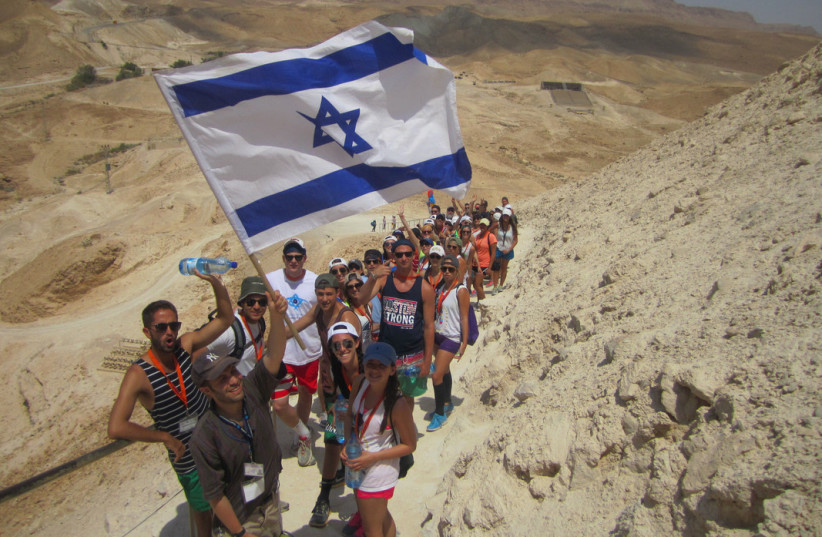
Then another student said he felt “a sense of magic and wonder.” Those were the words he chose to sum up an intense week of working in the fields, packing food for families in need, visiting a yeshiva, the site of the Nova festival, Tzfat, Masada and the Dead Sea, and finally spending Shabbat in Jerusalem.
Magic and wonder.
The fourth student was even more poetic: “I feel whole. After spending a week with other Jews in the Land of Israel, I feel more complete as a person. But I also feel that when I am here, the Land of Israel is somehow more complete too.”
These were not poets or prophets. They were American college students who had spent just one week here. I told them that this week’s Torah portion speaks to this very idea. Moshe urges those who will have the privilege of entering the Land of Israel to understand that this is no ordinary place. It is precious and sacred, and we must live here accordingly.
Thank you to the group, led by Rabbi Mark Wildes, for this important lesson.
Blessing the New Month of Elul
There is something special in the optimism of a new month. We renew ourselves, just like the moon, since we have the chance to start all over again. This coming Shabbat morning in synagogues throughout the world, we will recite the blessing in honor of the new month of Elul, which will arrive next Thursday and Friday.
The month of Elul is especially significant since it is the last month of the old year (5786) as we prepare for the new one (5787). Elul presents us with the opportunity to ask: What is it that we wish to improve, to change, to upgrade? In which areas of life, during this blessed time, has our potential yet to be fulfilled? Here is a translation from the new month's blessing:
"May the Holy One, blessed by He, renew it [the new month] for us and for the entire nation of Israel, wherever they may be, for goodness and for blessing, for gladness and for joy, for deliverance and for consolation, for livelihood and for prosperity, for good news, for complete healing, for imminent redemption, and let us say: Amen."
Parashat Re’eh: Seven Words That Change Everything
The opening verse of this week’s Torah portion presents us with a revolutionary idea. Let us pause over the seven words God addresses to us and explore them together:
“See, I set before you today a blessing and a curse.”
SEE — In Hebrew, God addresses each of us personally, using the singular form: Re’eh—“See.” Stop for a moment. Pay attention. Take a close look at the profound principle we are about to learn.
I SET — God is giving each and every one of us something personally. We wait to hear what that gift will be.
BEFORE YOU — The verse now shifts from the singular, re’eh—“see”—to the plural, lifneichem—“before all of you.” Every small action you take affects the wider community. Every mitzvah—and, God forbid, every action to the contrary—has an impact on us all.
TODAY — Not thousands of years ago in the desert, but now—today, at this very moment. At every moment, you choose how to act. This is not ancient history. It is current. It is happening right now.
A BLESSING AND A CURSE — And here we reach the heart of the verse. God has given us an extraordinary power: the ability to choose how we act in this world. The all-powerful God grants us, human beings, free will—the choice between blessing and curse, between good and evil. The choice is ours.
And what happens when, God forbid, you stumble and make the wrong choice? Go back just one word and remember: today. Today—and every day—you can begin again.
Now read the verse again.
May we choose well.
Want to read more by Sivan Rahav Meir? Google The Daily Thought or visit sivanrahavmeir.com