
The Palestinian Authority has increased lobbying to have the historic archaeological site of Sebastia recognized as a UNESCO World Heritage Site ahead of a debate in South Korea later this month, a move that the Foreign Ministry claimed on Wednesday is politically motivated and poses a threat to the ancient ruins.
The site, which has awaited joining the World Heritage list since 2012, has a history dating back at least 3,000 years.
Once ancient Samaria, the capital of the biblical Kingdom of Israel, it holds great importance in Jewish history. Herod the Great, the former king of Judea, renamed the territory Sebastia and rebuilt it with structures that survived through Roman, Arab, and Crusader rule over the land.
The archaeological site located in Area C, northwest of Nablus, lies next to a residential village in Area B whose economy relies heavily on tourism from the site and its surrounding olive groves. In November, Israel’s letter to Mahmoud Azem, the mayor of Sebastia, announcing plans to seize control of the site, sparked significant concern among Palestinians.
Defending the plans, the Foreign Ministry noted that the threat to the historic site stemmed from the “Palestinian Authority’s own record of neglect and complicity, which has allowed the ancient ruins to suffer rampant vandalism, theft, and desecration.”
Beirut’s Institute for Palestine Studies’s Interactive Encyclopedia of the Palestine Question (PalQuest) has acknowledged “the Palestinian Authority has not prioritized the protection or the restoration of heritage; it has proposed no heritage legislation and has dedicated few, if any, resources to heritage preservation,” though it has also blamed Israel for the poor upkeep of archaeological sites across the West Bank and Gaza.
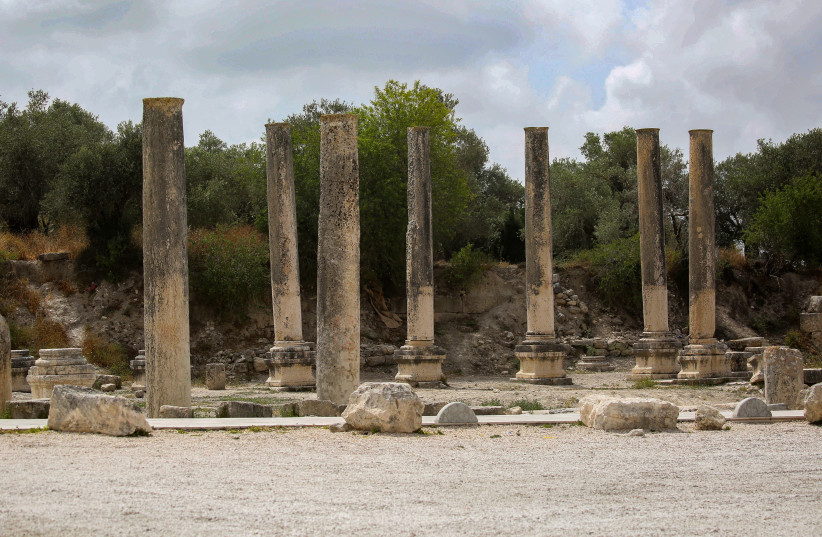
Palestinian Authority paves road through archaeological site
The PA notably paved a new road through the site in 2023, drawing condemnation from the Israeli government. During the works on the road, a wall from the Herodian era was destroyed and burial caves from the Second Temple period were broken into and looted, according to the organization Shomrim Al Hanetzach (Protecting Eternity).
In a statement to The Jerusalem Post, Heritage Minister Amichai Eliyahu said, “The land of the Jewish people belongs to the Jewish people. No international organization, certainly not one that acts time and again out of anti-Israel bias, will determine the identity of our heritage sites or rewrite the history of the Jewish people.
“Therefore, we are acting to secure the future of our national heritage sites. As part of this effort, we have advanced the expropriation of lands in the area of the Sebastia site to ensure its protection against any attempt to erase its identity or distort its historical narrative.
“Anyone who thinks they can erase thousands of years of history through political decisions is mistaken. We will continue to safeguard our land, our heritage, and the historical truth unapologetically and without fear. Get used to it,” Eliyahu said.
“The Palestinian delegation continues to exploit UNESCO to advance a hostile, one-sided campaign, specifically through its initiative concerning Sebastia, ancient Samaria. Sebastia is the historic, biblical capital of the ancient Kingdom of Israel,” the Foreign Ministry said in a statement.
“The attempt to portray the site as facing an emergency is entirely unsupported by professional evaluation, and serves only as a political tool to erase the site’s profound, well-documented Jewish and Christian history… This cynical weaponization of cultural heritage undermines the very credibility of the World Heritage Convention.”
Israel campaigning to expand control over West Bank, critics claim
More than a claim over a single historical site, critics have argued that the move to seize control of Sebastia is part of a broader campaign to expand Israeli territorial control over the West Bank.
In November last year, the Civil Administration began taking control of land, expropriating 1,800 dunams (1,80 hectares) in the West Bank for the “preservation and development” of the archaeological site.
In February, Israel reopened a land registry in Area C for the first time since 1967, a move the Palestinian Authority condemned as part of a “judaizing Palestinian land” project.
The heritage ministry has spent or intends to spend upward of NIS 30 million on the site, according to a November statement by the Civil Administration.
“Sebastia is one of the most important sites in our national and historical heritage … Our desire is to breathe new life into the site and make it an attraction for hundreds of thousands of visitors a year, which will strengthen the connection between the people, their heritage, and their country,” Eliyahu said in a statement last year.
More recently, the site has become the scene of clashes between Palestinian and Israeli residents of the West Bank, according to the PA-run media site WAFA, which accused Israeli settlers of “storming” Sebastia on Monday “under heavy protection from Israeli forces.”
The clash reportedly happened during a “solidarity gathering” connected to the UNESCO bid.