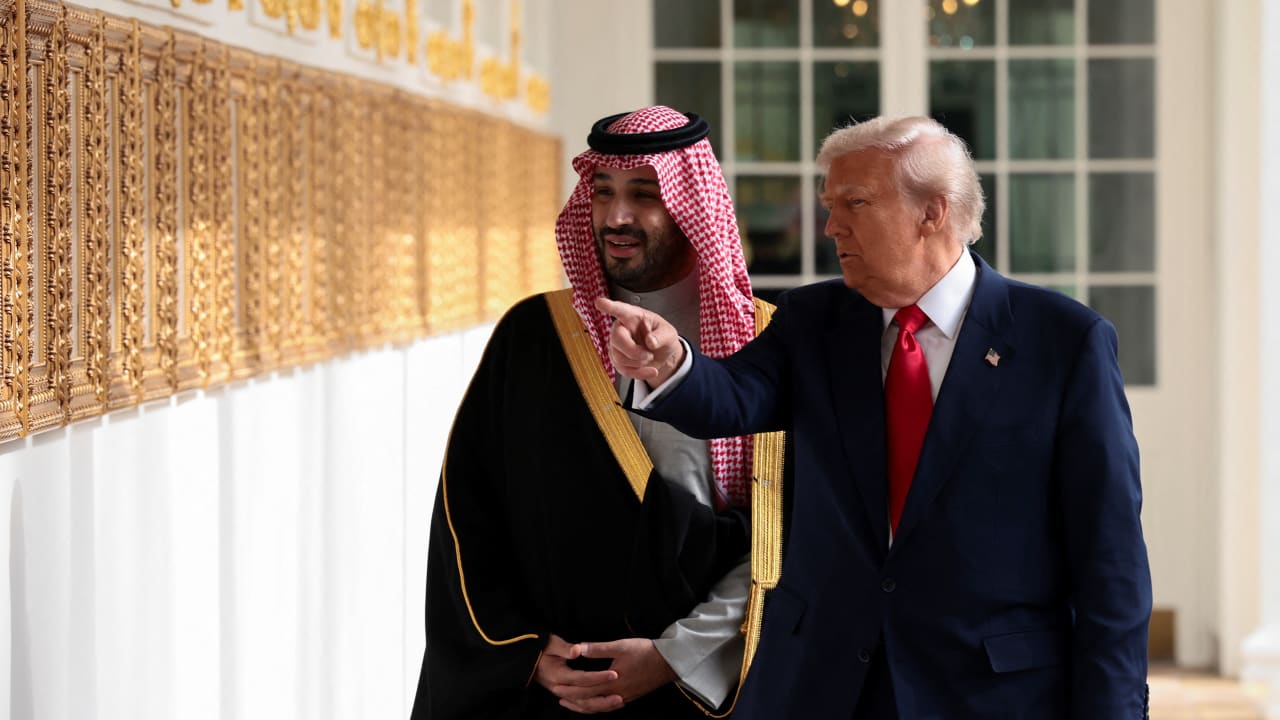
Saudi Crown Prince Mohammed bin Salman privately told evangelical leader and Trump ally Mike Evans that he was ready to recognize Israel “today,” but that his father, King Salman, remained the obstacle, Evans told The Jerusalem Post on Monday during a visit to Israel.
“When I talked to the crown prince, he told me that he would acknowledge Israel today,” Evans said. “But he said his problem was his father.”
Evans, the founder of Friends of Zion and a longtime evangelical supporter of Israel, said he met with the Saudi crown prince for two hours, with MBS’s brother and the Saudi foreign minister also present. According to Evans, the crown prince’s brother expressed a similar view.
The account could not be independently verified by the Post.
The comments came as US President Donald Trump moved to link a possible Iran deal to a broader push for Arab and Muslim countries to join the Abraham Accords.

Trump said Monday that countries including Qatar, Pakistan, Egypt, Jordan, and Turkey should join the accords as part of an effort to reach a deal with Iran, Reuters reported. Trump also said he had spoken Saturday with leaders from those countries, as well as Saudi Arabia and Bahrain.
Claim that MBS rejected the idea of dividing Jerusalem into two capitals
Axios reported Sunday that Trump asked leaders from several Arab and Muslim-majority countries, including Saudi Arabia, the United Arab Emirates, Qatar, Pakistan, Turkey, Egypt, Jordan, and Bahrain, to normalize relations with Israel after a possible agreement to end the Iran war.
Evans said he believed Trump’s demand was serious.
“I think it’s genuine,” Evans said. “Donald Trump has got enormous negotiating leverage with Saudi Arabia right now. Enormous leverage. And I don’t think there’s any question of the doubt that the president plans on delivering these countries because he’s trying to move towards a genuine peace.”
Evans said the Saudi crown prince had also been sharply critical of the Palestinians during their private conversation.
“The crown prince said, speaking to the Palestinians, they wasted our money,” Evans said. “He said they shouldn’t be attacking Israel. They should be copying Israel.”
Evans also claimed that MBS rejected the idea of dividing Jerusalem into two capitals.
“When he spoke about Jerusalem, he said if there was ever two capitals in Jerusalem, it’d be a terror capital,” Evans said. “He appeared to be more pro-Israel than a large percentage of the Jewish population.”
The Abraham Accords were signed during Trump’s first term, normalizing relations between Israel and the United Arab Emirates and Bahrain in 2020, followed by Morocco and Sudan. Saudi Arabia has long been viewed as the central prize of any broader normalization effort, though Riyadh has publicly tied recognition of Israel to progress on the Palestinian issue.
Evans said he was unconvinced that Palestinian statehood was the real obstacle to Saudi recognition.
“I’m not so sure that was holding it up,” he said. “I think honestly things have changed. I think there’s no problem with him. I think he’ll do it. I think Donald Trump means it.”
Trump’s latest proposal also included countries seen as more complicated prospects for normalization with Israel, including Qatar, Turkey, and Pakistan. Qatar has hosted Hamas leaders and played a central mediation role in hostage negotiations, Turkey’s government has sharply criticized Israel during the Gaza war, and Pakistan has never recognized Israel.
Evans argued that Trump’s personal relationships and diplomatic leverage could still produce results.
“Donald Trump has got enormous negotiating leverage,” he said. “He’s built a lot of friendships, and he can deliver on them.”
Evans framed the possible expansion of the Abraham Accords as part of a larger regional battle against Islamist movements, especially the Muslim Brotherhood.
“Most of the ammunition that has created the problems for the State of Israel and for the Jews worldwide is the Muslim Brotherhood,” he said. “By creating this alliance with these Sunni countries, Abraham Accords, you are checkmating the Muslim Brotherhood.”
Evans also defended Trump’s handling of Iran amid Israeli concern over reports of a possible agreement.
“No president in history has done more for the State of Israel than this president,” Evans said. “You’ve got to look at the positive rather than the negative.”
He warned that Iran would make a major mistake if it tried to mislead Trump.
“I don’t believe Iran is going to keep their promises,” Evans said. “If they try to play him for the fool, he’ll come back and hit them. They would make a terrible mistake to underestimate this president.”
Tucker Carlson and MAGA’s Israel debate
Evans also addressed the internal Republican debate over Israel, including the influence of Tucker Carlson and other voices critical of US support for Israel.
He said Friends of Zion had mobilized 1,000 pastors who traveled to Israel and then used social media to counter what he described as anti-Israel narratives inside parts of the conservative movement.
“When you and I talked last time, Tucker Carlson was in the White House,” Evans said, referring to Carlson’s proximity to Trump-world figures. “And very close to the vice president.”
Evans said Friends of Zion then launched a social media campaign against Carlson.
“We mobilized our 1,000 pastors who came to Israel,” he said. “We started going after a social network campaign. We got 138 million views and started attacking, exposing Tucker Carlson.”
“Tucker Carlson right now has been thrown under the bus by Donald Trump,” Evans added. “He’s out.”
Evans said the broader phenomenon should still concern pro-Israel conservatives, especially because Carlson maintains a large following among younger right-wing audiences.
He also claimed, without providing evidence in the interview, that Gulf money had helped fuel anti-Israel narratives online.
“There’s a huge amount of Gulf oil money, documents of AI that are being used to fuel and feed all of this,” Evans said.