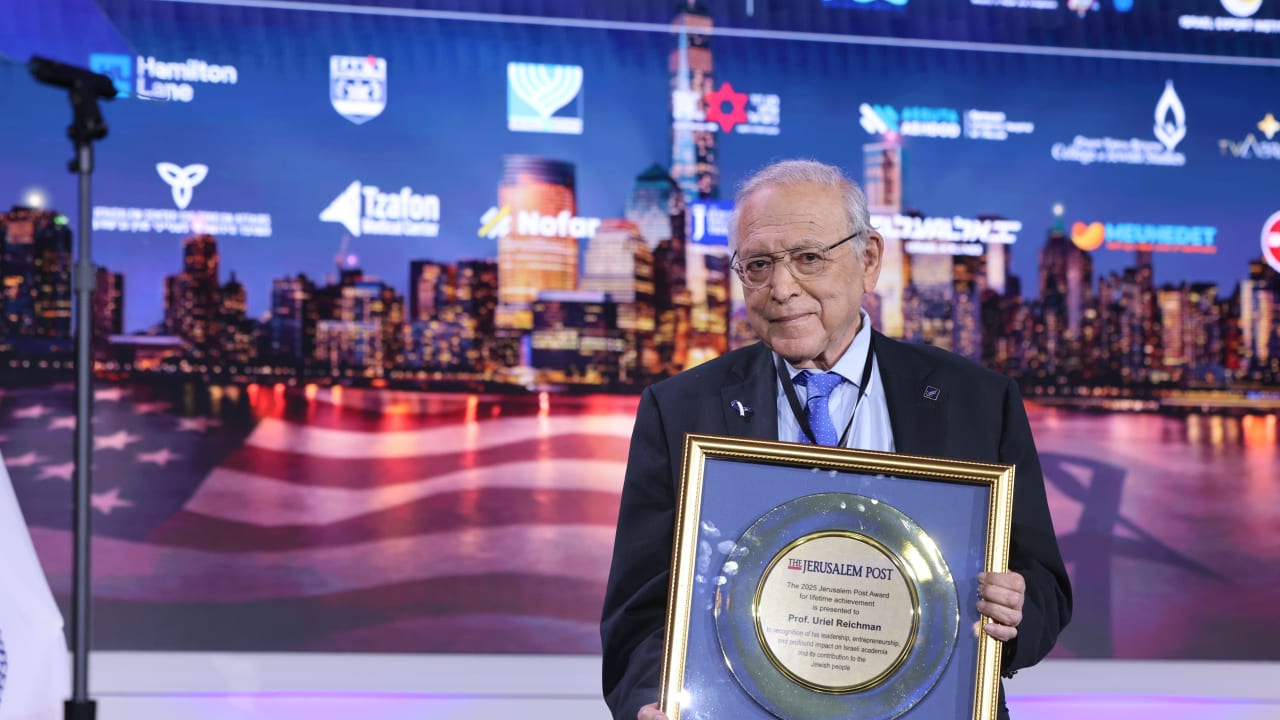
It's hard to capture a life as rich as that of Professor Uriel Reichman with just one event, but last month's Jerusalem Post New York Conference did precisely that.
As the founding president of Reichman University and recipient of a special Lifetime Achievement Award, Prof. Uriel Reichman is already looking beyond accolades. True to form, his focus remains firmly on the future - and on the commitment of the university he built to the future of the Jewish people.
"I see this period as an enormous challenge," he says, his voice clear and determined. "And we want to live up to it."

As the founder of Israel's first private university, Prof. Reichman is no stranger to either vision or adversity. From his service in the Six Day and Yom Kippur wars, to his campaign for a written constitution for Israel in the early 80s, to transforming a once-dismissed dream of a bilingual, Zionist institution into one of Israel's premier universities, Reichman has always chosen the harder path, so long as it was the right one.
Today, amid a sharp rise in academic boycotts targeting Israeli institutions, Reichman University is responding not with retreat, but with resolve.
"We're not just defending ourselves - we're building," says Reichman. The university is strengthening ties between Israel and the Jewish world, expanding international education, and doubling down on academic excellence and research leadership.
At the heart of this vision is a mission that transcends institutional goals: to establish a world-class academic home in Israel for top-tier Jewish faculty and students from around the globe.

Through its Raphael Recanati International School - Israel's largest English-language academic hub, with thousands of students from nearly 90 countries - Reichman University is already realizing this goal. Now, says Reichman, the work must accelerate: more students, deeper global partnerships, and a renewed commitment to Israel as a center of intellectual and moral leadership for the Jewish world.
"As the world's only official Zionist university, we believe in turning challenges into opportunities," he concludes. "This is the time to build."
"The worst pogrom in modern Jewish history"
In his conversations with Jerusalem Post Editor Zvika Klein, Reichman is candid about the profound shift that occurred on October 7, when Hamas launched its attack on Israel. "It was a pogrom," he says, comparing the atrocities of that day to the darkest chapters of Jewish history. "It is perhaps the worst pogrom that the Jewish people have suffered in modem times."
His voice drops as he recalls the stories of rape, slaughter, and the children who died holding on to their parents. But the aftermath, he stresses, was no less shocking. "For the first time, our brothers and sisters... were crying, shouting for help, and no one came."
The feeling of abandonment extends beyond Israel. On American college campuses, Reichman sees how Jewish students have become more isolated and unsupported. "The universities," he states, "failed to genuinely protect Jewish students. It's shocking." He expresses disbelief as he considers the substantial Jewish contributions to American academia: "One-third of the Nobel Prize winners in the US are Jews... the financial backing from the Jewish community to universities is vast. Yet, this is the treatment of Jewish students."
A response grounded in education and identity
For Reichman, the response to this crisis isn't to shrink away. It's to build. Specifically, to strengthen Israel as a global academic option for Jewish students. "Anti-Semitism in academia," he says pointedly, "should be countered by academic Zionism."
He's been working toward that goal for decades. From the university's inception, Reichman insisted on a bilingual model, teaching in both Hebrew and English, to accommodate students from the Diaspora. "At that time the other universities insisted on teaching only in Hebrew," he recalls. "But, for someone who grew up in English, to excel intellectually in a foreign language is very difficult. So I said: whatever we teach in Hebrew, let's also teach it in English."
That choice was rather unpopular, seeing as when he initially suggested establishing a university in Herzliya to draw Jewish students globally, he was actually laughed at. "There was a lady," he recalls, smiling, "the wife of a very wealthy man, who laughed out loud. She said, 'Maybe you'll get someone from Europe or the States to come to... nothing?"' He pauses, then smiles. "But the way I'm built - I love challenges."
And challenge he did. Today, Reichman University's international school thrives. Alumni across the U.S. and beyond continue to speak of the life-changing experience they had studying in Israel. "They say we changed their lives, their attitude, their sense of Zionism."
New academic bridges
Now, Reichman wants to take that vision further, his next goal being to transform Reichman University into a world-class research institution that can rival the top American schools, particularly in fields like artificial intelligence, synthetic biology, and climate economics.
"We're not claiming to compete with Harvard and Stanford in everything," he admits. "But in certain areas, if you pinpoint correctly, you can do it." He sees opportunity in adversity. "Over the years, America was where many brilliant Israelis emigrated. Now, maybe top scholars - Jewish scholars - will look at what's happening, and choose to come here."
It's not just about attracting talent. It's about offering an alternative. "There needs to be a place in Israel," he says, "where you can get the best education, meet brilliant Jewish kids from all over the world, and feel like you belong. A place that is not just a refuge, but a destination."
This vision is not about isolation. On the contrary, Reichman is adamant that his university must maintain ties with institutions abroad. "We need to create academic collaboration," he says. "Dual degrees, joint research, partnerships with the universities that didn't succumb to antisemitism. This flow should build the bridge that has been neglected too long."
The Zionist mission takes academic form
To understand Prof. Reichman's drive is to understand his roots. Born before the establishment of the State of Israel - his birth certificate still reads "Palestine" - he carries the weight of history with him. "We were educated to look at ourselves as those who continue the contribution of the Shoah survivors and the fighters of the Independence War," he says. "And that meant one thing: responsibility. That the Jewish nation will survive."
That same sense of purpose underpins Reichman University. "From the beginning, I said this is a Zionist university," he says. "Some thought academia should be neutral, purely global. But I said no, this is a university with a mission. To educate future leaders. To teach them to trust themselves, to write their own life story, and to stand up for our basic Zionist ideals."
Today, Reichman is still guided by those ideals. "I wouldn't have gone through the nightmare of building this place otherwise," he says, "when no one believed, and no one opened the doors."
His pride is evident, especially when he talks about the students. One image stands out in his mind: a photograph from the most recent orientation week. "There was a big party to kick off the school year. A student in a wheelchair, who had injured his legs during an IDF combat operation, was there. The other students lifted him up, and he raised his hand in victory. "That," Reichman says, his voice thick with emotion, "is the victory of the spirit. That is the spirit of this place." And that, perhaps, is the most apparent reason Professor Reichman is being honored - not just for what he's built, but for what he believes is possible.