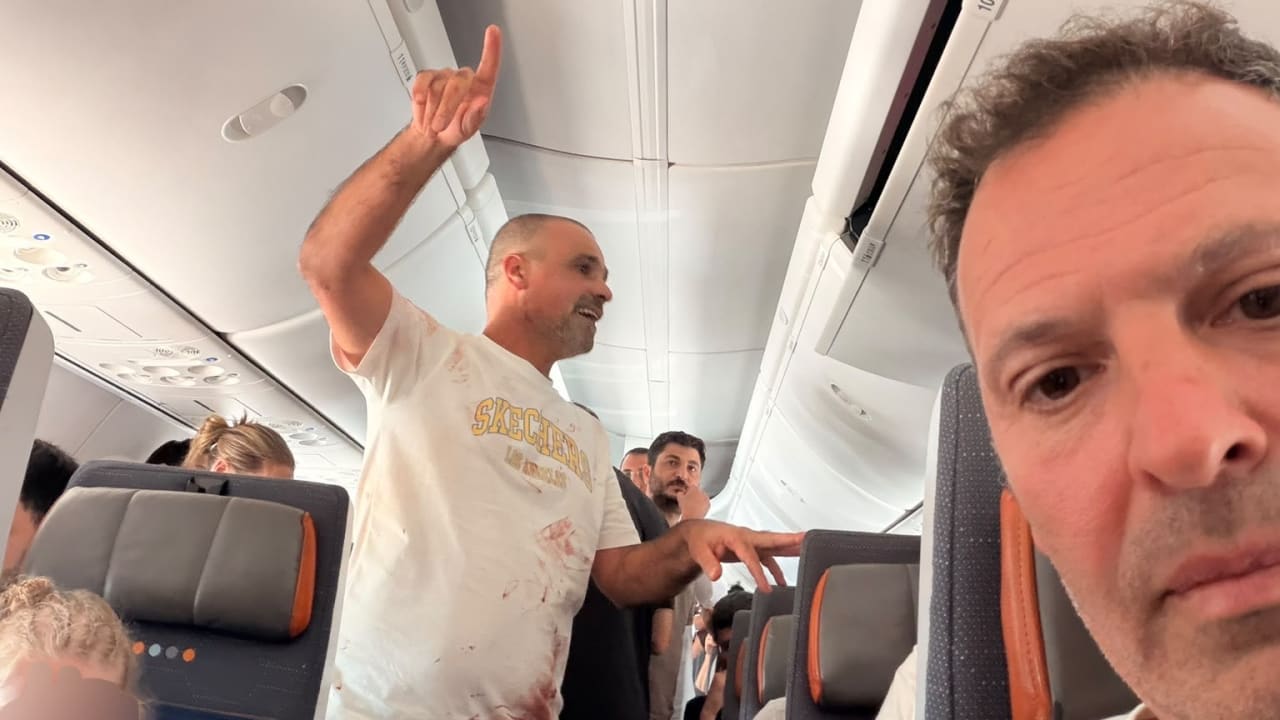
Passengers on flydubai flight 1073 thought they were being flown to Iran even after the co-pilot had been subdued, The Jerusalem Post has learned.
The Omani co-pilot, Hamam al-Hammami, had attacked the pilot, Capt. Smit Machchhar, with the cockpit axe and was attempting to crash the plane with 182 people on board. The attack was miraculously thwarted by the pilot and a group of Israelis who overpowered Hammami and stabilized the plane shortly before it would have crashed into the Arabian Desert.
It was “10 minutes of horror,” Uri Pintov told the Post.
But even with the pilot tied up, the passengers were not fully relaxed until they landed and were taken into the terminal at Tabuk Airport in Saudi Arabia – a six-hour drive from Jerusalem if the borders were open.
Pintov, who was on the flight with his wife, Michelle, and three children, following a family vacation in Thailand, said the passengers “did not trust” the crew, including the rescue pilots who had locked themselves in the cockpit.
“What was the copilot’s plan? Was he planning to crash us into Ben-Gurion [Airport]? Did he want to hijack the plane and bring us to Yemen or Iran? I felt like I was held hostage for an hour and a half,” he said.

“It was an hour and a half where we didn’t know where we were going, where they were taking us,” he added. “We didn’t trust anyone, so we separated the crew and put them in different places on the plane.”
The rescue crew did not speak to the passengers until 10 minutes before landing, Pintov said.
“It was so fast, and once they got into the cockpit, they locked the door, and no one could go in,” he said. “It could have been that they had their hands full, but they said nothing to us.
“As we were landing, I forced the crew member sitting next to me to tell me where we were, and then I understood it was Saudi Arabia. But we still didn’t know what their intentions were… if we were going to be hostages or not once we landed. We were ready for whatever was coming.”
The Pintov family sat in row 9, not far from business class and the cockpit. While they couldn’t see what was happening in the cockpit during the attack, Michelle told the Post, “We saw all the blood, and then we heard Yaniv saying that ‘we are in a critical situation, and we couldn’t rely on anyone on the flight.’”
Her family chose flydubai because the price was lower than El Al’s, she said, adding that she had no concerns regarding the airline. Even when she realized that the entire crew was male, she didn’t pay much attention to it.
“Everything was normal, until it wasn’t,” Michelle said. “I remember Tali coming out and screaming something. In my head, I was imagining that someone had a heart attack. But then I understood that something more dramatic was happening, and then we started falling.”

Still visibly shaken by the traumatic experience, Michelle recounted how she remembered the passengers screaming and the looks on her children’s faces as the plane plunged toward the ground at almost the speed of sound.
“I remember more screaming, and I was seeing my own death – our deaths,” she said. “It wasn’t even a question. I remember looking at my son Daniel, who is only 10 years old, and he was in shock with his eyes closed. My daughter Emma was sitting near the window and looked at me, terrified.
“Mia was sitting next to the window, and I saw her sending a voice note to her boyfriend, saying goodbye. I took my phone, too, and left a message for my mother that I loved her.
“I felt that I couldn’t say bye to my kids. I couldn’t say it out loud to the kids,” Michelle said, still visibly shaken.
For the Pintovs, the pilot wasn’t only a hero; he was a miracle.
“I went to help the pilot,” Uri said. “He was saying that he couldn’t breathe. He lost tons of blood from the attack. So, he is a miracle. He saved us.”
The plane, too, was miraculous. With its rapid descent, it could have easily come apart, but it did not.
“Boeing did something right,” Uri said with a small smile.
Saudis at airport welcomed and cared for Israeli passengers
Once they landed in Saudi Arabia, they were segmented into groups of 10 before being brought into the lounge. The Pintovs said the Saudis were very welcoming and caring for the Israeli passengers, offering them food and medical care.
Then came the questions of how they were going to get back to Israel.
“People were terrified of boarding the rescue plane,” Uri Pintov said, adding that they understood Israeli pilots were not going to be able to land in Saudi Arabia.
“It was surreal that we had to go on another flydubai plane,” he said. “How did they think we were going to board the flight?
“I am still shocked that no one in Israel was able to check the crew of the rescue flight and let us know it was safe to board that plane. Doing checks on pilots flying into Israel isn’t something new, but the Transportation Ministry did not do their job. This is a lawsuit.”
Although the attempted attack occurred close to the third anniversary of the October 7 massacre, Michelle said she did not see the connection.
For Uri, the hatred for Israel that has spread around the world is one of the reasons behind the copilot’s attempt to kill everyone on board.
“There is so much hate toward Israel around the world,” he said. “Since October 7, instead of making people understand the situation, it’s only gotten worse, and people like this terrorist are a result of the hate.”
Despite the attack, the Pintovs plan to fly again, perhaps during the Hanukkah vacation in December. But they said one thing is certain: They don’t plan on flying flydubai again.