Foreign Minister Gideon Sa'ar announced that the United Kingdom's consulate in east Jerusalem would be shut down, while British representatives at the Kiryat Gat Civil-Military Coordination Center (CMCC) would be expelled, following the UK sanctions against West Bank settlements announced on Wednesday.
Other sanctions include the termination of training by UK forces to Palestinian Authority security forces in Ramallah and banning the entrance of 12 British elected representatives and other British nationals involved in antisemitic and anti-Israel activity, as well as those who deny the very existence of the State of Israel.
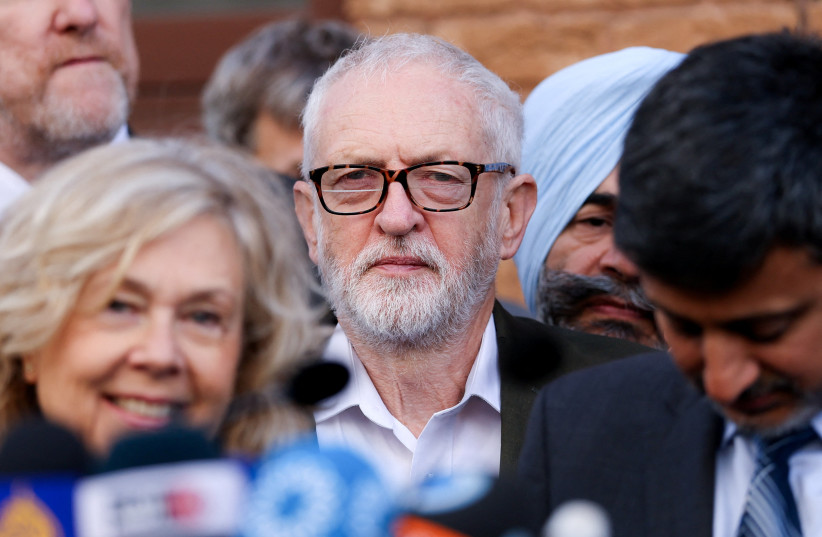
The 12 British officials banned from entering Israel are British MPs Jeremy Corbyn, Zarah Sultana, Naz Shah, Diane Abbott, Hannah Spencer, Carla Denyer, Sian Berry, Ellie Chowns, John McDonnell, Richard Burgon and Adrian Ramsay, as well a Riverway to the Sea director Fahad Ansari.
Sa'ar called the sanctions a "blatant" election interference, adding that the British declarations, and the declarations from other nations announcing sanctions that followed, "only pushed the possibility to find a solution [to the conflict] further away, rather than bringing it closer."
He also said, "Israel has nothing against the British people. We know that we have many friends in Britain. Unfortunately, a hostile Labour Government is in office, systematically acting against the State of Israel, and it has left us with no choice but to finally respond to its hostile actions."
Herzog, Lapid call out Britain for implementing sanctions
Earlier on Wednesday, President Isaac Herzog called the sanctions a "grave miscalculation, a gross interference in the democratic elections of a sovereign nation, and a decision that will fall on the wrong side of history."
"Sanctions are not a solution – dialogue is. I say to all foreign governments: Stop! Step away from the dead-end of sanctions and boycotts, and turn toward constructive dialogue and toward cooperation," Herzog said.
Former prime minister Yair Lapid (B'Yachad) also called out the sanctions against West Bank settlements, saying that "the British government's decision to impose boycotts and sanctions on Israel is a serious mistake. It is a wrong and dangerous policy, at the wrong time and for the wrong reasons."
"The decision made today will strengthen the extremist voices in Israel just before the Knesset elections and is a shot of encouragement to Hamas and the terrorist organizations," he warned.
Ben-Gvir demands Closure of Jerusalem's consulate, recognition of Argentina's sovereignty over the Falklands
National Security Minister Itamar Ben-Gvir celebrated the decision to close the consulate, saying that he "congratulated the Prime Minister and the Foreign Minister who accepted my demand and closed the British Consulate in Jerusalem."
He had published a social media post on X/Twitter asking Netanyahu to close it, which "operates openly on behalf of the Palestinian Authority."
Ben-Gvir also demanded that Israel formally recognize Argentina's sovereignty over the Falkland Islands, saying that "it's time for the State of Israel to publicly recognize that the Malvinas Islands are Argentine territory under occupation, which the British violently steal from the Argentine people."
"The British are not content with merely occupying the territory; they also carry out oil drilling there and steal the money from the Argentine people. I call upon Prime Minister Benjamin Netanyahu to recognize Argentina's sovereignty over the Malvinas Islands and to impose sanctions on Great Britain as long as the occupation continues," he added.
Jerusalem Deputy Mayor Arieh King similarly called for Israel to enforce the closure of Britain's diplomatic presence at 80 Nablus Road and 15 Rajeib Nashashibi Street, Jerusalem.
Finance Minister Bezalel Smotrich called for the expulsion of the British ambassador.
West Bank council heads slam British sanctions on settlements
Israel Ganz, head of the Mateh Binyamin Regional Council, said, "It is time for Britain to wake up: the British Mandate ended almost 80 years ago. The days when London determined where Jews could live in the Land of Israel are over and will not return."
He also pointed out that the "instead of addressing the difficult problems at home, the British government is mobilizing a coalition of pro-Palestinian countries to wage an economic war on Jews in Binyamin, Judea and Samaria. This is a moral disgrace."
"Our message to Britain and everyone who joins the boycott is clear: you will not succeed in getting the Jews out of Judea and Samaria," he concluded.
Efrat mayor Col. (res.) Dovi Shefler also issued a statement saying that "the British Mandate ended in May 1948, but it seems that someone in London has not yet internalized this. Even then, the British heaped hardships on the Jewish settlement while Arab terror raged, and even today they choose to punish Israel and the Jewish settlement, instead of directing the pressure on those who attack it and seek its destruction."
"In response to the British move, I call on the Israeli government to urgently pass a resolution that will correct the historical injustice of the Oslo Accords, and return the Jewish heritage site of Solomon's Pools to Israeli control, as it should have been in the first place," he added.
Peace Now, J Street celebrate sanctions
The Peace Now movement was among the few Israeli actors who celebrated the British announcement, saying that "settlements are a danger to the future of the State of Israel, and it is good that Britain and other countries are making the necessary distinction between sovereign Israel and the settlement enterprise and outposts beyond the Green Line."
"Sanctions against the settlements are not sanctions against Israel, quite the opposite. The distinction between them is an Israeli security, political and economic interest," the movement claimed. "Instead of competing with the settler right with automatic condemnations, the opposition should present an alternative: stop annexation, isolate the settlements instead of Israel, and return the country to a path of security, political order and a better future."
The American-Jewish organization J Street also celebrated the move, with its president Jeremy Ben Ami demanding that the US follow in the footsteps of its allies.
"The UK and other of Israel’s closest allies are making clear that the status quo is no longer acceptable: Israel must choose between permanent occupation and growing international isolation, or a future in which a viable, independent Palestinian state lives alongside a secure Israel fully accepted by the world," Ben Ami said.
"The United States should stand with its allies and take similar action, including ending trade with the settlements until Israel changes course,” he added.
Mathilda Heller contributed to this report.