
Some 2.6 million students were expected to begin the 2026-2027 school year in Israel’s schools and kindergartens on Tuesday, including some 180,000 first-graders, as the Education Ministry launched new programs and expanded initiatives introduced in recent years.
The ministry is placing particular emphasis on strengthening students’ sense of belonging and resilience, deepening studies of identity and heritage, introducing financial education into the school system, and expanding the use of artificial intelligence in both learning and examinations.
As students return to classrooms, the ministry said it will focus the school year on three areas: belonging and security, identity and roots, and knowledge and tools for coping with a changing world.
“We are opening the year with great responsibility and with a clear direction: to strengthen the sense of belonging and resilience of Israel’s students and deepen identity, values, and heritage while at the same time giving them the knowledge and tools that will enable them to lead and succeed in a rapidly changing world,” Education Minister Yoav Kisch said.
First week to focus on belonging, resilience, preventing ostracism
During the first week of school, the Education Ministry plans to focus on strengthening social ties and trust among students and between students and teaching staff.
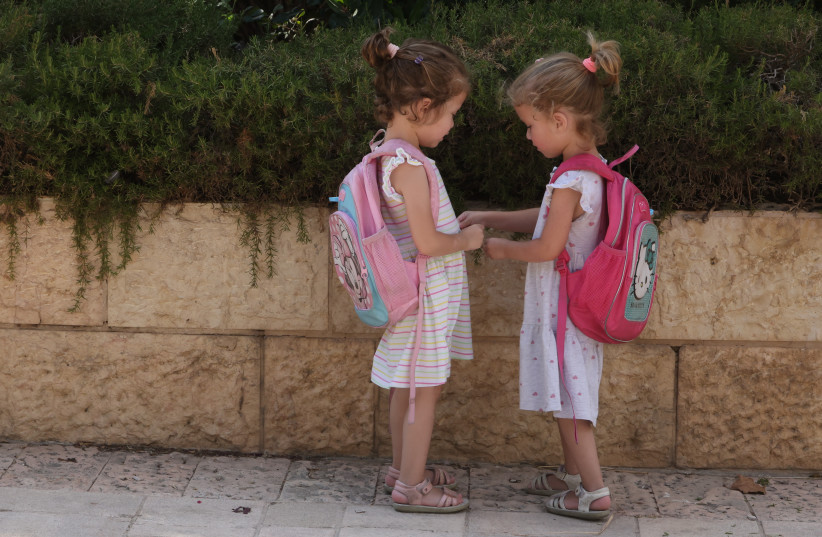
Alongside reacquainting students with their schools and classrooms, staff will be asked to conduct emotional and social discussions, identify students’ needs, and strengthen both individual and group resilience.
Special emphasis will be placed on preventing violence, social rejection, and ostracism, both in physical spaces and online. The ministry said the initiative is based on the view that academic achievement cannot be separated from a student’s social and emotional condition and that a sense of security and belonging is a prerequisite for learning and perseverance.
The school system’s theme this year is Roots of AMI [‘my people’]: Future, Heritage, and Entrepreneurship. It will run from kindergarten through 12th grade. Through the program, the ministry aims to connect identity and heritage with initiative, leadership, personal responsibility, and social involvement.
The Heritage Paths field of study will also be expanded this year to Druze elementary schools and seventh-grade classes in the state and state-religious education systems.
Preparing students for adulthood and the workforce with financial education
Prominent among the innovations this year is the first-ever introduction of financial education as a school subject.
In its initial phase, it will be taught in ninth grade and expanded to 10th grade beginning in the 2027-2028 school year.
According to the ministry, the program is intended to provide students with the knowledge and tools for independent financial management and critical thinking about financial issues, as well as prepare them for adulthood and the workforce. In addition to financial knowledge, the program is also expected to address personal, social, and civic responsibility.
“This year we will continue to connect roots with the future: We will expand STEM and artificial intelligence studies, introduce financial education for the first time, and continue to promote innovative and personalized learning,” Kisch said.
AI will play an even larger role in classrooms this year. As part of the expansion of the “Realistic Israel” reform, intended to strengthen science, technology, engineering, and mathematics education, Program 720 will expand to adapt teaching and assessment methods to the AI era. (The name, Program 720, represents 360 degrees around the student and 360 degrees around the teachers, enveloping both.)
This year, the program will run in English studies in all middle schools and expand to about 140 schools in STEM fields.
Over 12,000 English, science, and technology teachers are expected to undergo training in AI. Students will also receive dedicated training.
Eighth- and ninth-grade students will take part in a 20-hour program using personalized AI-based learning systems.
They are expected to learn how to use artificial intelligence thoughtfully and creatively, develop critical thinking, identify false information, and become familiar with the ethical issues involved in the use of the technology.
The change will not be limited to classroom instruction. AI tools will be incorporated into matriculation assignments in more than 10 STEM study tracks this year.
According to the Education Ministry, the move is intended to adapt assessment methods to the growing use of AI in academia and the research world.
Twenty-seven schools across the country, from Dimona to Majdal Shams, will open a dedicated AI sciences track. Graduates of the program will be eligible for a technological certification.
“Behind the opening of the school year is an entire system that has worked in recent months to bring the schools and kindergartens to this moment. “Our mission continues every day in supporting the teams and ensuring that policy and resources reach the classroom and every student,” Education Ministry Director-General Meir Shimoni said on Tuesday.
The Education Ministry aims to return Israel to the top 10 in the Trends in International Mathematics and Science Study examinations by 2029. Israeli students are expected to sit the exams this year for the first time since the reform began.
“We are opening the school year with an approach that connects roots with the future: a foundation of values and a sense of belonging alongside innovative learning, knowledge, and skills for a changing world. The goal is to give every student the tools to develop, create, and lead,” Ina Zaltzman, senior deputy director-general and head of the ministry’s Pedagogical Administration, said.
What about the Gaza border communities?
The school year opened in the Tekuma region with 22,233 students across the area’s five local authorities: the city of Sderot and the Eshkol, Hof Ashkelon, Sdot Negev, and Sha’ar HaNegev regional councils.
The figure represents an increase of approximately 9% compared with the period before October 7, 2023, amounting to an additional 1,802 students.
The growth in the education system comes as communities in the region continue to return to their homes.
Over the summer months, residents began returning to Kibbutz Kissufim. More than 95% of residents have returned so far. The communities of Holit and Kfar Aza have also returned, as have teenage students from Kibbutz Be’eri, who resumed their studies in the Eshkol Regional Council area.
The continued return to these communities, together with the rise in the number of students in the region’s local authorities compared with the previous school year, is another indication of the process taking place in the Tekuma region, from rehabilitation to renewed stability and growth.
The Tekuma Administration is continuing its efforts to strengthen the education system as a central pillar of community resilience and regional growth.
This year, it will be advancing eight major education projects with a combined budget of NIS 364 million.
The investment focuses on developing educational excellence, expanding holistic services, and implementing supportive tools to strengthen stability and the quality of education while advancing students throughout the region.
The plan places special emphasis on strengthening English and technology studies, recruiting and retaining high-quality personnel, and developing a pipeline of future education system managers.
The measures are part of an effort to create conditions for the region’s long-term growth, retain the existing population, and attract new families to the area.
Among the main investments in 2026 are NIS 184m. for the Tekuma Education Basket, which allows local authorities to advance educational responses according to local needs; NIS 103m. for additional education facilities; and NIS 54m. to support informal education programs.
Alongside investments in infrastructure and educational services, the plan emphasizes developing educational excellence and expanding opportunities for students, strengthening English and technology studies, recruiting and retaining high-quality personnel, and building a pipeline of future administrators.
These measures are intended to strengthen the existing education system and create conditions that will support the region’s long-term growth, retain its population, and attract new families.
“The increase in the number of students in all the region’s local authorities compared with last year is far more than a numerical figure. It reflects the return home, the strengthening of communities, and the transition of the Tekuma region from rehabilitation to growth,” Tekuma Administration head Aviad Friedman said.
“The education system is one of the most important anchors in building the future of the region, and therefore we are investing in it to address today’s needs with our sights set on the years ahead.
“Our goal is for the children of the region to receive an excellent education here, for families to choose to continue building their lives here, and for the region’s communities to continue growing and becoming stronger. That is our mission, and that is the renewal we are working to achieve,” Friedman explained.