The High Court of Justice on Monday will hear arguments in a petition challenging a series of laws that have sharply restricted the activities of the United Nations Relief and Works Agency for Palestine Refugees in the Near East (UNRWA) over the past two years.
The hearing will be held before Justices Ofer Grosskopf, Gila Canfy-Steinitz, and Yechiel Kasher.
The petition was filed by 10 Palestinian residents, together with Adalah and Gisha. UNRWA itself is not a petitioner in the case.
At the center of the case are two laws passed by the Knesset in October 2024 and an amendment approved in late December 2025. One of the original laws prohibits UNRWA from operating within what Israeli law considers the sovereign territory of the state, while the second bars Israeli authorities from maintaining contact with the agency.
The December amendment expanded the state’s enforcement powers, including by providing for the disconnection of water, electricity, fuel, and communications from properties used by UNRWA. It also granted powers relating to the seizure or expropriation of specific sites and excluded the agency from protections under the Israeli law implementing the United Nations’ privileges and immunities.

The petitioners have asked the court to strike down the legislation, arguing that it violates the rights of Palestinians who depend on UNRWA for dignity, education, health, and property. They have alternatively asked the court to rule that the legislation cannot be applied, directly or indirectly, in the West Bank or Gaza.
Petitioners argue that laws affect large sections of Palestinian population
According to the amended petition, the laws do not merely regulate Israel’s relationship with a UN agency but have effectively shut down or disrupted services used by large sections of the Palestinian population. The petitioners argue that the continued closure and demolition of facilities could create facts on the ground that cannot be reversed even if the court ultimately accepts their arguments.
The legislation has already been followed by a series of enforcement operations in east Jerusalem.
On December 8, 2025, police and Jerusalem municipal officials entered UNRWA’s Sheikh Jarrah headquarters, seized equipment, removed the UN flag, and raised an Israeli flag over the compound. Israeli officials said at the time that the operation was related to unpaid property taxes and was intended to determine who was using the site.
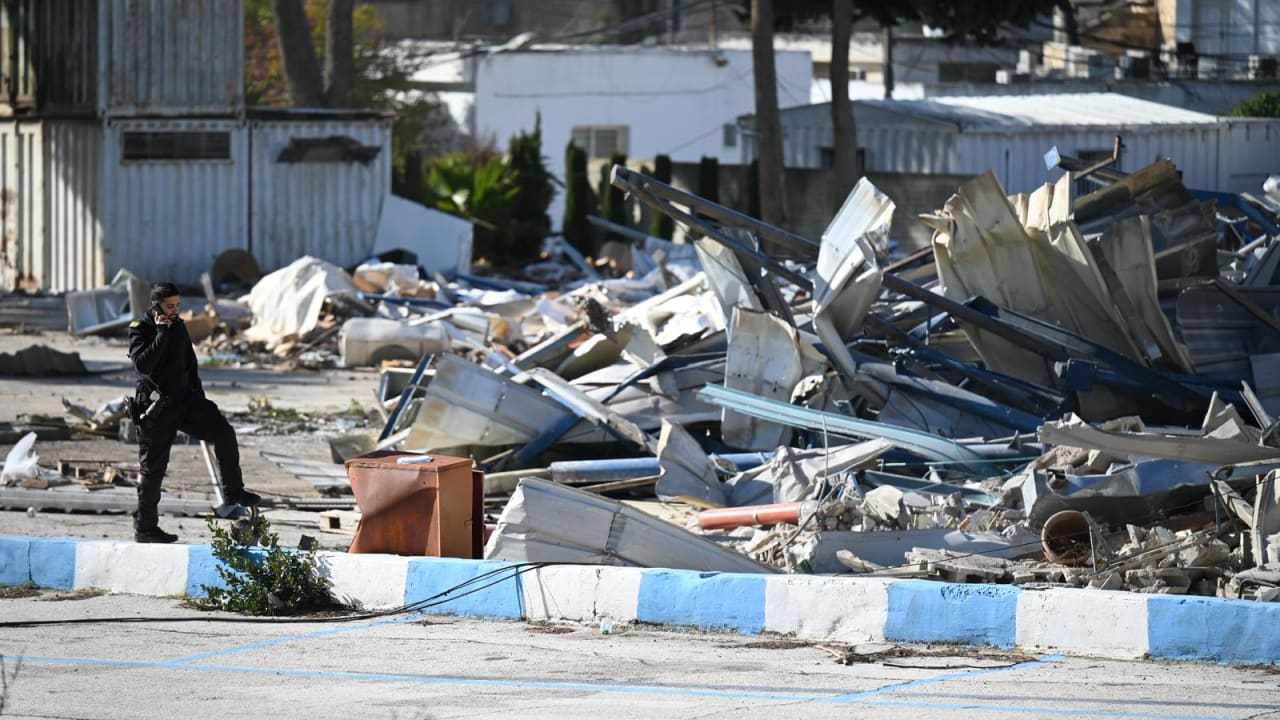
On January 20, the Israel Land Authority, accompanied by police and Border Police forces, entered the same compound with bulldozers and demolished most of the structures there. The petitioners describe the demolition as one of the clearest examples of the irreversible harm created by the amendment.
Water and electricity supplies were also cut to UNRWA facilities in Shuafat refugee camp on January 27 and 28, affecting buildings that included schools, a health center, and other service points, according to the agency. The state later confirmed that electricity providers had sent notices to 10 UNRWA-linked properties and disconnected them in late January.
The dispute has continued beyond east Jerusalem. Israeli forces and Jerusalem municipal officials entered UNRWA’s Kalandia Training Center on July 27, in the second such incursion in less than a month, according to the agency and UN officials.
UNRWA said approximately 80 students and 45 staff members were present and were confined inside the facility while the operation was carried out. The training center, which has operated for more than 70 years, provides vocational education to students from refugee communities throughout the West Bank.
The petitioners argue that incidents such as these demonstrate that the effects of the Israeli legislation extend beyond the territory in which UNRWA is formally prohibited from operating. They say the agency continues to provide education, healthcare, welfare, and emergency assistance in the West Bank and Gaza, where replacing its infrastructure and workforce would not be immediately possible.
The state has asked the court to reject the petition, arguing that the petitioners have failed to establish a concrete factual basis for claims that the legislation has caused a broad collapse of services.
State says alternative arrangements have been made for other education, aid groups
In its updated response, the state said alternative educational arrangements were found for students whose UNRWA schools in east Jerusalem were closed and that other humanitarian bodies and aid mechanisms are operating in Gaza. It argued that many of the petitioners’ complaints concern individual enforcement decisions that should be challenged through separate administrative proceedings rather than through the annulment of primary legislation.
The state also framed the laws as a sovereign decision concerning Israel’s relations with an international organization, adopted against the background of allegations that UNRWA employees and facilities had been connected to Hamas and other terrorist organizations. UNRWA has rejected allegations that the agency as a whole is tied to terrorist groups.
The international legal implications are also expected to feature prominently in Monday’s hearing.
The International Court of Justice found in an October 22, 2025 advisory opinion that Israel, as an occupying power, is required to agree to and facilitate humanitarian relief schemes provided by UN bodies, including UNRWA, and must not obstruct the delivery of essential services to the Palestinian population.
On December 5, the UN General Assembly extended UNRWA’s mandate until June 30, 2029, by a vote of 151-10, with 14 abstentions. In a separate resolution, it cited the ICJ opinion, reaffirmed support for UNRWA’s operations, and called on Israel to respect the agency’s mandate and privileges and immunities.
The case was originally filed in January 2025. Justice Dafna Barak-Erez initially declined to freeze the laws, noting the state’s claims that preparations and alternative services were being put in place. In January, a three-justice panel rejected a further request to freeze the December amendment because the original petition had not yet been updated to challenge it, and ordered the petitioners to file the amended petition now before the court.
Monday’s hearing is therefore likely to turn both on the practical effects of the legislation and on whether those effects justify the exceptional step of striking down the laws themselves.