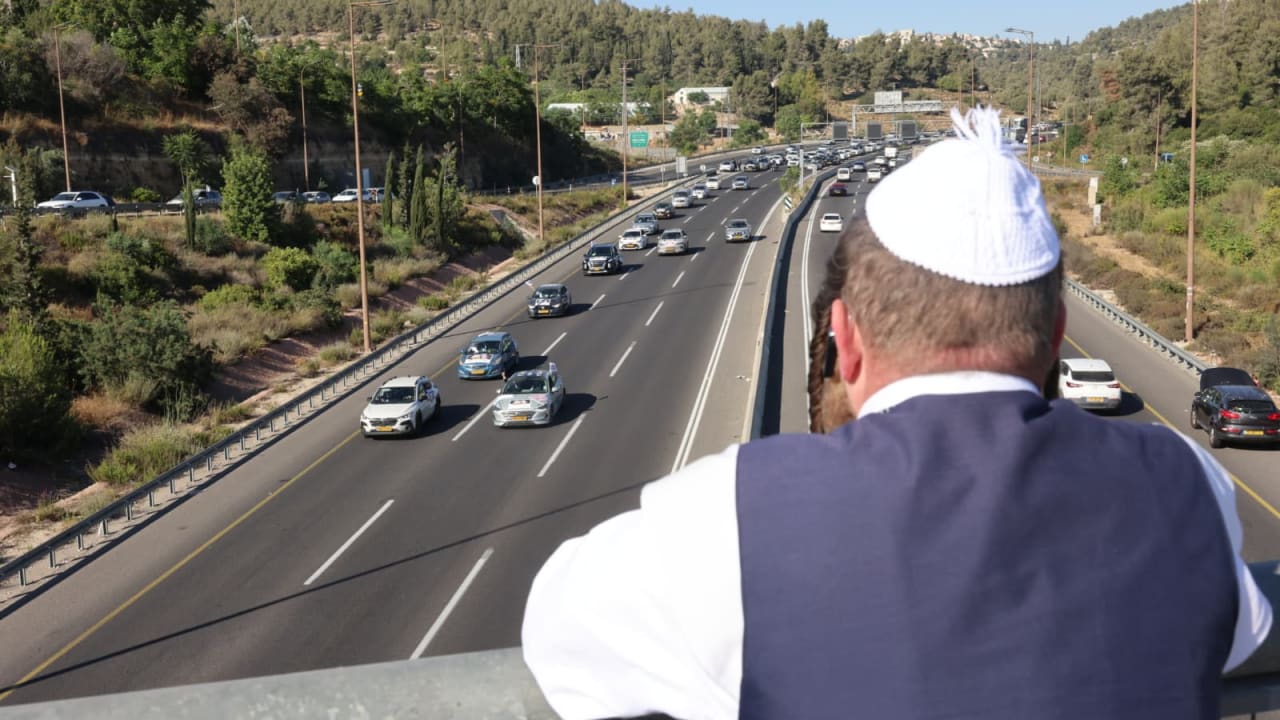
The country’s highways returned to normal congestion levels on Wednesday evening after thousands of haredi (ultra-Orthodox) demonstrators blocked Highways 1 and 4 in mass nationwide anti-IDF draft protests.
MKs Yitzhak Goldknopf (United Torah Judaism) and Religious Services Minister Michael Malkieli (Shas) participated in the demonstrations.
The convoy organizers called on the wider haredi public and its supporters to join the protesters in sending a sharp message to the government and the defense establishment regarding enlistment policy.
Sources in the defense establishment maintain that this is the enforcement of the law.

The stated goal of the protest was to bring about the “immediate release of all detainees of the Torah world,” to halt arrests, and to revoke what they define as “decrees against Torah students and their families,” according to a statement released by the organizing committee.
“We will not sit idly by while our brothers are behind bars for the ‘crime’ of studying Torah,” the statement added.
Police sources did not rule out the possibility that the haredi Jerusalem Faction (Peleg Yerushalmi) would attempt to hold impromptu protests later, in light of an unofficial message circulating on social media.
Police observed protesters getting out of their vehicles at Harel Interchange on Highway 1 and occupying traffic lanes on foot. Officers noted that this went far beyond the agreed method of protest with the organizers, and from that moment, the protests were declared illegal.
Heavy traffic throughout Israel
Heavy traffic was also reported on 28 other major roads, according to Maariv, and officers worked to remove the protesters.
Many main routes, including highways 2, 6, 7, 20, 40, 41, 57, 65, 70, 443, 444, and 531, also experienced heavy disruption resulting from the protests.
According to organizers, convoys traveled along major routes and stopped at busy crossroads, including Highways 1, 4, and 6; the Aluf Sadeh Interchange and the Ganot Interchange in the Center; Bar Ilan Street and the Chords Bridge area in Jerusalem; and the Elad Junction.
Convoys set off from Jerusalem, Elad, Ashdod, Tiberias, Betar Illit, Beit Shemesh, Bnei Brak, Givat Ze’ev, Haifa, Hatzor Haglilit, Modi’in Illit, Nof Hagalil, Netanya, Arad, Safed, Kiryat Gat, and Rehovot.
Vehicles also departed from dozens of locations for the demonstration, which was organized by Agudat Yisrael, part of the UTJ Knesset faction, as other groups from the haredi community, such as the Jerusalem Faction (Peleg Yerushalmi), were expected to join the protest.
Channel 12 reported that protesters in Ashdod blocked a bus carrying IDF soldiers.
Violent scuffles break out at ultra-Orthodox anti-draft protests
Social media footage showed several clashes between haredi protesters and passersby. In one fight, a passerby tried to stop a demonstrator blocking a road.
In Arad, protesters and local secular citizens scuffled, and in one video, a secular citizen could be seen trying to whip draft protesters with what appeared to be a phone charger.
According to Maariv, the deputy mayor of Beitar Illit and chairman of the hassidic faction, Rabbi Gedaliyahu Eisenstein, was among those attacked during the incident in Arad.
Arad Mayor Yair Maayan called on residents to “act with restraint and mutual respect, and to refrain from violence between residents.”
In a separate incident, a pregnant woman was seriously hurt on Highway 1 after her car hit a protester’s vehicle, media reported.
In another video, a police officer confronted haredi protesters after they blocked a tunnel, causing major holdups.
Additional officers were deployed to try to regulate traffic, and police diverted drivers to alternative routes.
Police sources did not rule out the possibility that the Jerusalem Faction would try to hold impromptu protests later, after a message circulated on social media.