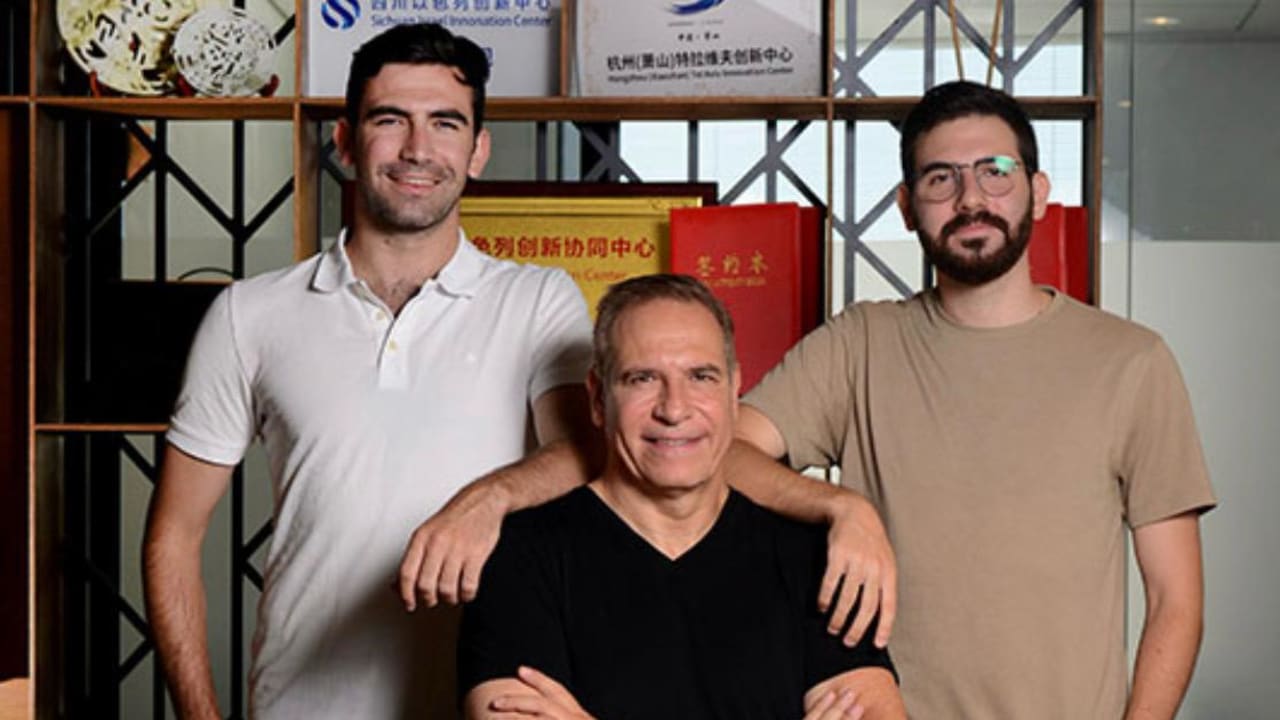
Amir Gal Or is an Israeli hi-tech entrepreneur who is chairman of the Infinity Investment Group, which manages a venture capital network in China. He served as a fighter pilot in the Israeli Air Force for 24 years and was a member of the IAF’s aerobatic team.
He founded the first two technology companies in the field of materials – the Infinity Group and Innovation – in collaboration with his mother, Prof. Leah Gal Or, a materials scientist who worked on the development of DNA in the 1970s. He was also the CEO of the Entrepreneurship Development Center, the investment arm of the Ministry of Economy that assisted Israeli start-ups.
Gal Or, an expert in the world of investments and VC management, specializes in initiating and leading technology and healthcare companies. He has 25 years of experience in the venture capital arena in Israel, the US, Hong Kong, and China, where he established 23 VC funds through the Infinity Group with a total of $2 billion, with personal involvement in 75 exits in Israel, the US, and China.
One of his passions is developing models of empowerment, direct investment in talented people, searching for the areas of human genius and maximizing personal potential. He manages and hosts the podcast Time in China and Time with Amir Gal Or.
He recently launched the bookWorking with the Chinese: Secrets of Success, Insider Insights, written after than two decades of working and investing in China. In the book, he provides a rare glimpse into the Chinese business world, such as how to create connections with the Chinese; how to build trust in a world where so much is hidden between the lines; how to navigate among the enormous business opportunities; and the risks in China's changing market.

Gal Or witnessed the process whereby China is transforming from an industrial powerhouse to a global innovation hub. His book encompasses the experience he has gained in hundreds of investments and partnerships he has created. In it, he shares China's unique operating system, the cultural codes, fundamental values, social subtleties, and unwritten laws that dictate relationships and the rules of the game in the business world, and in life in general in a world of geopolitical struggles, global power shifts, and China's rise as an economic and cultural power.
Two of Gal Or’s children work with him. Raz, the eldest, is the founder and director of Y-platform, a media company operating in China. Twitter and YouTube in China have invested in him, and he is a well-known social media influencer there. His son Amit runs OMGene with Gal Or, a company that combines advanced research with artificial intelligence in the field of behavioral genetics. The company's vision is to raise the level of personal and organizational consciousness.
You grew up in a home that emphasized academic excellence. How did that influence the choices you have made?
My home life instilled in me abstract thinking without practical limitations; the freedom to think.
What did you learn about heroism, risk, and responsibility from your service as a fighter pilot?
I learned that lack of concentration can cost you your life; that you must not get stuck in the order of priorities; and that anything can happen.
What is the secret to dealing wisely with the Chinese -- in culture, business, and political discourse?
First of all, listen, then analyze the interests of the Chinese. Develop personal relationships based on authentic interest. And remain mentally flexible in the business arrangements in which the Chinese operate.
Why is that important?
It is important to maintain a positive relationship with China, especially in light of its increasing involvement in the Middle East. The influence of our activities in the media and investments in China is substantial, and in many ways it is more influential than the government and the embassy.
How do you see relations between Israel and China in the coming years, also against the backdrop of geopolitical changes?
The relationship will be characterized by a practical approach with limitations. That is, there will be cooperation in areas where Israel has added value, such as solutions for advanced industries, medicine, and agriculture. This is alongside limitations in areas perceived as security or areas where the Chinese are independently effective.
In the field of foreign relations, no substantial improvement should be expected in light of the clear identification with the US and China's historical connection with the non-aligned countries.
What did you learn about risk from the Chinese market that they don't teach at Harvard?
I learned that it is dangerous to expect that what was is what will be. That is, changes are the name of the game, and the cards can be redealt at any moment. There is no need to be alarmed by this. Change can be an opportunity.
You have managed investments worth billions. What makes an investment ‘right’ in your opinion?
I seek to invest in companies run by people who are adapted to the market and the environment in which they operate. Resilient people operating in a growing and fragmenting market.
How is the field of investment changing in the era of artificial intelligence?
It is changing a lot. The opportunities will come from applications in areas that were not possible before, such as biological development solutions, automation, and robotics.
Two of your children are partners in business. What is it like working with family?
It is a great privilege; a wonderful combination of emotions and skills. There are many advantages to this, along with the need to balance complexities. The range of emotions is wider. It requires skills of balance and broad understanding, and to be more sensitive to situations.
What prompted you to start your podcasts, and what do you hope to achieve through them?
The podcasts and my book are designed to reduce the knowledge gap about China in Israel. As opposed to many other countries, there are almost no Chinese communities or Chinese students in Israel.
What message would you like to convey to the next generation of Israeli entrepreneurs?
Entrepreneurship is a way of life, and the future and security of the State of Israel depend on the quality of development and creativity. We win in both security and the economy thanks to entrepreneurship and creativity.
This article was written in cooperation with Amir Gal Or