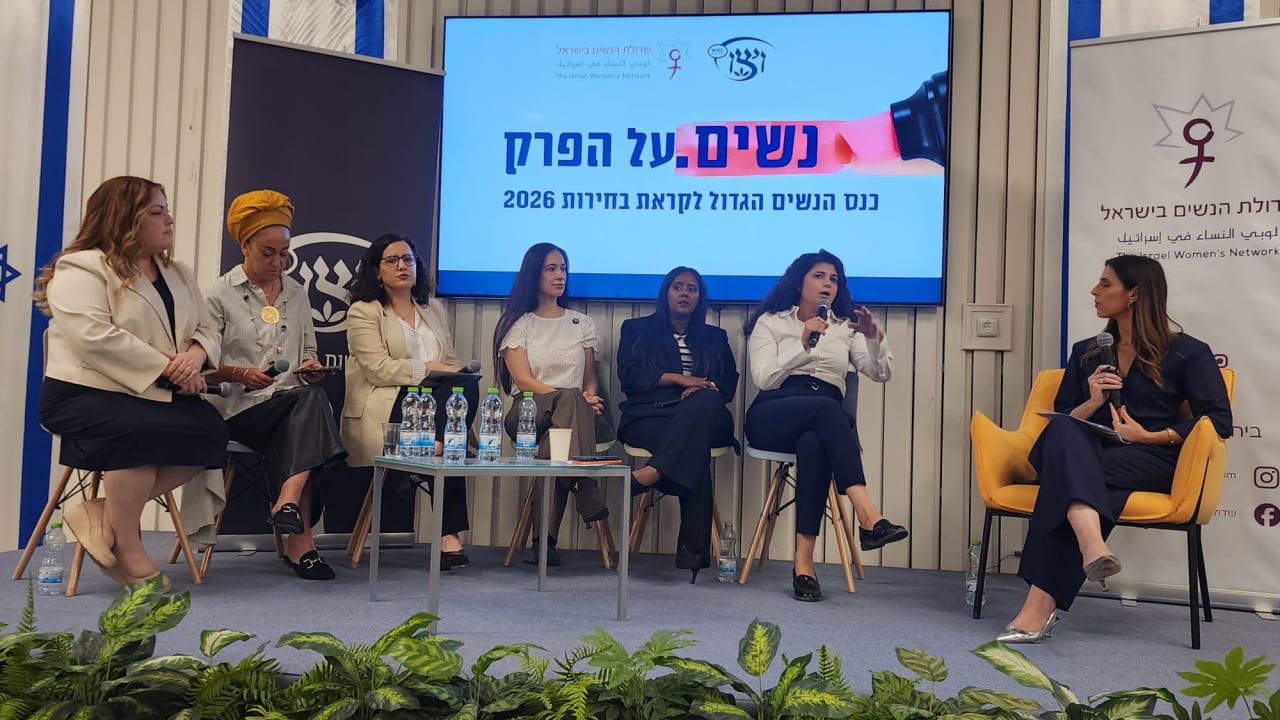
Women’s safety, equal pay and women’s representation in decision-making were at the center of a cross-party election conference organized by WIZO and the Israel Women’s Network in Tel Aviv on Sunday, where the organizers pressed candidates to turn campaign promises into laws, budgets and policy.
The discussion of violence against women came hours after a woman was killed in Beersheba. Her husband was arrested on suspicion of murder, according to police. WIZO World Chair Anita Friedman referred to the killing in her opening remarks, saying the fight against violence could not wait.
“In a country fighting for its life, it is hard to get attention for issues of gender equality,” Friedman said. “This is not a luxury, but our future. Advancing women is advancing social and national resilience.”
The conference, called “Women on the Agenda,” was organized by WIZO and the Israel Women’s Network ahead of the October 27 election. Journalist Dafna Liel moderated the event. The organizers’ announced agenda also included the war’s effects on women and the future of early-childhood care.
The organizers presented an August survey conducted for WIZO by the Roshink Research Institute among 600 women and men in what they described as a nationally representative sample. Asked which steps the next government should prioritize for women, 40% selected reducing wage gaps and advancing women at work; 36% chose better pay and conditions in care, education and welfare jobs; and 32% chose a funded national plan to combat violence against women. Another 29% selected preventing violence in relationships among teenagers and young adults.

The survey also found that 54% of respondents expected party blocs to come to the election with a clear plan for advancing women, while 48% said meaningful representation of women on their preferred party’s list mattered to them.
WIZO warns women remain underrepresented in senior leadership positions
WIZO CEO Marcel Asulin said women were present across Israeli society but became less represented closer to senior positions and centers of influence. “Israel cannot give up half its talent -- women,” she said, pointing to representation in the Knesset and government, the civil service, the military, local authorities and business.
Tal Hochman, CEO of the Israel Women’s Network, said about 60% of women did not identify even one party leader who represented their interests. “We are not satisfied with declarations about the importance of equality,” she said.
“We demand that the parties say what they intend to do in practice: which laws they will advance, which budgets they will allocate and which rights they will commit to protect.” She said the organization would continue pressing parties to fulfill their commitments after the election.
Candidates offered proposals on political representation as well as safety. B’Yachad candidate Keren Terner committed to 50% representation for women on boards and in the civil service. Oded Forer of Israel Beytenu said advancing women’s status was not only a women’s issue. He proposed applying quotas first in public institutions and then in the private sector.
Violence against women drew proposals from several participants. Former Prime Minister and B’Yachad Chairman Naftali Bennett said he would establish a separate police division to address violence against women. “There is no way that, when facing a violent man, the woman has to change her whole life and go to a shelter,” he said. “The offender should change his life.”
Bennett pledges to repeal laws on rabbinical courts, gender segregation in higher education
Bennett also said he would not rule out appointing a woman as national security minister. He pledged to repeal the law expanding the authority of rabbinical courts and the law allowing gender-separated tracks in advanced academic degrees. Both are enacted laws; his comments were campaign commitments, not changes to the law. Discussing possible solutions to enlistment needs in the ultra-Orthodox community, he said: “I will not accept harm to women’s rights. Period.”
Israel First Leader Sharren Haskel proposed expanded electronic monitoring and said repeat offenders should be kept in a secure setting so they could not continue endangering the public. Inbar Yehezkeli of Yashar said the rights of victims and suspects were not balanced, pointing to cases in which suspects were not held in detention while proceedings continued.
Election candidates call for greater women's participation in IDF, security decision-making
Military service and women’s place in security decision-making also came up. Democrats MK Naama Lazimi argued that women’s participation was part of preserving the IDF as an “army of the people.” Reservists-Economic Party candidate Einat Wilf called for women to be included in decision-making, especially on security and foreign affairs, saying they brought a fresh perspective.
On family policy, Bennett said parental-leave rights should extend to fathers as well as mothers, but did not detail the terms. The organizers had also listed early-childhood care among the conference’s main subjects.