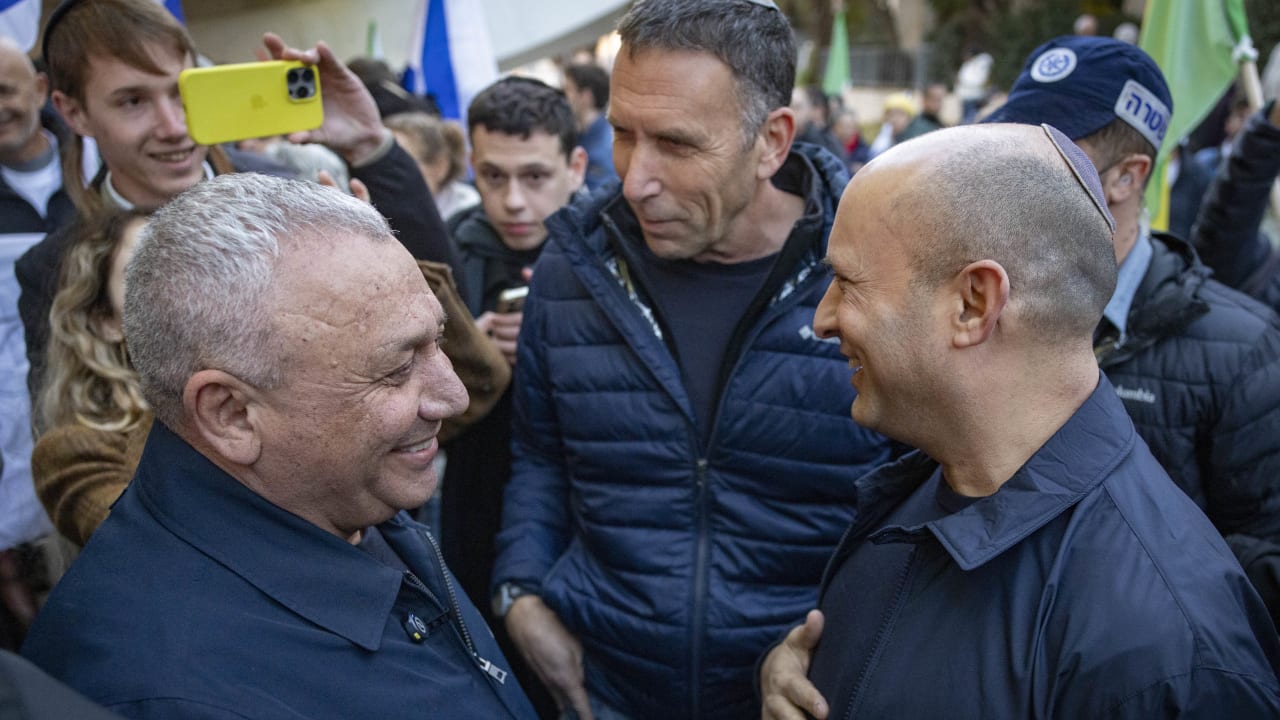
B’Yachad leader Naftali Bennett and Yashar leader Gadi Eisenkot are no longer waiting for candidate lists to be finalized and have begun competing directly as both seek to define their political camps and coalition paths ahead of the coming election.
Speaking at an event in Rishon Lezion, Bennett drew a clear right-wing line against Eisenkot, saying he supports E1 construction between Jerusalem and Ma’aleh Adumim and that “anyone who opposes a Palestinian state should support settlement in E1.”
He also made clear that he opposes a Palestinian state “under any constellation.”
Regarding haredi (ultra-Orthodox) conscription, Bennett positioned himself against both Prime Minister Benjamin Netanyahu and Eisenkot.
“Bibi is talking about a 50% exemption, Gadi is talking about a 30% exemption, I am talking about 0 exemption,” he said, stressing that any framework that leaves 30% outside the draft would ultimately collapse into a much broader exemption.

Bennett also hardened his security stance, stating, “Anyone who launches terror balloons into Israel deserves death,” while noting that, as prime minister, he ordered the purchase of munitions intended to help Israel contend with Iran’s air defense system as part of preparations for a strike.
He also proposed targeting the Iranian regime with a sustained military, economic, diplomatic, and cyber campaign.
Eisenkot aims to lead governing coalition
Eisenkot, for his part, has sought to present himself as a candidate who can translate his polling advantage into a governing coalition.
In Maariv’s weekend poll, his Yashar party received 25 seats, compared with 15 for Bennett’s B’Yachad and 20 for Likud. Eisenkot also led Netanyahu in the question of suitability for prime minister, 48% to 37%, while Bennett led Netanyahu 45% to 40%.
Eisenkot has spoken of a target of 63-65 seats for his camp and attacked Netanyahu’s approach, which he described as “victory through not losing.”
He has also hardened his position on conscription, setting a goal of at least 10,000 haredi recruits in each cycle, most of them to the IDF and some to national service, alongside personal sanctions against those who do not serve.
Eisenkot pledged that if his camp failed to reach a 61-seat majority, he would work to expand his coalition rather than default to another election.
In doing so, he is leaving himself the option of trying to assemble a majority even after the election if the results do not give his camp 61 seats.
Eisenkot also claimed that when he was IDF chief of staff, Netanyahu asked him to appoint Ofer Winter as military secretary. The request was made in part because of the importance of having someone who wore a kippah at his side.
Eisenkot said he refused because he was unwilling to make a military appointment based on political or sectoral considerations.
THE DIFFERENCES between Bennett and Eisenkot have become sharper as the two continue to campaign for overlapping groups of voters.
Bennett is offering soft-right voters an alternative to Netanyahu without moving closer to the Left. Eisenkot is seeking to hold the political Center while persuading right-wing voters that he is not dependent on Yair Golan.
E1, the conscription law, and the approach to the Palestinians have highlighted the clear dividing lines between Bennett and Eisenkot, with the conscription issue emerging as one of the primary tests facing the next government.
Shas has already raised the stakes, as MK Yoav Ben-Tzur said the party would demand that a conscription law be passed before the next government is formed.
“If we have to enter a coalition, a conscription law will pass before the government is formed. Unequivocally,” he said.
Netanyahu, therefore, faces conflicting demands even before coalition negotiations have begun.
Bennett and Eisenkot are competing over who can present the stricter conscription framework; Shas is demanding that the issue be settled as a condition for joining the government; and Likud is already signaling that it is prepared to discuss that demand even before the government is sworn in.
Liberman keeps his distance
Yisrael Beytenu leader Avigdor Liberman has once again maintained his independence and has not declared support for any prime minister candidate.
In Maariv’s weekend poll, Yisrael Beytenu received nine seats. Regarding the question of suitability for prime minister, Netanyahu led Liberman 40% to 37%.
Separately, Yair Golan is operating from the other end of the political spectrum.
The Democrats have invested in a campaign aimed at young voters and in consolidating an independent left-wing camp, while Golan, for now, is also maintaining his political independence ahead of what comes next.
The Zionist opposition’s advantage still does not automatically produce a majority for an alternative government.
The Arab parties received a combined 13 seats, eight for the Joint List of Hadash, Ta’al, and Balad, and five for Ra’am.
The Zionist opposition’s advantage still does not automatically produce a majority for an alternative government.
Eisenkot could emerge as the leader of the largest party and still discover that the numbers do not add up to a coalition.
Bennett wants to remain an independent alternative. Liberman does not want to become an appendage to another candidate. Golan wants to preserve his party’s independence.
Benny Gantz and Gilad Erdan, meanwhile, are preoccupied, first and foremost, with their own political survival.
The battle for the premiership has already begun, even though the composition of a potential alternative government to Netanyahu remains far from settled.
This is how the political system looks on the eve of the new week: on the Right, parties are trying to prevent votes from being lost; in the Center, parties are trying to assemble lists that will be able to clear the electoral threshold; and among the larger parties, the battle over leadership of the respective camps is already underway.
The approaching deadline for submitting candidate lists will force the parties to finalize their alliances, but the question of coalition formation will remain open even afterward.
Even before Election Day, several questions that will directly affect the result will be decided: which lists will clear the electoral threshold, how many votes will be lost below it, and which party leaders will reach the ballot box with a plausible path to a 61-seat majority.