
Fifty years ago, on July 4, 1976, the United States was celebrating its 200th birthday.
At the time, the president of the US was Gerald Ford, the former vice president who became president after Richard Nixon resigned in August 1974, following the Watergate scandal. Among the bicentennial observances were the “Bicentennial Minute,” a series of 60-second television segments broadcast nightly from July 4, 1974, to December 31, 1976, commemorating the 200th anniversary of the American Revolution, and “Operation Sail.”
In this operation, 14 tall ships from 14 nations, together with an armada of 50 warships, sailed through New York Harbor. The American Freedom Train, a train tour across the contiguous 48 states, served as a traveling museum displaying artifacts such as George Washington’s annotated Constitution.
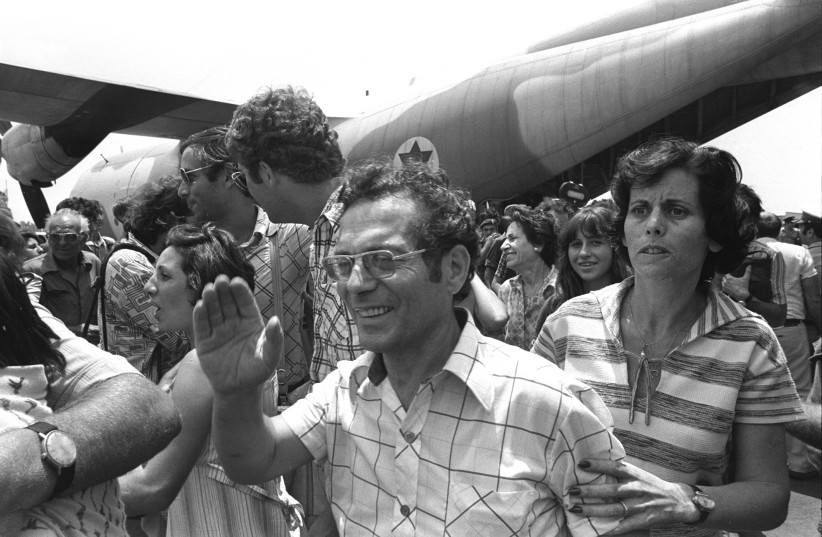
These, and other observances, were carefully planned for years to communicate the ideals of the American Revolution. Yet, perhaps the most meaningful expression of the values of America – the defense of freedom, the courage to persevere, and the value of human life – came not from the planned Bicentennial celebrations, but from an unexpected event that unfolded over that Independence Day weekend: Israel’s rescue of 102 Jewish and Israeli hostages, held by Palestinian and German terrorists in Uganda’s Entebbe Airport following the hijacking of their Air France plane.
The sense of euphoria, both in Israel and throughout the Jewish world, was palpable. Just days after the hostages landed at Ben-Gurion Airport, clothing stores throughout Israel were hawking hot-selling T-shirts emblazoned with the photo of Idi Amin, Uganda’s president, with a speech bubble placed above his head, mouthing the Hebrew words Kol Hakovod Le’Zahal (Well done, IDF).

Over the past 50 years, numerous books have been written about the IDF operation, called “Operation Thunderbolt”; later, it was renamed Operation Yonatan, in memory of Yonatan Netanyahu, Prime Minister Benjamin Netanyahu’s older brother, who was the commander of the operation and was fatally wounded during the Entebbe rescue operation.
The publications document, analyze, and interpret the decisions, processes, and chronology of the rescue. In addition, four major feature films and TV movies were made about the Entebbe rescue, and numerous YouTube videos and documentaries cover the subject.
Fifty years later, as the memory of Entebbe gradually fades from the collective consciousness of Israelis and Jews around the world, what meaning does it hold? How did it shape Diaspora Jewry’s relationship with Israel, and how should its legacy be understood in the shadow of the events of Oct. 7, 2023? What lessons can today’s leaders learn from yesterday’s decision-makers?
To commemorate the 50th anniversary of Entebbe, the Magazine spoke with five prominent Jewish figures with deep American ties: historians Michael Oren and Gil Troy, Israeli basketball legend Tal Brody, columnist and author Barbara Sofer, and Rabbi David Wolpe, one of America’s most prominent and articulate rabbis, to gain a deeper understanding of the Entebbe rescue, asking for their recollections of the event and its meaning today. All, except Wolpe, live in Israel.
The rescue that echoed around the world
“I was chipping ice in the back of a liquor store in Los Angeles,” says Michael Oren, the American-born Israeli diplomat, historian, author, and politician, recalling the moment when he heard about the Entebbe rescue. Oren was working in Hollywood as a gofer for Orson Welles as well as in a liquor store at night, to help make ends meet. While at work on Saturday evening, July 3, Oren heard someone say, “The most amazing thing happened with those Israelis.”
“I was preparing to make aliyah eventually, so it was a source of great pride,” he says.
“I couldn’t wait to get to Israel and get to the army. I was a lone soldier, and I wanted to follow in Yoni Netanyahu’s footsteps. We all did at the time.” Oren joined the IDF in 1979 after making aliyah and became an officer in the Paratroopers Brigade.
Fifty years later, Oren, now 71, who served as Israel’s ambassador to the US from 2009 to 2013, and was an MK for the Kulanu Party from 2015 to 2019, says the significance of Entebbe is that Israel lived up to its promise as the nation-state that saved the Jewish people.

“The State of Israel lived up to its self-proclaimed identity. We’re willing to send our army out to defend and save Jews, and it can pay a cost for it. I think that’s the lesson of Entebbe,” he observes.
If he were explaining the story of Entebbe to a young Jewish person in the US or Europe, Oren says he would sum up the mission with two Hebrew words – “‘Chazak v’ematz – be of strength and good heart. Do not give in to terror.”
He points out that history has shown that special forces operations to rescue hostages can often fail. For example, in April 1980, the United States’s attempt to rescue 52 hostages in Tehran ended in disaster, as the rescue failed, and eight US service members died. “It didn’t work. You see how other people have tried to do similar things. It’s not so easy.”

He acknowledges that the stunning success of Entebbe led some to believe that rescuing the hostages in Gaza after Oct. 7 was just a matter of time. “I think it created an expectation that our special forces would be able to liberate these hostages eventually. They weren’t even in Uganda; they were right in our backyard. But it couldn’t be done.”
Oren suggests that one aspect of the Entebbe story that has been ignored was the role that antisemitism played in the event. The terrorists, two of whom were German, separated the hostages into two groups: the 98 Israelis and non-Israeli Jews (alongside the Air France crew and pilot) and the 148 non-Jewish captives, who were released before the rescue.
The idea of a “selection” brought back memories of the Holocaust, which had ended just three decades earlier.

He concedes that while the memories of Entebbe have faded over the past 50 years – just 13% of Israelis are over the age of 65 – Israelis, particularly members of the younger generation, are constantly being buffeted with major events that cause past events to recede from their collective consciousness.
“If you ask teenage Israelis if they know what the Entebbe raid was, I don’t know if they’re going to have an answer for you. We are in a country where Entebbe-like events, in terms of their scale, occur with alarming frequency. It’s difficult to remember Entebbe when you have Iranian missiles raining down on your neighborhood.”
What can today’s Israeli policymakers learn from the story of Entebbe? Oren avers that one weakness of Israel’s defense policy is its predictability. “We act according to the book. One of the best pieces of intelligence is when you somehow get to throw the book out and be unpredictable. Entebbe was the embodiment of our unpredictability.”
Was Entebbe a military victory, diplomatic triumph, psychological boost, or all three? “Neither,” says Oren. “I’d call it a moral victory. It expressed our raison d’etre.” The lesson of Entebbe has endured, he adds. “ I think it’s still a shimmering example of courage, creativity, and audacity.”
A defining moment for Diaspora Jews
Gil Troy is an award-winning American presidential historian and a leading Zionist activist. The author of nine works on US history, Troy, who lives in Jerusalem and writes a weekly column for The Jerusalem Post, has also penned seven books on Zionism, including the classic anthology, The Zionist Ideas. He is the editor of the three-volume set, Theodor Herzl: Zionist Writings, the inaugural publication of The Library of the Jewish People. In 2020, he and Natan Sharansky co-authored Never Alone: Prison, Politics, and My People.
In July 1976, Troy was 15 and was, in his words, “an American history junkie.” Enchanted by the bicentennial observances that summer, he reluctantly left the celebrations for Camp Tel Yehudah, a Zionist summer camp affiliated with the Young Judaea movement, in Barryville, New York.
Troy recalls the events clearly. The terrorists had hijacked the plane on Sunday, June 27, from Athens, and after a brief stopover in Benghazi, Libya, forced the pilot to fly to Entebbe Airport in Uganda, arriving in the early morning hours of Monday, June 28. During that week, the non-Jewish passengers were released in two groups over two days. Forty-seven hostages were freed on Wednesday, June 30, and an additional 101 were released on July 1.
“It’s important to emphasize that this was not just a 24-hour terrorist attack,” Troy says. “This was a days-long terrorist attack in the buildup. I remember vividly being at Camp Tel Yehudah. We had one friend who had a boombox, and we would sit around like we were still in 1947, waiting for the vote on Partition. We were allowed to listen to the radio night after night to hear what was happening, and it was an ongoing drama.”
When Shabbat began, the boomboxes and radios were turned off. After Shabbat, he continues, “I remember we gathered in a circle for havdalah, and somebody announced, ‘They’re free, they’re free!’,” he recalls.

“We started singing, dancing, and high-fiving, and all the worries about missing the July 4th celebrations and the Tall Ships were put aside. It was really an extraordinarily powerful moment. The State of Israel was 6,000 miles away, but we felt so much a part of the story.
“That’s part of the power of Jewish history and the power of the Zionist movement and of Israel. We felt it in our fingertips. We felt liberated, and for me, that was a very profound moment.”
Returning to the present day, Troy suggests that Entebbe changed the way that Jews viewed themselves. “I think that every Jew walked around the next day with more of a spring in their step and a stronger back. I often argue that when I look at the young generation of American Jews, and I see how much more comfortable they are with their bodies and how much stronger and prouder they are than we, the ‘Woody Allen Jews,’ the clever, fast-talking type of Jew who is still uncomfortable with his body but nevertheless wins. I say that’s part of the Zionist story, and Entebbe is a part of that story.”
The rescue at Entebbe, Troy explains, came at a pivotal moment in Jewish history. “In 1972, there was the Munich massacre at the Olympics, when Israelis were slaughtered in Germany, of all places, during the Olympics, of all events. And then there was the 1973 Yom Kippur War.
“This was the start of the spate of Palestinian terrorist attacks, which made people terrified, not only because we cared about what was happening to schoolchildren in Kiryat Shmona and Ma’alot. [On April 11, 1974, Palestinian terrorists murdered 18 people in Kiryat Shmona, eight of them children. On May 15, terrorists killed 25 hostages, including 22 children in Ma’alot.] Yasir Arafat was threatening; he killed American diplomats.
“This was the start of having to arm the synagogues of Europe, and now, unfortunately, [synagogues in] the United States.
So this was a moment of fear,” Troy notes. “It was a moment of powerlessness.” Israel’s rescue of the hostages at Entebbe, says Troy, echoing Oren, showed Diaspora Jews that there was a Jewish state capable of protecting Jews anywhere in the world.
While Entebbe represents the ability of Jews, and the Zionist project, to take responsibility for their own fate, it is both a blessing and a curse, Troy suggests.
“On the one hand, it is a reminder of the unfortunate Zionist reality that we’ve had to constantly fight for ourselves and fight to defend ourselves. It is also a reminder that while Theodor Herzl was a remarkable visionary, the one thing he got wrong was that he thought that having a Jewish state would eliminate antisemitism, partially because there would be no Jews left in the Diaspora, because they would either assimilate away or move to Israel,” he explains. “But he also thought that once we were normalized with a normal state, we would not have antisemitism. Obviously, it didn’t quite work out.”
On the other hand, says Troy, because there is a State of Israel, when Jews are attacked, they can defend themselves. “When they attack, we’re not paralyzed. We have agency.
“It’s a profoundly Zionist moment and a profoundly Zionist message, and an empowering message that is really important to remember today. For so many American, British, and Canadian Jews suffering from an antisemitism they didn’t expect, Entebbe is both a reminder of how ugly and lethal antisemitism can be, but also that we are not alone and that we are not powerless.”
Leadership beyond politics
At one point, Troy makes perhaps his most salient point – the absence of political considerations in the decision-making of the leaders of the time – prime minister Yitzhak Rabin, defense minister Shimon Peres, opposition leader Menachem Begin, and others.
“We’ve had this entire conversation without talking about who was in office. It didn’t matter if it was Left or Right. It didn’t matter where they stood on the Palestinian issue; it didn’t matter what their economic policy was. It mattered that they took the right decision at the right time, in the right way, and it worked.
“You had a sense that the debates that they were having internally were about the tactics, the strategy, and the successes.
It wasn’t about politics; not everything is about politics, and not everything is about Bibi, and not everything is about Gaza, and not everything is about the Palestinians. It’s sometimes about us; it’s about our values; it’s about our need to survive in this very tough neighborhood.”
Troy returns to the unlikely timing of the Entebbe rescue occurring on the Bicentennial weekend, and what it meant for American Jews. “Rather than it being a moment of rupture, it became a moment of reinforcement that our pride as Americans and our pride as Jews and our pride as Zionists reinforced one another. It made the bicentennial even more meaningful.
“It was also a more innocent time, when you didn’t sit there and agonize if you were a Jew first or an American first, or what your connections to Israel and Zionism were. It was really a very reaffirming harmonic convergence.”
An American heart, an Israeli soul
Fifty years ago, on July 4, 1976, Barbara Sofer was living in Jerusalem with her husband and four-month-old son, enjoying a summer off from her teaching at the Hebrew University High School and freelance writing. “I remember holding my son in my arms,” she recalls, “as my husband came home from morning prayers in the synagogue, pointing to the television and sharing the exciting news of the rescue.”
Sofer, who today is a popular Magazine columnist and author and is the Israel director of public relations for Hadassah, the Women’s Zionist Organization of America, remembers that the breaking news of the rescue that Sunday morning brought feelings of joy tempered with sadness. “After a week of worrying about the hostages since their capture, we felt relief, exultation, and pride, mixed with heartbreak for Yoni Netanyahu and the three hostages who were killed. Like breaking the glass at a wedding, our joy is seldom complete.”
For the Connecticut-born Sofer, who had grown up memorizing the poems of Robert Frost and the Gettysburg Address, America held a special place in her heart, but it was Israel – and the Entebbe rescue in particular – that truly captured her imagination. “I was always grateful that my grandparents found refuge from the pogroms of Eastern Europe in the United States and that I lived in a free society without prejudice. The bicentennial was a major event for me. Still, it was overshadowed by my heart bursting with admiration for the courageous and resourceful operation in which my Israel had flown 4,000 km. to rescue our hostages.”
The world’s reaction to Entebbe, she remembers, was overwhelmingly positive. “This was Israel of creativity, Israel of daring, Israel that would never let its people go, would never abandon hostages, was not waiting, but was going to do something dramatic and great and fly in the skies and do all the amazing things. We didn’t have the chronic criticism, no matter what we did in those days.”
On the day of the Entebbe rescue, Sofer’s husband wrote to her mother in Connecticut, encouraging her to come live in Israel. “How could she miss out on living in such a country of amazing heroism?” she says. Her mother listened to her son-in-law and made aliyah.
Today, the four-month-old that Sofer held in her arms when she learned the news of the rescue is both a professor at the Technion-Israel Institute of Technology and a lieutenant-colonel in the IDF, having served hundreds of days of military service in the reserves, including hostage rescue.
“Entebbe showed that Israel is ready to go the distance for Jews everywhere,” she concludes. “It strengthened the positive view of Israel for the world and also the feeling of Jews that Israel will come to rescue you.”
Israel on the map
If there was one statement that epitomized Israel’s resurgence in the period after Entebbe, it was the proclamation of Tal Brody after Maccabi Tel Aviv defeated the heavily favored Soviet Red Army team CSKA Moscow in the semifinal game of the FIBA European Champions Cup in 1977, when he exclaimed, “We are on the map! And we are staying on the map – not only in sports, but in everything.”
Brody, now 82, was born in Trenton, New Jersey, and starred at the University of Illinois. He was selected in the 1965 NBA draft by the Baltimore Bullets, but chose to play in Israel. Brody made aliyah in 1970.
Recalling how he felt when he learned of the Entebbe rescue, Brody says, “The feeling was great that Israel went thousands of miles to Africa to make a statement that if there are Israelis on that plane and you do something like that, that Israel would go any place in the world to protect and save people from the Jewish community. I just remember that the feeling [after Entebbe] was elation.”
Brody says that Entebbe symbolizes Israel’s ability to overcome the odds, just as Maccabi triumphed the following year.
“When we won the European Basketball Championship, people were very proud that we could play basketball on that level and compete against the Russians, which was the Soviet Union at that time, which took the best players from over 20 satellite countries.
“And here [with Entebbe,] the fact that Israel is a small country with a relatively small army compared to many places in the world, and the fact that such a small country could take the lead in supporting their citizens, no matter where they are in the world.”
The Entebbe rescue operation was even used as a tool to motivate the Maccabi team, Brody recalls. Before the title game against Mobilgirgi Varese on April 7, 1977, in Belgrade, Yugoslavia, Maccabi Tel Aviv coach Ralph Klein screened Operation Thunderbolt, which starred Yehoram Gaon as Yoni Netanyahu, instead of practice. The film and its message must have been effective, as Maccabi won the championship game 78-77.
How would Brody explain the significance of Entebbe to today’s generation of Jewish athletes? “I would tell them that they’re living in a country that, despite all the problems that there are in the world, has their back, and that’s very important to know for any citizen. Every person in the military knows that Israel will never leave a soldier in the field.
“The main motto is that Israel is here. The Jewish community in the world is very lucky that Israel is here to help in any way possible, wherever they are, and to stand up for them wherever they are. They have a place to come to if they’re living in a place that becomes unbearable because of antisemitism.”
Brody says that, in a sense, the Entebbe rescue helped put Israel on the map, just as his victory did several months later.
“Entebbe, at that period of time in the world, was known all over the world. It was carried respectfully, with honor, without twisting the narrative. It showed what Israel is. It’s one of the very few events where the narrative was 100% pro-Israel.”
The shift from victim to hero
Rabbi David Wolpe, the Max Webb Emeritus Rabbi of Sinai Temple in Los Angeles and a leading figure in modern Conservative Judaism, is widely recognized for his public debates, media appearances, and writings on faith, existentialism, and combating antisemitism.
In 1976, he was a 17-year-old camper at Camp Ramah in the Poconos. He recalls that when the camp learned of the rescue, an explosion of jubilation ensued. “For people of my generation, it was the validation of the shift from victim to hero.”
Like Brody, Wolpe says that Entebbe engendered the type of pride that was “understood by your non-Jewish neighbor. It’s like, ‘Yes, that was amazing.’ It wasn’t just Jewish pride. You knew that almost all the people around you would think of it as remarkable as well.”
He suggests that there was tremendous identification within the American Jewish community when the news of the rescue broke. “These are ‘our boys’ who pulled off this miraculous salvation. He adds that the tragic death of Yoni Netanyahu and the publication of his letters added weight, substance, and meaning to the story. “It made the story not just a cartoon, because there was a real loss.”
Wolpe says that for him, Entebbe cemented and strengthened his lifelong appreciation and admiration for Israel, but sadly notes that this admiration is an ingredient that is lacking among many young Jews in the US today. “They don’t see Israel as a nation that rescues, and that’s what Entebbe was. It was quintessentially Israel, the nation that rescues. They see it much more sadly as a nation that persecutes. It is tragically misguided.
“Most young American Jews have never grown up with an Israel that wasn’t ruled by Benjamin Netanyahu. So, they don’t hear opposition. Therefore, to say to them that Israel is beleaguered, or oppressed, or whatever sounds artificial.”
For Wolpe, the Talmudic concept of arevut (Hebrew for responsibility), is Entebbe’s enduring lesson. “It stands for no Jew being left behind. We have to take care of one another. The lesson of Entebbe is that we don’t forget about those members of our family who need us.”
Commenting on the American Jewish community in 2026, Wolpe says that the sense of kinship between Israel and the Jewish community in the United States has been severely weakened.
“[This is due to] the waning of historical memory and the lack of context, which is combined with antisemitism and the prevalence of influences, both intellectual and monetary, from Russia and the Middle East. Russian propaganda and Qatari money, and other money, have combined in very dramatic ways to change the narrative.”
Wolpe concludes that after Oct. 7, when many Jews living in the Diaspora have been feeling more vulnerable, the story of Entebbe is especially meaningful. “It makes it [Entebbe] more relevant, because the peril feels closer, and the needed salvation more miraculous. Here was a time when the peril was imminent, and the salvation was, in fact, miraculous. So, I think the Entebbe story, in some ways, speaks to American Jews more now than it has for a long time.”
Heroic miracle
Perhaps Troy sums up the meaning of Entebbe best: “Particularly at this moment, when both Israel’s image seems to be tarnished abroad, often not because of Israel’s fault, but because of the haters from above, from beyond, American Jews have lost their romantic love affair with Israel.
“To go back to Entebbe and remember the romantic, heroic, and self-sacrificing Israeli of yesteryear, along with the Israeli who then, as now, was willing to sacrifice everything to defend not just Israel, not just the homeland, but world Jewry, is a very important touchstone.
“To use the word ‘miraculous’ when you talk about Entebbe doesn’t really seem like you’re stretching it. It’s sometimes overused, but I think, in this context, it’s spot-on.”