
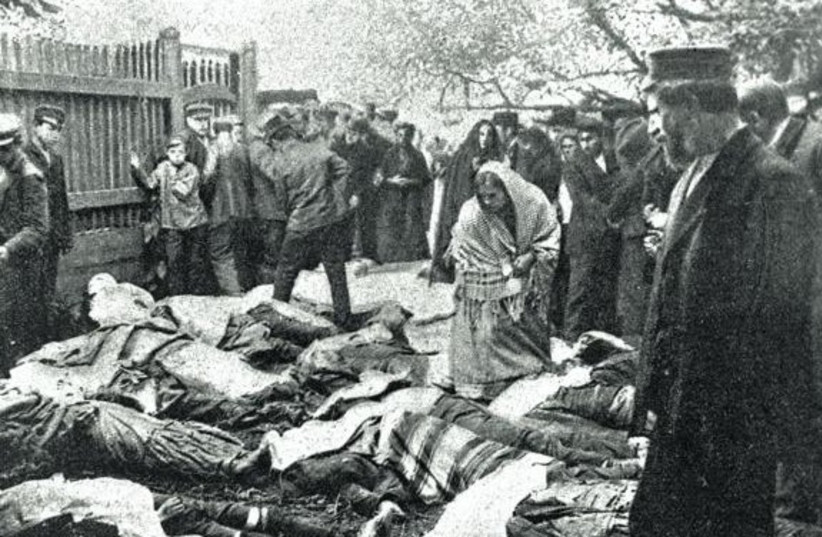
On June 14, 1906, at least 70 Russian Jews were killed, and 90 were injured in the three-day-long Bialystok Pogrom.
Bialystok, located in modern-day Poland, was a western city in the Russian Empire with a majority Jewish population.
In the 1910 census, four years after the pogrom, around 68.5% of the population was Jewish, according to data from the Jewish Virtual Library.
The pogrom became the bloodiest incident against Russian Jews that year. It is worth noting that because multiple victims were taken to other towns, different hospitals, and private homes, the exact number of victims will never be truly known.
Bialystok was known for its textile industry. A large number of the fabric mills around town were owned by Jews and employed Jewish workers.
As such, the Jewish Labor Bund, a Yiddishist, secular, socialist Jewish labor organization, had a stronghold in the community. Jewish anarchist movements and the Polish socialist party also had strongholds in the city.
Why was there a pogrom in Bialystok?
Three days before the pogrom, the city’s police chief, named Derkatcheff, was killed. He was generally viewed as benevolent towards the city’s Jewish population. Chief Derkatcheff notably said that a pogrom would happen over his dead body. That is almost exactly what happened.
Derkatcheff’s rival, Police Commissioner Sheremetev, and the rest of the police force, were viewed as violently antisemitic.
Sheremetev blamed Jewish anarchist groups for Derkatcheff’s killing. Then, local officials spread rumors and distributed leaflets that Jews would bomb Catholic and Orthodox churches.
In preparation, Jewish leaders went to the governor in Grodno, over 100 knm away, to ask for Sheremetev’s removal. The governor refused, but promised the Jewish delegation that no pogrom would happen in June.
What happened in the Bialystok pogrom?
On June 14, authorities allowed a Catholic procession through the town’s market square on Pentecost. During the procession, a bomb went off and killed one person in the procession.
Simultaneously, an Orthodox Christian procession was occurring in town, during which shots were fired. Russian authorities then claimed that Jews had attacked both and called for retaliation against Jews.
Thus, the pogrom began. For three days, Russian troops and policemen attacked Jewish homes and businesses.
On the third day, Russia’s minister for internal affairs ordered tsarist forces to stop the pogrom.
The pogrom came after the 1905 Russian Revolution, during which the city was a center of the anti-tsarist labor movement. It is part of the second wave of pogroms that eventually led to World War II.
Historians view the pogrom as a response to the labor movement by local authorities and government employees, who were later held accountable by Russia’s state Duma for the incident.
After the State Duma investigation, Bialystok’s industry and trade suffered a notable, prolonged decline.