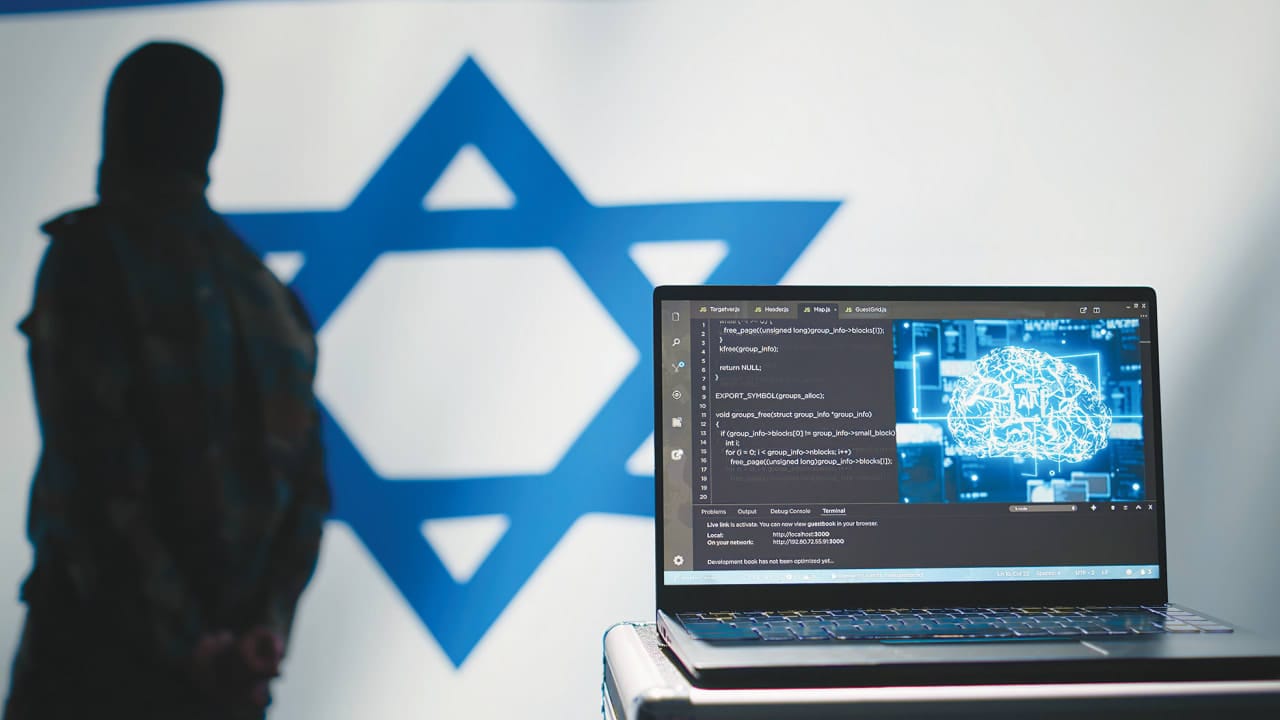
As the US House Armed Services Committee debates whether to pass Section 224 of the fiscal year 2027 National Defense Authorization Act, a provision that would formally bind American and Israeli defense technology sectors through joint research, co-production, and shared industrial infrastructure, Israel has quietly moved past the argument entirely.
While Reps. Thomas Massie and Ro Khanna warn darkly about entangled supply chains and backdoor military integration, the IDF has already built something far more consequential than any congressional framework: a dedicated operational AI unit designed to rewrite how armies fight in real time.
On May 20, the IDF inaugurated Alumot, a Hebrew word meaning "Beams," at the Gideonim base near Rishon Lezion. The unit sits inside the C4I and Cyber Defense Directorate under Maj.-Gen. Aviad Dagan and is deliberately unlike anything the Israeli military has fielded before. Alumot does not work in a lab. It does not produce research papers or wait for acquisition cycles. It embeds combat soldiers, AI specialists, data analysts, and operational planners in a single hub and tasks them with developing battlefield tools that go directly to frontline forces. The mission, in Dagan's words, is to "make accessible the information and artificial intelligence capabilities we have to the fighters at the operational edge."
Alumot is not a think tank. It is not a procurement vehicle. It is a live operational engine designed to compress the time between a battlefield problem and a technological solution to near zero. The IDF watched its own forces fight a high-intensity, multi-front war beginning on October 7, 2023, and drew a specific lesson: the army that wins the learning competition wins the war. What Alumot institutionalizes is something most Western militaries have never fully accepted, which is that AI development, when left to traditional bureaucratic timelines, arrives after the battle is over.
The unit follows the December 2025 establishment of the Bina division, which consolidated the IDF's previously scattered AI projects under a single organizational roof within the C4I directorate. While Bina has centralized, Alumot operationalizes. The sequencing is deliberate and fast. From scattered programs to unified command to frontline deployment: Israel managed that entire transition in under six months. Pentagon reform cycles move in decades.

This is the context that the Section 224 debate in Washington systematically ignores.
Critics of the NDAA provision, including some figures on the Right who should know better, frame the proposal as Israel gaining leverage over American defense priorities. They warn that if Israeli firms build weapons components inside US congressional districts, lawmakers will become politically dependent on sustaining the relationship. They argue that entanglement creates obligations that future administrations cannot easily reverse. Every one of these critiques treats the relationship as a liability.
The United States military is currently investing heavily in catching up to problems that Israel has already solved, at scale, under fire. Israel's layered air defenses, its drone countermeasures, its AI-assisted targeting, and now its live operational AI integration infrastructure all represent battlefield knowledge acquired through genuine combat, not simulation. The IDF has not been running exercises. It has been fighting. And the systems it has developed, including the ones that will flow through Alumot to frontline soldiers, are forged under conditions of actual consequence.
Section 224's critics are exercised about hypothetical supply chain leverage. The strategic reality is that America risks leaving operational AI integration lessons learned entirely on the table because of a procedural squeamishness that no adversary shares.
China is not squeamish. It has spent the past two years studying every drone tactic, every electronic warfare innovation, and every AI-assisted decision loop that emerged from Israel's multi-front conflict. The People's Liberation Army does not hold congressional markups about what it is allowed to learn.
The irony of the Section 224 debate is that the critics have correctly identified the direction of travel and drawn entirely the wrong conclusion.
Yes, US-Israel defense technology cooperation will deepen. Yes, it will become structurally harder to reverse. Yes, Israeli systems will become embedded in American supply chains and American platforms. Every single one of these outcomes is a strategic asset for the United States, not a vulnerability.
The next American soldier who benefits from AI-assisted targeting, networked battlefield intelligence, or real-time data processing will owe something to an IDF unit that Congress has never heard of. The question Section 224 actually poses is whether America formalizes that inheritance or pretends it does not exist.
The writer, a fellow at the Middle East Forum, is a policy analyst and writer based in Morocco. Follow him on X: @amineayoubx